|
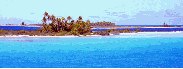
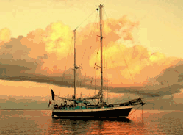
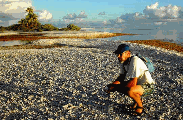
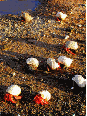
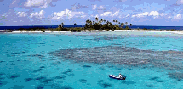
would have been extremely difficult to figure out exactly which one was the safe channel. Inside the lagoon we found a sleek black hulled scooner anchored, a picture of serenity. Though we had imagined there might be a village, there was no sign of habitation here, but just endless miles of utterly beautiful lagoon. Ashore we walked the shoreline discovering a huge gathering of hundreds of hermit crabs in large shells with lobster red appendages. While I stooped to photograph them the no-nos had their lunch. Two days later I erupted in a welter of itching bites that gave me no rest for the next week.
Needing to find a phone we set off again, this time for Kauehi, an atoll 12 miles wide, supporting a large number of pearling operations. The picturesque shacks pearched on stilts on a long sand spit which jutted into the lagoon from the village and others were positioned on coral heads scattered elsewhere in the lagoon. By dingy we headed ashore to a wharf where scores of people gathered to weigh the sacks of copra they were sending off aboard the cargo ship anchored beside us. A pretty red-roofed church dominates the waterfront. The rest of the village was a straggle of modest homes, most of them sporting a satellite dish on a pole beside them. The racks containing large outboard engines and a plethora of sppedboats indicated a healthy prosperity, but something was not right. The villagers do not seem to like each other very much. There is a lot of in-fighting, aggression and stealing from each other. Later in Fakareva, we met a pearl farmer who had relocated from Kauehi after his entire string of grafted three-year-old pearls had been stolen. Ten thousand of them!
Strong northerlies were forecast. We headed across the lagoon to shelter behind the windward motu. Then after dark, with the moon not yet up, the wind turn right around to blow from the south, putting us on a lee shore. We rode all night on two anchors, Michael cat napping in the cockpit, the surf breaking at our stern. By morning one anchor had corkscrewed with the strain.
Our son was home from hospital now, and over the crisis. Daily check-in calls were not longer necessary. We made plans to move on to Fakareva, just 55 miles to the northwest.
The Tuamotus have surely earned their name, The Dangerous Isles. Once inside a lagoon there is no shelter should the wind go around, and the lagoon is too wide to traverse quickly, or after dark. The long fetch means waves can grow dangerously high. The passes in and out of the lagoons are also tricky. Timing departures and arrivals in important, to catch the slack tide. A cruiser may not impulsively decide to up anchor to leave in a hurry.
By 2:00 o'clock the next afternoon we entered Fakarava on a bearing that bore no relationship to the detail of the map we had. The detail was incorrectly scaled and it had taken Michael a few minutes of confusion to work out the discrepancy. Had we tried to use the GPS and go in at night using the chart, we would have found ourselves high and dry on a reef half a mile from the entrance.
A fellow Kiwi lived on Fakareva with his native born wife. They tended a hydroponic garden, only the second one we hade seen in the atolls and cut copra for a living. "How can copra bring in enough money<" I asked.
" Here it is subsidized. The government pays us 5 times the market price. This is mainly to provide a source of income on the islands so that not all the natives will flock to Tahiti for jobs, depopulating their own islands.
Lashed up in the eaves of their house were spars off a vessel wrecked there a few years before with the strong mara'amu wind blew up while the skipper had his engine apart. The mara'amu is the southeasterly trade wind that establishes late in the season, but blows at 25 to 35 knots. When a boat is anchored on a lee
|
|