|
and telephone whenever possible.
Tuamotu Archipelago
Although on 6 August, the day we left, the weather conditions had not yet settled, we hoped to get a hop on the passage and not run out of wind along the way as the next large high arrived. However, we were not prepared to be enveloped in the tail end of a frontal system, which gave us a lively wet night. The remainder of the five-day voyage was smooth sailing: time to catch up on sleep and read a book or two.
The Tuamotu Archipelago spreads across a vast area of ocean 600 km wide and 1,200 km long and contains 78 atolls. The group has long been known to mariners as the "Dangerous Archipelago" or the "Labyrinth." In the days before GPS, ships often lost track of where they were if the sun was hidden for a day or two. It was only too easy to wreck on a reef that remained invisible until it was too late to avert disaster. Michael's parents sailed through these islands on their way to New Zealand in 1969. Their engine had broken down. Without it they had to bypass all the atolls. They tell a story about one time when the distance was too great to make it between two of the islands in daylight. In the dark of night they could hear the frightening sound of surf somewhere near. But their boat "Aireymouse" was miraculously picked up in the strong current and pushed through the invisible channel and out of danger. We keenly felt the danger as we navigated first past tiny Maria in the dead of night, then the Acteon Group the second night. The third night Nukutuvaki and Pinaki slid to leeward. That following afternoon we were caught up in a slow moving trough with rain and mist. Visibility was nil. Without a radar we might never have noticed Vahitahi at all. When we could see it with our own eyes (knowing exactly where to look), the atoll lay to starboard only 2 ½ miles away!
We entered Hao's 35-mile long lagoon at the northern end through the well-marked pass, our engine turning over in case of emergency. The pass looked wild and rough but the incoming tide catapulted us into the tranquil lagoon. We anchored off the village and ashore found the gendarme who flicked through our papers until satisfied, then suggested we moor Sea Quest in the old military boat basin. "When the wind is out of the east, like today, the anchorage off the village is OK. But in five minutes the wind can change around to the west and put you on a lee shore. The petite port is safer." Hao's lagoon is roughly seven miles wide. The fetch across relatively shallow waters would indeed become dangerous in a hurry.
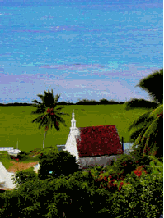
For three decades Hao had been off-limits for yachts and tourists, used as the base for the South Pacific atomic testing program that began in the early 60's and was finally terminated in 1998 amid world-wide protests. New Zealanders are especially interested in Hao, for it was here, that after the Greenpeace protest ship Rainbow Warrior was sunk by French military saboteurs at the main Auckland wharf, that the pair of secret service agents that were caught, were sent to be incarcerated. Major Alain Mafart and Captain Dominique Prieur had posed as married tourists. After the sinking and the death of Greenpeach photographer, Fernando Pereira, the pair were sentenced to ten years imprisonment. In a deal struck with the French government (who were complicating NZ's trade with Europe) the pair were sent to Hao to be confined under French supervision. Captain Prieur's real husband Hao's military Commandant. Major Alain Mafart disappeared from the island soon after. Today there is a huge airport on Hao's sleepy 14-mile island, which in places is only the width of a football field. A few soldiers care for the airport facilities. The island supports a village with at least three churches.
When the blazing heat of the tropical sun diminished, we walked the village lanes and along the way met Lydia, a beautiful young mother, who invited us back to her breezy home for
|
|