|
Surprised at such a mercurial opening Michael answered. "No, we did not. We cannot pay you so much but we would like to present you with a gift of rice (20 pound bag) and I can help you with repairs," said Michael.
"Repairs? Can you do some grinding for us? Can you help us fix our other fiberglass boat?" After some discussion it was agreed to accept our gift and let Michael give a hand.
"Now you can look around the island. The boy will take you." Chief Lewis waved us away.
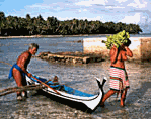
A cluster of women had gathered shyly fifty feet away to stare. All were scantily clad in only a very short sarong covering from the waist down. As we approached one of the women stepped out to offer Michael a woven crown of flowers and they all shook our hands gravely. One young woman with a baby perched on her hip took my hand. "I am Manuela," she told me. Her English was perfect because she had lived for a long time in Washington with a relative. As we walked along she retold stories of the island.
Still remembered was the war, she said, when the island had been occupied for awhile by the Japanese. They had worked the natives hard, insisting all the while that the Yanks were many times worse than they were. Near the end of the war, after the Japanese had departed, a U.S. scout plane buzzed the island several times. Thinking that if the Yanks though the tough Japanese were still defending the island they would be protected, they ran up the Japanese flag. The Americans retaliated by strafing the island killing 30 islanders.
A youth hurried up. "Tino wants you to go with him to work with the men," he told Michael. So without him Miki and I carried on exploring with Manuela as our guide. Men and women generally go about their chores separately, so in a sense Michael was out of place among the women. As we walked I noticed that the tiny island was encircled with family compounds, each within a square of clean coral rubble. The chief and the most important families lived in oval houses that stood on high platforms of carefully cut coral blocks from long ago. Manuela told of the origin of all this building material. In the distant past, she said, a native priest had foretold that a dreadful storm would rage across the island bringing with it huge waves that would drown everyone. So the chiefs decided to build a high tower. A great structure thirty feet high was constructed; the next year as foretold, the storm came. Though it swept the island clean the population survived. The danger past, the great platform was dismantled and the stone reused.
Along the beach we met a group engaged in the bloody task of slaughtering a turtle. It was the breeding season so it was easy to pick the turtles up while copulating in the shallows. The islanders harvest many at this time of year, though the chief's have signed papers agreeing to stop the kill during breeding season.
Manuela led us to a charming open-sided thatched woman's house on a three-foot high base. It its cool shade the bare-breasted women sat harnessed to their primitive back-strap looms weaving patterns of bright colors. As they worked the women chatted amiably with each other, some weaving and others preparing colorful warps. On several looms banana fiber was being worked in patterns that were a special tribute to the Catholic Bishop of Micronesia who was expected in just two weeks time. He would officiate at a ceremony that would make Christians of more than half of the remaining pagans of Eauripik. Miki and I were led to a mat and asked to sit while from a nearby fire was brought steaming breadfruit that we gingerly ate with our fingers. The young girls gathered close, fascinated with Miki's exotic looks, reaching out to stroke her long glossy hair.
The young girls of Eauripik with their sweet expressions and large almond eyes are very beautiful in their own right. But their slim figures disappear with maturity because on tiny Eauripik the main food is coconut. Breadfruit is seasonal and the island supports only a few of the valuable taro beds. On Eauripik Atoll coconut was cool drink, flavoring, cooking oil, cream, snack, baby food, chicken feed, dessert, alcoholic beverage and candy. No wonder then that the women soon grew fleshy, though never obese. They worked too hard for that.
Will you girls marry on this island, I asked?
Shyly giggling, hands covering their mouths, one of them finally replied. "We don't
|
|