Father Seamus O'Flynn
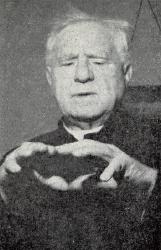
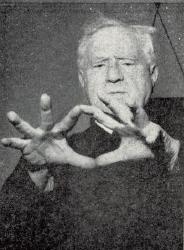
Father Seamus O'Flynn was a catholic priest from Cork in Southern Ireland who treated people with stuttering and claimed to be able to cure them. He was also a keen dramatist with a particular interest in the works of William Shakespeare. He ran a drama company known as The Loft in his home county of Cork. Apparently, many of the people he cured of their stuttering went on to appear in one of his productions. He came to international prominence when the BBC produced a documentary on his method in the final years of his life, which later went on to tour international film festivals.
O'Flynn's method was also outlined in a series of articles in the Irish Sunday Independent by journalist Raymond Smith, and later appear in a book, Father O'Flynn - The Well of Love (Lilmac Books, Dublin, 1964). There were a number of elements to the method of Father O'Flynn and they are summarised herein. The different elements are my interpretation and understanding of his methods.
1. Resonance
According to Raymond Smith, resonance was one of the most important facets of Father O'Flynn's method. It was based on the logical premise that there must be the beginning of a sound before it can be moulded into words. He felt that one of the causes of stuttering was when the speaker tried to utter words with the mouth alone without any resonance in the voice-box. However, if there was an exising resonance within the voicebox, that from therein words could be formed and moulded. He spoke of a 'flowing sound' which is somewhat similar to another popular methology, the slide, where the sound of the initial consonant of a word is prolonged.
The consonant, m, was advocated as a good one to use to form such a resonance. He advised people to vibrate 'm' within the cavaties of the head, to such an extent that the resonance will be registered if the first finger is placed on the tip of the nose. When such an resonance has been establised, the aspirant can then open his mouth, while still retaining the resonance, and mould the sound into words and sentences. Interestingly, people who interject their speech with mmmm's are often seen as displaying the symptoms of disfluency. O'Flynn's methods turns this around, turning the symptom into the cure, moving it from ex post to ex ante, so to speak.
O'Flynn states that when a person is breathing properly (see below), with all the cavities resounding, all the breath should be going into the voice leaving no unvocalised breath passing through the mouth. In such a scenario, a lit match placed before the front of the mouth should not be extinguised, even if a very loud sound is being transmitted from therein!
2.Developing the muscles of the Soft Palate
The second method advocated by Father O'Flynn involved developing the muscles surrounding the soft palate, the fleshy part at the back of the roof of the mouth ending at the uvula. He claims that if the muscles of the soft palate are weak, there is a physical impediment to the hard palate and the tongue forming the sounds of fluent speech. He recommends exercising the muscles of the soft palate through yawning and laughing. By developing the muscles of the soft palate, the process of speech apparently becomes easier and easier.
3. Breath Control
The next part of the O'Flynn method is the development of proper breathing, a method common to many of the systems developed to deal with the problem of stuttering. Father O'Flynn's method centres around developing what he calls the abdominal press. The abdominal press pushes the air up into the lungs. By training the process of breathing so that the abdomen effectively pumps air into the lungs, the stutterer develops the machinery to promote fluency in their speech.
To develop the abdominal press, Father O'Flynn recommends that you tie a piece of tape just above your waste and then take a deep breath in through your nose, filling up your lungs. By virtue of the abdominal press, the tape should now fall slack. Pull the tape tight again and now practice breathing in and out with the abdominal press in place. The physical motion of breathing should now be concentrated beneath the apex of the triangle formed between your lungs and the lower rib.
4. Correct Posture
Posture pertains to the whole breathing apparatus. When the frame of the body is in the right position, the fluency of speech is improved. Father O'Flynn provides two exercises to develop correct posture, both involve the postulant lying on their back.
The first exercise involves placing a book on the bones of the upper chest, and then lifting the book by expanding the chest, i.e. filling the lungs with air. The second exercise, which he suggests should be attempted after success has been achieved in the first exercise, is to place another book on the lower ribs, just below the triangle as previously described. To lift the lower book, the aspirant will need to fill the back of his lungs. Apparently, it takes quite a bit of practice!
By undertaking the exercises as described above on a regular basis, the postulant should develop what Father O'Flynn describes as deep breathing. It will apparently rid him or her of the spasmodic aspect of speech and their speech should flow freely and continuously. The exercises should also develop straight posture.
A correct posture is described as:
i. The back is quite flat and the shoulder blades don't stick out
ii. When standing up, an imaginary straight line should bisect the centre of the head, the relevant ear, shoulder, hip, knee and ankle.If such a line cannot be drawn, the chest is not properly up.
iii. When standing against a vertical straight wall, the heels, buttocks, shoulders and poll (the back of the head between the ears, though the term is generally used for horse and not human anatomy) of the head can touch the wall without strain.
5. Physical Exercises
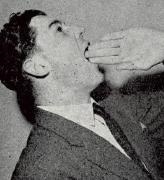
Father O'Flynn recommends a number of physical exercises to develop the relevant muscles to facilitate fluent speech. One involves sticking the first three fingers in between the teeth (see picture above). This should develop the flexibility of the lower jaw, giving greater action to the tongue and lips.
Success is your proof
Father O'Flynn reiterates at the end of his programme that the individual with a stammer must be prepared to personally apply the methods described and to persevere despite setbacks. This is relevant to all stuttering therapy, whether through using the O'Flynn system or any other.