PI is the mathematical constant, which for many thousands of years has been of great importance. It is used in geometry, for example to calculate the area of a circle.
PI is what we call an irrational number, meaning that it cannot be expressed as a fraction. When we write PI, we therefore have to write it in a decimal form, e.g. 3.14159265... This leads to the question:
There are several ways of doing this, and a geometrical approximation is given here. (We say approximation because being an irrational number, PI can be expressed to an infinite number of digits after the decimal point. This means that no one can ever calculate it exactly, because even the biggest, best computer in the world is unable to store an infinite sequence of digits).
Consider a circle. Inside the circle, we can draw an equilateral triangle (a triangle which has all it's sides the same length), that touches the circle at 3 points. We call this an inscribed triangle. We can then also draw an equilateral triangle outside the circle (a circumscribed triangle) which again touches the circle at three points. This is shown in figure 1.
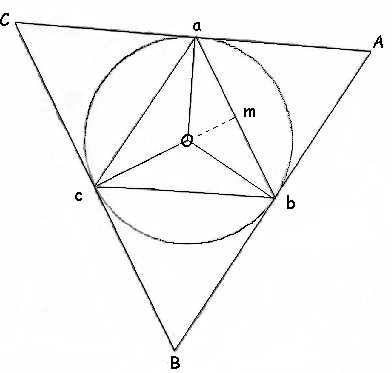
Figure 1. Inscribed and circumscribed triangles.
If the circle has a radius r, which could be 1cm, 8cm, or anything you like, then the area of the circle will be PI×r2. This will be less than the area of the outer triangle, but greater than the area of the inner triangle. Therefore, by calculating the areas of the outer and inner triangles, we can say that PI must lie between certain values.
So, the area of the inner triangle can be calculated as 3×sin(60)×cos(60)×r2.
Likewise, the area of the outer triangle can be calculated as 3×tan(60)×r2.
Therefore, we have shown that:
3×sin(60)×cos(60)×r2 < PI×r2 < 3×tan(60×r2.
Cancelling the r's gives:
3×sin(60)×cos(60) < PI < 3×tan(60).
You may see that the above method gives quite a wide range of values for PI. This does not lead to a very good approximation. We can therefore improve this method if we use a circumscribed and inscribed square, instead of a triangle, as shown in figure 2.
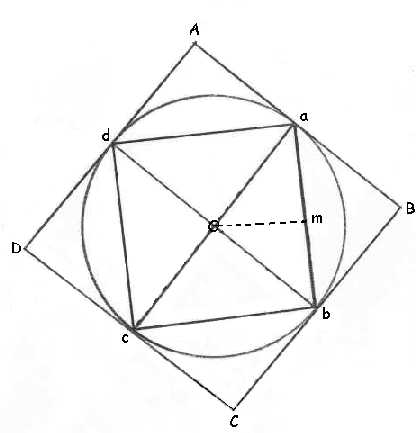
Figure 2. Inscribed and circumscribed squares.
In a similar way to above, we can show that the area of the inner square is:
4×sin(45)×cos(45)×r2.
Likewise, the area of the outer square is:
4×tan(45)×r2.
Comparing these with the circle area, and cancelling the r's leads to a closer bound for PI:
4×sin(45)×cos(45) < PI < 4×tan(45).
i.e. 2 < PI < 4 (when we put this into a calculator).
Again, we see that this is not particularly helpful in estimating a value for PI. So what should we do?
We can see why this method is not yielding very good results so far - there is a lot of wasted space between the two squares, which should not be there. However, if we continue to inscribe and circumscribe shapes with more and more sides, the wasted space will get less and less. So, using a pentagon will give a better bound on PI than using a square. Likewise, using a hexagon will be even better. If we use a dodecagon, we would get even better results. Eventually, if we went far enough, the shape that we were inscribing and circumscribing would become a circle, and then we would have an exact bound for PI.
But, can we find a formula, which depends on the number of sides that the shape we're using has? The answer is (of course) yes! Consider an octagon. This shape has 8 sides. We can therefore divide it up into 8 isosceles triangles and multiply the area of one of these by 8, to give the area of the octagon. So for example, for an inscribed octagon, the area of one of the isosceles triangles is 1/2×base×height. The angle at the top of the triangle will be 360/8=45. So, the base length will be 2×r×sin(45/2). Likewise, the height will be r×cos(45/2).
Therefore, the area of the octagon will be 8×r2×cos(45/2)×sin(45/2).
The area of the circumscribed octagon can also be calculated, using trigonometry too, in a similar way. In this case, the height of each isosceles triangle is r, and the base length is 2×r×tan(45/2).
This leads to:
8×sin(45/2)cos(45/2) < PI < 8×tan(45/2).
For a general case, for a shape with n sides, we can divide each shape into n isosceles triangles, and calculate the area of each of these. This leads to a general formula:
n×sin(180/n)×cos(180/n) < PI < n×tan(180/n).
We can therefore set bounds on PI, and for very large n, calculate PI very accurately. (Note, that although this method gives good results, it is not the method used by computers when they are calculating PI, because it is what we call an inefficient method, because it takes a lot of computer computation to calculate PI to each new degree of accuracy, and so only works slowly).