Percentages Solutions
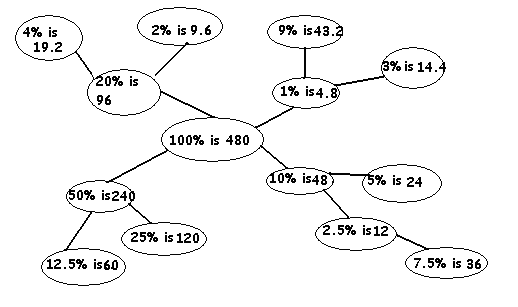
1.
2. Simply write them as a fraction of 72 and then multiply by 100.
a) 25%
b) 33.3%
c) 20%
d) 75%
e) 12.5%
f) 62.5%
3. 17.5% of �16 Can be calculated as follows:
10% of �16 is �1.60
Halving to give 5% is �0.80
Halving again to give 2.5% is �0.40
17.5% of �16 is then �1.60 + �0.80 + �0.40 = �2.80
So the bill comes to �16 + �2.80 = �18.80 Another way to have done this is to calculate 117.5% of �16.
4. Either calculate 80% of �75 by using equivalent decimals so that
0.8 × 75 = �60 or
Find 10% of �75 = �7.50
Doubling this to get 20% which is �15
Subtract this from �75 so that we have �60.
5.
36 ÷ 0.8 = �45 or use the unitary method.
80% is 36
so 1% is 36 ÷ 80
= 0.45
so 100% is 0.45 × 100 = �45
6.
26-20 = 6
6 ÷ 20 = 0.3
As a percentage this is 0.3 × 100 = 30%
7.
John's rate of interest: (6/150) × 100 = 4%
Jane's rate of interest: (5.4/120) × 100 = 4.5%
So Jane's rate is better.
8.
5% of �3000 is �150 so in 4 years he will have �3000 + 4×(�150) = �3600
3000 × ( 1.05)
4
. Don't worry if you didn't get this, it will be covered in a later chapter.
Back to Exercise
Back to percentages
Quick test
Top