| a) a5 | b) a3b2 | c) a5 b3 | d) a4 × a2 | e)a3 × a6 |
| f) a3 × a2 | g) a5 × a2 | h) b4 × b3 | i) (a3)2 | j) (a2)4 |
What did you notice? How can you write am × an in their shortest form?
| a) a5 ÷ a2 = a × a × a × a × a ÷ (a × a) = a × a × a × = a × a × a = a3 | b) b3 ÷ b2 | c) b5 ÷ b3 |
| d) b7 ÷ b3 | e) b8 ÷ b3 |
What do you notice about bm × bn?
How can you write them in their shortest form?
You should by now have worked out that
Substitute a,m and n with numbers of your choice and fiddle about with them to convince yourself.
Using these results this implies that
Combining results b,c and d gives us
What do you think fractional indices mean then? I.e. if you had a1/2 or a1/3 etc.
This might help you:
a. am × an = am+n
b. am ÷ an = am-n
c. am ÷ am = a0
d. So a0=1
e. 1÷ am = a0 ÷ am
f. = a-m
b) a1/3 × a1/3 × a1/3=
Check your answers here.
We'll give indices a break now while you continue with the other bits.
Before you try the next exercise, I would advise you to read up on the algebra notes on simplification first.
| a) 5a + 3b - 4a + 2b + c | b) 6a2 + 2ab - a + 2a2 |
| c) 6b2 + 3a2 + 2a2 + 2ab + 4ab | d) 10a + 6b + 2a + 3a2 + 3b |
| e) ab2 - b2 + 4ab2 |
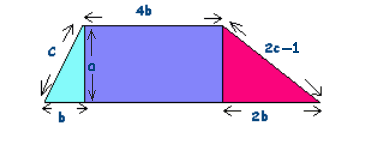
b) Write out an expression for its area by considering the area of the shapes within the trapezium.
| m+p | m-p+q | m-q |
| m-p-q | m | m+p+q |
| m+q | m+p-q | m-p |
| a) 4(a + 3b) | b) a2(3a + ab) | c) 2ab(ab + b2) |
| d) 3a3(4a + 3x) | e) ab2(5a + b3) |