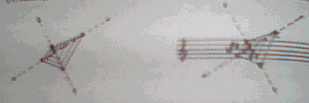
 can be extended; a delay on the B could have the following effect
  , and if dynamics are added, a dimension is gained which causes a spatial accentuation in the figure:
Mauricio Kagel
Amy C. Beal, "Negotiated Cultural Allies: American Music in Darmstadt, 1946-1956," Journal of the American Musicological Society 53, no. I (Spring, 2000), 105-139. Complete PDF (3.4 MB) pp. 105-115 ( 1.1 MB) pp. 116-127 (1.1 MB) pp. 128-139 (1.1 MB)
Crisis seems to be a status quo in musical form (the confusion of concept is already classic: crisis instead of renewal), and now we are beginning to take account of new compositional principles that have a large penchant in the direction of graphic solutions, thereby overstepping the properties of the usual notation . If one chooses to regard these graphic representations as merely an extension of musical semiography, one is ignoring the desire for unknown projections of the invention- which surely is what inspires these new symbols and methods. The metamorphosis of musical language in the last sixty years enjoined a direct adaptation of the way of writing; this is no longer a matter for argument , but the relationship is the other way round today: the development of particular notations implies a latent development in the musical language. This stage is often rejected on account of the systematic separation of the point of departure (the idea) from the final effect (the notation) in a composition; this effort of ours-schematic introduction to the principles of a theory of musical translation and rotation- will surely bolster up any rationalized objection to the idea, but the following exposition of the theory has been undertaken for other reasons.
?The fact that the structure of a piece of music can find an analogy in the visual representation only makes wider the gaps between idea, representation and realization. Composing today is no longer a matter of subjective attitude to an objective form; the correspondence of forms and methods is to be found in the subject- the sound-both in its manifestation in performance as the extension of the idea, and also when an interpretative treatment of the material is demanded by the perspectives of infinite possible points of combination in the internal articulation of the form.
?In composition interpretation stands in a reciprocal relation with decision; the steps between the two take the form of codex-consisting of language of stimuli and signals ad hoc-on the same level as the organization of pitches or intensities.
?The perception of the musical form of some works is only possible through the active interpretation (in the sense of a synthesis) on the part of the instrumentalists, and not through a merely passive interpretation (in the sense of an analysis). The act of hearing is then inseparable from the form, just as a formant is inseparable from the sound (of which it is part). The ‘timbre’ of forms such as these is dependent on characteristics of the interpretation, and in the interpretative enchainement of various sections.
?Forms that allow of manifold interpretation require manifold (multivalent) material; an ambiguity of form could not be achieved without a directly corresponding ambiguity in the material. The inclusion of interpretation as a constitutive concept in composition tallies with the pre-requisite that one should be in a position to harness all the attributes of form in every respect-this is one of the few mental ostinati that has been preserved in present-day composition.
?The graduation of interpretation in the broad area between the possible and the utopian will have no mean part to play in the problems concerned with the presentation and design of musical passages by geometrical means. Naturally, a technical process must be found which can provide an insight into the investigation of the investigation of the function and effect of translating and rotating.
?Rising or falling as directions in a series of notes are components of a geometry in two dimensions; connecting lines between the combined directions of several notes create surfaces that can be articulated temporally and dynamically. For example, this ‘figure’ can be extended; a delay on the B could have the following effect , and if dynamics are added, a dimension is gained which causes a spatial accentuation in the figure:
?If we investigate the figure divorced from the musical stave  the earlier distance between the notes is no longer an expression of a temporal sequence; the perimeter, accentuated by four dots, is free of any temporal function and therefore cannot force any directional movement on our attention.
?The isolation of the figure from its complementary relationship to a musical process serves for an experiment. There is now no temporal sequence from left to right to fix the orientation of the figure, so movement becomes possible if one refers the figure to a musical parameter (for example, pitch).
?The following is the result of the application of two simple categories of movement:

For the presentation of a translation or rotation at least two stages in the shift are necessary.
?The application of these categories of movement in the sphere or music is quite conceivable. The combinations of spatio-temporal movement that appear require a definition of the following concepts:
.)Dots are notes that determine the outline of a virtual figure (surface).
(Note-dots refer to pitches; time-dots refer to durations and intervals of entry; space-dots refer to intensities and spatial movement).
.)Basic shape is the virtual figure determined by the dots. This it is that can be shifted from an original position to other positions by means of the processes we are describing
.)Derived shape is a shape that varies from the basic shape in its position in relation to a common axis (i.e. not a repetition of the basic shape as in the simple translation with a constant axis-see ‘translation’)
.)Identity will be used to describe the correspondence of the basic shape with itself-in graphic terms, a congruence of the two outlines; in time it should be understood as the reappearance of the original constellation (constellation of pitches or whatever the dots stood for in their original position).
.)Period means a cycle of shifts that returns to identity.
.)Regular shift is a shift that does not alter the virtual outline of the basic shape. It is expressed by the finite position of a single category of movement(2).
.)Discontinuous shift is a shift where the interval between the original position and the final position is not expressed in time. In the case, what is shown is the effect on the basic shape of only one moment of movement, i.e. an irregular, static alteration(3).
.)Successive shift is a shift where the basic shape and the derived shape follow one another separately.
.)Compound shift is a shift where the relationship between the basic shape and the derived shape is visible in the graphic presentation, but the two form a unity when translated into acoustic terms(4).
?We will meet these nine expressions again in the course of our exposition of straight-line and circular shifts in their application to basic shapes of pitches, durations and timbres.
Translation
?The shifting of note-dots provides us with an opportunity to regard the concepts of repetition and transposition from a new point of view. In the following examples a repetition is a special case of a translation with a constant axis, and a transposition is a special case of a translation with a variable axis. This is the result of the fact that in translation we always take into account the relationships of the surface (graphically speaking) or times (acoustically speaking) of two shapes, whereas in the usual concept of repetition, the time (interval of entry) is not taken into account(5).
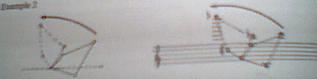
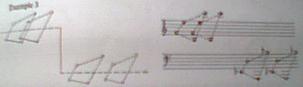
?Examples for two similar and tow dissimilar shapes in two stages:
?Similar shapes
?
Dissimilar shapes

?(b)common variable axis: 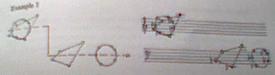

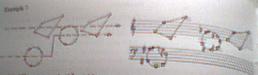
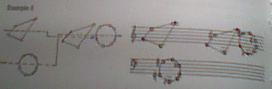
(c) (d) (e) for dissimilar shapes are also applicable to similar shapes, as long as these are made clearly distinguishable by the use, for example, of different timbres. If not, the translation of two similar shapes on different axes is effectively the same a translation of one shape on a variable axis.
Rotation
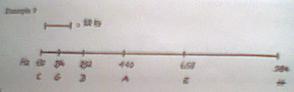
Example 9 shows a series of fifths expressed in frequency cycles per second (cps); [translator’s note: in the examples the abbreviation Hz (Herz) is used instead of cps]. The frequency intervals are given on a linear scale; they get progressively larger in the proportion 2:3. The series of fifths begins at 130 cps (C below middle C; he numbers have been rounded off according to even temperament 12 root 2).
?
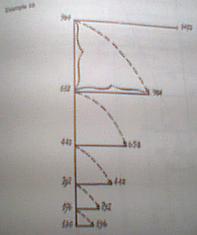
In example 10 the series of intervals is presented vertically, and the intervals them-selves are projected onto horizontals; thus each interval forms a right-angle with arms of equal length. These angles form a co-ordinate system of which the abscissa and the ordinate both represent frequencies. The abscissa is a continuous frequency scale, whereas the ordinates are projections of this scale.
If we draw a vector from 130 cps so that it makes an angle of <20 with the abscissa, the point at which the vector intersects the ordinates indicates frequencies (see example 11). A new series of frequencies is produced if we drop perpendiculars from the points of intersection onto a horizontal line f. If we go further and interpret f as a time-axis t, we can read off the duration for each frequency. The original series of fifths has been transformed into a derived series of frequencies that no longer has a single interval as a modulo. The first interval is now a major sixth, and the following intervals get smaller and smaller. The greater the angle between the abscissa and the vector, the larger the derived intervals become. The greatest possible angle in example 11 is <55; with a greater angle the vector will no longer intersect the frequency lines above 292 cps.
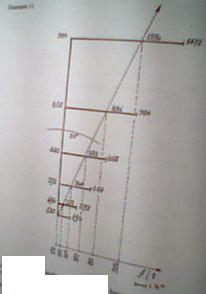
The vertex of the angle can occur at other frequencies (e.g. 440 cps, 984 cps, ect.); but the largest variation is obtained by drawing the vector so that it takes a new angle at every point of intersection with an ordinate. This is shown in example 12.
In order to do this we have to determine the series of angles; the proportion 2:3 is chosen as the constant interval of the scale:
1 2 3 4 5 6 7 8 9 10
<30 <45 <67.5 <101.2 <151.8 <227.8 <341.7 <152.5 <48.7 <73
The following series is the one used in example 12:
2 4 3 5 1 7 10 6 8 9
<45 <101.2 <67.5 <151.8 <30 <341.7 <73 <227.8 <152.5 <48.7
The vector has always to reach a point of intersection that lies on an ordinate. However, if the vector –because of its angle-cannot intersect an ordinate, then the latter is extended as far as is necessary to provide a point of intersection. The extension can take place in both directions-towards the higher or lower frequencies. If the ordinates determined by the series of fifths are extended , a larger range is covered by the frequency scale. The frequencies of the intersections that lie on extended ordinates are transported on to the ordinates that contain these frequencies in their original length.(For example, a vector that starts from 545 cps on the fourth ordinate with an angle of <151.8 intersects the fifth ordinate in extension on the left. The resulting frequency-377 cps- is transported onto the third ordinate, and a new vector is drawn from that point with the defined angle, etc.).
?The new series of frequencies is no longer a rising one as in example 11; the series of angles that is applied determines the tendency of the derived frequencies: rising, falling, or alternating. The series of frequencies in time is also dependent on the series of angles, if one understands the intervals between the frequencies that are ordered horizontally as delays (+intervals) of entry: wider angles correspond to shorter delays of entry and acuter angles to longer delays of entry.
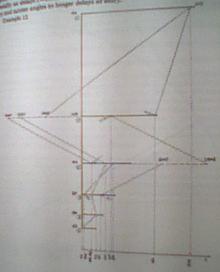
?In a first interpretation, reading from left to right, we get the following series of frequencies: 4
Ordinates 1 3 3 2 3 4 5 4 5 6
Frequencies 130 305 485 261 377 545 685 579 974 1452
337
?A second interpretation of example 12 for frequencies is given by the sequence of intersections on the ordinates 1-6; the series of frequencies is then:
Ordinates 1 2 3 4 3 5 5 6 4 3 4
Frequencies 130 261 337 545 377 685 974 1472 485 305 579
?One can get a corresponding series of delays of entry if one interprets the frequency scale from example 11 as a t-scale in which the largest interval receives the longest entry delay. However, it is more favourable to define time intervals and frequency intervals by different rules of combination. If one applies the delay of entry of the first interpretation of example 12 to the 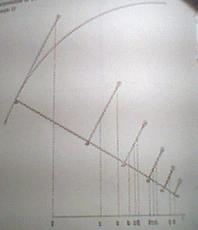
second interpretation of the same example, one obtains new combinations; the sum of the delays of entry will then always be larger than in the second interpretation.
?We will now take the frequencies obtained from the intersections of the vectors and the ordinates in example 12 as a basic series. We will permutate this basic series by means of rotation. We take the anscissa (the continuous scale of frequencies) as the axis, and 130 cps as the turning point. In example 13 the axis is rotated to the left by <60, and perpendiculars are drawn from the frequency points to the ordinates.
?The remarkable transformation in this example is not only the new ordering of frequencies, but also the alteration in the corresponding sequence of intervals of entry. As a consequence of example 13 we can formulate the following axioms for the rotation of note-dots (frequencies):
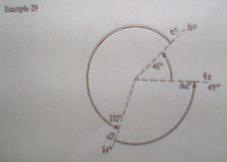
The preceding axioms will also be applicable to the points of the rotative basic shape when they have other references (time-dots and space-dots). In example 14 the continuous scale of frequencies is not a straight line but a circle. What were previously the ordinates are now sections of radii of the circle. Choose any frequency area as representing the circumference of the circle (e.g. 1640 cps), and each degree is then 1/360th of this frequency area (in example 14: 1640 cps/<360= 4.55 cps/<). The length of the section of the radius shall be equal to the frequency interval on the continuous scale of the circle (e.g. increasing in the proportion 2:3). The new distance between the frequencies can then be read off again on a horizontal.
?The rotative basic shape in this example offers a larger range of possibilities for transformation and combination than the one in example 13. The circle encloses a virtual ‘frequency area’. Any point in this area can be joined by a radius or the continuation of one, and in this way a certain ambiguity is provided by the simultaneous presence of two interpretations. If every radius is extended to become a diameter, only the higher of the two frequencies can be raised; the lower frequency reaches the value of the higher frequency: 130-------- > 1640
3150< -----Maximal ambiguity is achieved at the centre of the circle: there, each radius reaches a different frequency.
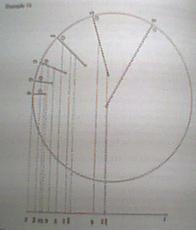
A series of delays of entry within a total length t is to be rotated round a defined centre. The axis of rotation (t) is identical with the straight line on which the time-dots are located; each dot describes a circle around z.
The ‘speed’ of the rotation is determined by:
According to the nature of the instrument for which the diagram is to be interpreted, the delays of entry result in pauses (e.g. for percussion instruments), identity of duration and delay of entry, or overlapping (for brass and strings, etc.).
In example 15 three angles of rotation are given-<30, <50 and <83. Perpendiculars are dropped from the dots on the axis to a common straight line so as to provide transpositions of the total length t. Each of these transpositions alters the delays of entry in proportion to the angle of rotation: 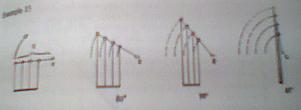
<0 and <90 are the limits of the scale of transposition for the original length t; derived length (delay of entry) is the name we will give to a transposition. Between <91 and <180 we get the retrograde of the derived length (<180-<83=<97; <180-<50=<130; etc.).
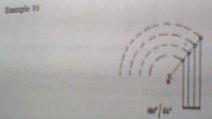 and between <181 and <360 we get a repetition of the transpositions from <1 to <180.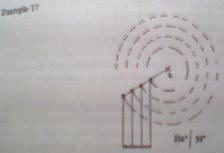
From <0 to <90 the original length is shortened. A derived scale of lengths can be formed with the angles of rotation; and it would also be possible to make a proportional scale of the length from 2:1 of the traditional notation: 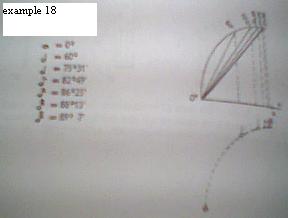
Here we have an unending series converging on 2 (infinite number of members with a complete number as sum): 1+1/2+1/4+1/8+1/16+1/32+1/64…--- > 2
So, rotating through <90 we arrive at the length 0.
?A diverging unending series: 1+1/2+1/3+1/4…, in which the sum of the members is larger than a pre-determined whole number, has the following equivalent in a scale of angles of rotation: 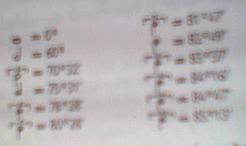
This converging unending series is a harmonic series, whose function-be it for frequencies, lengths, tempi or timbres- can be articulated by means of a system of angles of rotation.
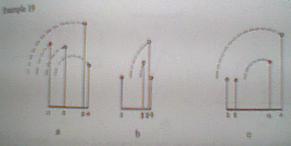
?But a system in which –by means of rotation-a series of intervals of entry is transposed only into smaller values results always in acceleration. Therefore it is necessary to combine the system of rotation with other processes such as will allow of an increase in the sum of the intervals of entry, in other words, deceleration. For this purpose we have to introduce different vectors with simultaneous rotation for each time-dot. In this process several speeds of rotation are superposed, and these prevent any harmonic transpositions of the original lengths (i.e. where the diminution of the delays of entry is proportional to the diminution of the total length). In example 19a we observe the rotation of four time-dots with different angles of rotation. If we number the dots we can see that the original order has been permutated; the diminution of the delays of entry is not proportional to the diminution of the total length. In example 19b the rotation only affects the dots that lie between the two extremes; the total length is unaltered. In example 19c it is the outer time-dots that rotate, the others stay still, non-harmonic, since the alteration of the original shape does not affect the relationship between the delays of entry and the total length proportionally.
[in example 19a there is a mistake in the numbering; 1,2,3,4 should read 2,3,1,4]
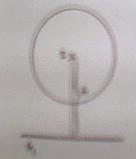
The application of different speeds of rotation for each individual time-dot means that the rotation of the series of dots is independent of a common vector serving as a single axis of rotation. Different angles of rotation automatically result in different axes of rotation. The speed of each individual dot can always be found out by the number of rotations or by the angle described by each point in its path from identity to identity. <90 cannot be regarded as the limit of the transposition since retrogrades and repetitions at <0 and <360 can be avoided by means of different speeds in simultaneous rotation. This exclusion of a common vector makes it possible to use a process that results in an augmentation of the original lengths. If now, instead of the perpendiculars, we extend the vectors in all angles onto a common straight line G1 underneath the circle, we have abolished the limit that was given before by the distance between the outside dots (i.e. the diameter of the circle).
The augmentation of the sum of the lengths (delays of entry) on this straight line is determined by two factors:
 |
|
Extensions of vectors between <0 and <180 intersect a straight line G2 above the circle.
By overlapping two or more straight lines one can achieve a higher density of delays of entry. (It is not necessary to use all the dots that result from this overlapping procedure; lighter density is achieved even when certain areas of the straight lines are ‘filtered’ or various individual dots are left out).
Examples 20c shows the overlapping of G1 and G2 that results from the examples 20a and 20b: 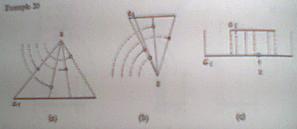
In example 21a we see how-with the application of different speeds for each time-dot of the original order-it is possible to co-ordinate two or more intersections (given by the various angle-positions) on a single straight line, without having recourse to a corresponding number of straight lines (though the tendency to diminution leads to ‘strettas’ of the original delays of entry when two or more ‘harmonic’ transpositions are overlapped). If diminution is the only result of a transposition, each entry delay has a characteristic effect; successive transpositions then only provide faster periodicities that are clearly perceptible in the overlap.
Different speeds of rotation for the individual time-dots allow us to compose larger or smaller ‘density zones’ in a single superposition, without repeating any characteristic interval. The density zones are dependent on whatever angle of rotation are applied, on the number of super-positions, and on the assimilation of the ‘harmonic’ transposition to these super-positions.
Example 21a shows two super-positions on the same straight line; example 21b shows the same with the delay of entry of the ‘harmonic’ transposition.
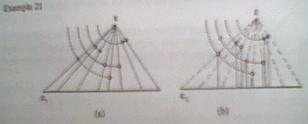
The application of straight line above as well as a straight line underneath produces symmetries similar to those in examples 15-17. There, the limits of the scale of transposition of the original length t were <0 and <90; from <90 to <180 retrogrades of any of the transpositions reached in the derived lengths could occur. Since retrogrades can be avoided by means of different speed, let us now follow the position of the angles in relation to the <0 position (e.g.<450<315).
The mirror dots that lie on the same straight line, a vector has to be extended as far as the opposite straight line can never produce a superposition. Example 22shows two complementary angles (adding up to <90) of <60 and <30. The derived lengths have been drawn in:
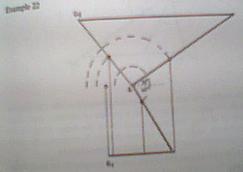
When the angles add up to <90 it is not necessary for the <0 position to be regarded as one of the two arms of the angle. The right-angle can be shifted; in this case the two arms of the angle have been extended as far as the straight line above and/or below the circle.
?The fact that complementary angles are independent of the <0 position, permits us to use it as a module. (Two pairs of complementary angles make up two supplementary angles; the resulting retrogrades can only be avoided if every vector (arm of an angle) constitutes the axis of rotation for a different dot.)
The principle of complementary angles can also be applied to pairs of angles that add up to less than <90. The angles in question can be freshly defined for each process of rotation, this enabling one to obtain a differentiated articulation of the lengths. The angle regarded as the sum will be referred to as the module-angle.
?Having decided on a module-angle, its relationship to <90 and <180 must also be fixed; if the module-angle is contained n times in a complementary angle, retrogrades result (for example, 9*<10, 6*<15, 9*<20, 6*<30, etc.).
In example 23 the module-angle is <70; it is made up of the following pairs of complementaries: <25 and <45 <10 and <60 <20 and <50 <30 and <40
<70 + <70(<140) + <70(<210) + <70(<280)
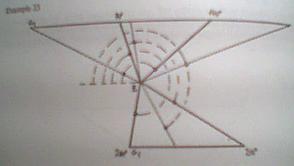
Apart from module-angles, one can also use certain proportions for the purpose of transforming a series of delays of entry (7). In a process of rotation, every angle corresponds to an interval of time. The number and size of the angles determine the changes in the delays of entry, which is why we have thought fit to provide the above sketches of the various possibilities for the articulation of these changes.
By means of translative and rotative procedures one can progress from fixed, determined time-dot-structures to constructional processes of quite a different sort, which then produces bendings, contractions and stretchings in a particular flow of time. Example 24a shows the paradigm phase of a time-spectrum with the formants 1 to 13 in (logarithmic) order. The space between two formants is equal to that between the individual dots of the lower of the two formants (as with the projection of the frequency abscissas in example 10). This concurrence of the single entry delay and the vertical distance between formants can be compared graphically with the presentation of the relationships of the harmonic series (or series of partials) in the realm of frequencies. When the distance between the formants is drawn as a constant, the formant rhythm in the vertical is no longer congruent with the structure of the time-spectrum ( the time-dots of each formant are delays of entry with duration included, presented on an illusory surface). This mode of presentation enables one to rotate sections of this spectrum around a time-axis; this time the rotation does not provide any regular grid-I results in a surface with a certain density-gradient as a continuous acceleration.
Example 24b shows a rotation through <30 of a circular area with its centre in the middle of the eighth formant. The area between the sixth and twelfth formants first accelerates the projected periodicity of the basic phase, and then slows it down. The interpenetration of two areas of time-spectrum is shown in example 24c (coupling of straight line and circular shifts) and 24d (simple translation of the same area)(8).
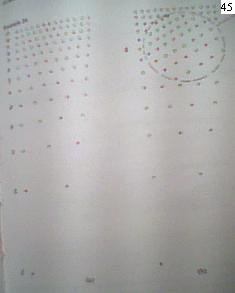
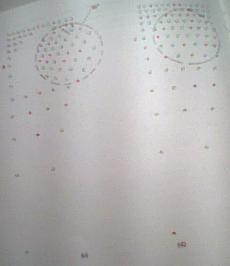
Changes of timbre by rotation are best obtained by means of electro-acoustic processes. Partial tones and their amplitudes can be varied by a process of rotation as follows: the selected partials are ordered in a scale (in example 26 from 100 cps to 1,500 cps); for the amplitudes we will use a hairpin-type of dynamic notation-it is divided into two equal parts by a horizontal axis, and the breadth is measured in decibels (dB)(see example 25). The maximum breadth of the hairpin is to be equivalent to 0 dB; the point where the two halves of the hairpin meet represents –40dB. If we set up an equivalent measure in centimetres for one second (t=ordinate), we can establish an amplitude for every point in time.
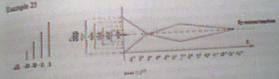
If we substitute f (frequencies in the series of partials) for t, and measure A (the amplitude) for every partial, we get a stationary sound spectrum:
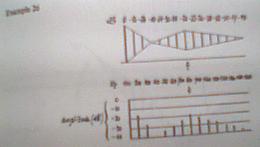
For the purpose of observing the variations of timbre produced by a rotation of the hairpin, we will draw two lines from the extreme points of maximum amplitude (0dB) parallel with the horizontal axis of the hairpin (the axis of rotation). The hairpin rotates about an axis-for example, the dot above 800 cps- but the space between the two parallel lines represents an area of amplitude which remains fixed and independent of rotation. Two interpretations are possible:
A series of angle of rotation for the hairpin can be defined by means of a proportion (e.g. 2:3). Thus we get the sequence:
<0 <20 <30 <45 <67.5 <112< 168 <252 <18 (<378)…
1 2 3 4 5 6 7 8 9
We will select <45 and <252 (4th and 8th members of the sequence) for the following examples.
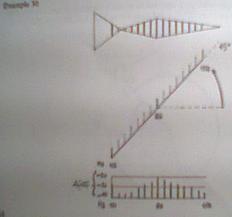
?The length of the axis of rotation (diameter of the circle in example 27, divided by the angle of rotation) is to represent a defined duration t. With the diameter we can also get the circumference of the circle, t*pi; the circumference measured in cms corresponds to the duration in minutes of arc. By means of this procedure the speed of transformation of a timbre is incorporated in the process of rotation. In this case governed by the relationship between t and the angle of rotation. If t has a defined duration, every angle of rotation (as an interval of rotation) has an equivalent time-interval which is proportional to the duration established for <360.
?A consistent procedure results from both intervals (arc and t). In example 27 and 28 we can follow the transformations in timbre-spectra: t=14" (example 25); amplitudes and frequencies are read off for the angles of rotation <45 and <252.
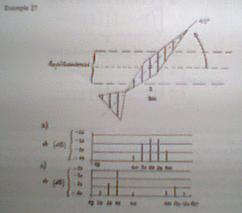
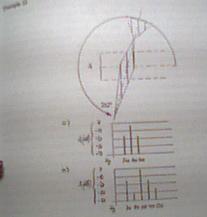
It is not absolutely essential for a rotation to retain a constant temp. t can change; for example t1=14" from <0 to <45; t2= 10" form <45 to <252; t2=25" form <252 to <360.
It becomes clear from the examples given that the results are very different depending on whether one takes the widths of the hairpin that lie inside the area of amplitude or the widths that lie outside it, or both. When angles of rotation are chosen that approach <0 or <180 the amplitude differences become hardly perceptible. (at <0 and <180 the amplitudes are identical.) Further, the results for frequencies and amplitudes are determined by the shape of the hairpin (or envelope-curve). The frequencies of the basic spectrum are to remain constant throughout all possible variations. If we start with influence on the turning timbre, corresponding to the number and order of the selected partials (even-numbered, odd-numbered, or alternating) and their position in the spectrum (low, medium or high register).
However, when the frequencies do not fit the grid of the harmonic or sub-harmonic spectrum, and form an unharmonic spectrum, then the rotations of the amplitude curve affect not so much the resulting timbre, as the particular frequencies themselves; the result is then perceptible as a dynamic variation in the components of the chord(9).
If , instead of the hairpin, we now turn the frequency scale ordinate), we get-with the same angles of rotation- different results. The different results for amplitude show the difference between the two different sorts of rotation. Whereas the frequencies of the spectrum are arranged graphically in a line, the amplitudes in the hairpin have ‘breadth’. So the frequency line serves at the same time as an axis of rotation; the amplitudes describe a circle around their axis of symmetry. The process of composition is then decided by the selection of one of the possibilities offered by rotation round one axis the amplitude curve at the same time; these transformations are different again from those described above, even though the angles of rotation are still the same. In this case the direction is decisive; with a double rotation, it is the speed with which
both axes turn that affects the total process.
?If both axes turn at the same speed, we see that the original spectrum becomes altered. The parallelism of the axes of rotation does not prevent the relationship between each frequency in the spectrum and its amplitude from being different each time, because the area of amplitude always remains in its original position and measurements are always taken vertically.
?There is however no possible variation in the amplitude when both axes of symmetry rotate in the same direction with the same speed and area of amplitude does not remain in its original position, but follows the rotation in company with the hairpin. The duration of the sound is shortened in proportion to the angle of rotation.
?The determination of different angles for the simultaneous rotation of the frequency axis and the hairpin depends on the degree of transformation that is required. The shape of the amplitude curve determines the speed with which a particular transformation of the original timbre is reached. Complex envelope curves with many maxima and minima have much larger capacity for variation than relatively simple envelope curves.
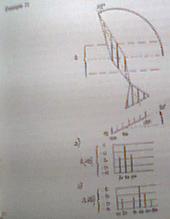
?The angles of rotation that we have applied in example 31 came from the previously derived proportion series 2:3.
?All the above examples are easy to execute with electronically produced tones. Turning timbres constitute a problem which finds its simplest solution in composition with electronic means.
Complete projection in space is not yet available in electronic music; but one can only imagine ‘music in space’- a space without holes- where this complete projection in space is a constitutive element in the composition. Our present space is made up of several tracks which, with the aid of strategically suspended loudspeakers, provide some sort of substitute for an imaginary continuum. An organization of mobility of sound by means of turning timbres will then be a specific category of the concept ‘musical space’. Some of the principles of rotation explained here can be executed in space even with the primitive technical means at present at our disposal; a ‘muted’ spatialness does nothing to interfere with our perception of space. Although this ‘muting’ has proved itself a very musical business (the mute on a violin still allows the timbre of the instrument to be recognized), is nevertheless a stage that will have to be superseded.
?When the fundamentals and partials of a spectrum have been fixed, each frequency has its own amplitude; the superposition of these gives the general envelope curve of the spectrum. The same procedure can also be executed in instrumental music(10).
?Postscript, by the way of a footnote
We have characterized translation and rotation as only two of the many possibilities for the representation of the emergence of form and its evolution. Thus all the above examples are merely preliminary reflections on the subject; the choice of a method is not to be identified with a complete declension of the method. To define exactly the concept ‘form’ in its effect on all musical aspects, one would have to include a sort of ad infinitum in the definition, a status nascendi. The fact that both Boulez (third sonata) and Cage (Piano Concerto) describe their works as ‘work in progress’ indicates (not because the two composers represent aesthetic antipodes) a generalized conception of the current idea of form. ‘Progress’ in unobtrusive homage to Joyce; what they are actually thinking of is surely the unfettered growth of a musical form.
The problems connected with this ‘unfettered growth’ seem to constitute a psychological factor of composition; if a work is limited in respect of its duration and the extent of its form, this excludes functions that were always a part of composition: the more one regards the concepts limited-unlimited as a duality, the more uniform do the established footholds become. Limited-unlimited are not reciprocal values of determinate-indeterminate or unambiguous-ambiguous-which is the current association in musical jargon-but rather a hanging on to or letting go of processes (so far applied more in the technical primacy than as gesture) that are in constant control of the construction of the form and its duration. (There certainly exists a common genealogy between the Wagnerian idea of extending endless melodies by means of renovation, and the present-day procedure for finding endless form articulations by compromise with combinatory technique and the appropriate chance repertoire- which we quite consciously accept).
This striving for endlessness in the duration of a piece of music will perhaps be compared later with the false endlessness of Renaissance perspectives, which, as Henry Focillon writes, ‘playing with themselves, they work against their own ends’. But as long as formed duration is a problem that only reflects the most obvious part of the evolution of form, all processes that determine the temporal function are going to stand in need of further development (dynamics included, both in the department of the amplitudes of individual sounds and in the department of the amplitudes of the components of a sound which determine the timbre. Actions of various significance should also be included, together with their reactions on each other). In the matter of rotating note-dots, the vertical and horizontal can only be materialized in fixed positions; the inclusion of circular shifts resolves both dimensions into moments of a rotation: simultaneous becomes successive and vice versa. Change of register in the vertical with simultaneous alteration of the horizontal becomes the constant norm: this is perhaps the broadest basis that rotation can give to formal thinking. Between chord and melody there is not only one arpeggio; between its point of departure and its return to identity the basic shape describes and endless number of stages: the movement introduces a multi-dimensional variability.
‘Earlier it was thought that when a thing changes it must be in a state of change, and when something moves it must be in a state of mobility. Today we know that that is a mistake(11)’. This seems appropriate for the interpretation of the concept ‘movement’ in composition. (Movable strips of paper and turning discs make the score a ‘mobile’; movable surface paralyse continuous movement.)
‘What I call elements of the graphical representation are those that visibly belong to the work. This requirement should not be understood to mean that a work belong to the work. This requirement should not be understood to mean that a work must consist of a number of elements. The elements should provide forms, but with out sacrificing themselves in the process. Self-preservation(12)’.
November 1958-December 1959
(I have to thank K.H. Stockhausen for his help in editing this article.)
1‘Das Bildnerische Denken’(Pictorial Thinking) by Paul Klee-from which this remark is taken-should be confronted in its significance with ‘Le Livre’ of Mallarme for the important connections with recent principles of formation. The important difference is that ‘Le Livre’ could not be considered the antecedent of a development in musical thinking without the illuminating studies of Jacques Scherer, which really follow through to the ultimate consequences. Klee’s book on the other hand is a document that requires no commentary; his graphic explanations are at the same time the technique dialectic of language, and as such and because of the comprehensive experiments in the field of the evolution of forms, the book is well suited to serve as a basis for musical education. Our familiarity with this book has led us to no small number of observations-and it was not always necessary to transpose these into musical terms. Klee’s pre-knowledge and prediction is serial and above all anti-serial music is more than pure chance. The reciprocal relations between musical and extra-musical problems are effective today more in abstracto than ever they were in the materialization: techniques, general solutions, single applications of processes from some other field- all these can be taken over in music with or without alterations. Only in such cases where the piece of music is a translation of a secret language or sounds like technological naturalism do we need to be reminded of music’s capability of expressing itself with its own means.
2 Irregular shift would be such a one as causes a deformation in the virtual outline of the basic shape (e.g. combination of different regular shifts affecting partial areas of the basic shape).
?Our investigations are restricted to the effect of regular shifts.
3 Continuous shift would be a shift such that the movement between original and final positions was audible as a time-interval, the continuity of the shift makes it possible to perceive the course of the process, i.e. an even dynamic alteration. Continuous shifts are not suitable for the present investigation since audible examples are not available. The most characteristic are spatial movements (e.g. from loud-speaker to loud-speaker); we do not wish to treat these here.
4 There is a basic difference between shifts that take place only in the sphere of the audible, and those that are initially graphic and later acoustical. All categories of movement that entrain successive temporal transformations in the basic shapes are determined as far as the direction of the process in concerned-e.g. from left to right; a shift can remain within a limited duration, so that an analysis of the movement is possible. When a basic shape is superposed on its derived form the shift remains in the visual field; the compositional sense should be understood as residing in the synthesis of a constructed reproduction. In the case of graphic shifts the derived shape can also stand on the left of the basic shape; the direction of a graphic shift is initially independent of the category that provokes the movement, and is also free from any connection with the flow of time. Such processes are made visible in the following examples; basic shape and derived shape are inseparable and are connected with an increasing or decreasing transition. Besides Translation (I) and Rotation(II) there are various subordinate simple categories of movement; almost all of them can be combined to form couple categories (with the inclusion of regular and continuos shifts). We list the following simple categories:
(III)Stretching, or centripetal shift of the basic shape, with no change in the relationships of the outline.
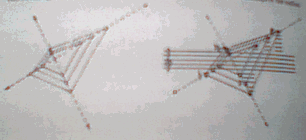
(IV)Jamming, or centrifugal shift of the basic shape, with no change in the relationship of the outline.
(V)Mirroring a basic shape on a mirror-axis (axis of symmetry). In the case of simple mirroring, the basic and derived shapes touch each other at the mirror-axis (vertical mirror is also called retrograde).
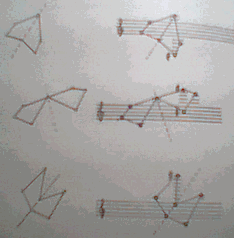
We list the following coupled categories:
?Screwing, as a coupling of straight line and circular line and circular shifts around a screwing point and a constant axis of translation.

?Rotation develops really as a changed principle of screwing-when one represents time as a (straight-line) sliding axis. If one hears successively the basic shape and a shape derived from it, this has the effect, temporally, of a turning in a certain direction.?
?Rotation and mirroring as a turning of the basic shape around one turning point and one mirror-axis
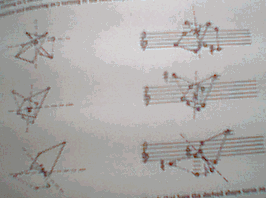
?The difference between this and the usual sort of rotation is that here the derived shape turns on top of the basic shape.
?Rotation and spreading as a circular and centripetal shift (with regular or irregular growth of the basic shape) around a spiral axis.
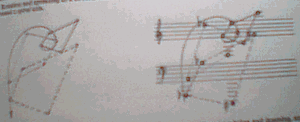
Other coupled categories of movement could be: mirroring and spreading, translation and jamming, screwing and spreading, etc. All these categories of movement can be interpreted from the most various points of view. An investigation of all the combinatorial possibilities of these categories can only be justified by the intention to include them in a composition. In the main text of this article we have tried to dispense with a comprehensive and systematic treatment since, in view of the multiplicity of the resulting connexions, there are is no room for such a development within the framework of this treatise. Our experience is based mainly on translative and rotative forms of shift (in the electronic piece ‘Transicion I’ and its instrumental pendant ‘Transicion II’); these therefore are the object of our analysis.
?For a complementary acquaintance with the principles of alteration of basic shapes the following literature can be recommended: La Symetrie et ses Applications, Jacques Nicolle, Paris, 1950; Gestalt und Symmetrie, K. L. Wolf and D. Kuhn, Tubingen, 1952.
?Even today a large part of musical thinking rests on symmetrical treatment of the material, and the effect of this on the formal elements. The difference between our attitude and earlier ones is that we now prefer the higher stages of symmetry. So we no longer have to find a ‘golden mean’ to which everything can be referred; in present day composition we can achieve the highest equilibrium by means of a ‘wandering mean’.
5 The classical method or regaining the past in a piece of music is the reprise. Even when a reprise is varied it is not difficult to achieve the desired association with the music heard previously. No other method of accommodating the past in music is possible, without the use of repetition, for the ‘experience of the past’ consists above all in re-animating or bringing to mind the events, shapes and sounds (organized or not) that have already been heard previously.
?Even if repetition were not an element of musical syntax that is difficult to incorporate into our present day musical language (chiefly on account of its aesthetic coloration), yet a revolution seems possible. The strength of something re-experienced depends on the degree of variation of the reprise, on the new context in which it appears, and also on the memory of the listener. These three factors can form a basis for new principles of organization, if we consider not only, musical elements but psychological ones as well. A reprise carries particular weight in the form, as even a ‘quasi-reprise’ if a section has to be chalked up on the account of ‘formal articulation’; in such a case the ear performs of its own accord no mean poetic feat: it supplies the rhyme. (Perhaps that is why the favourite form in musical education is the Rondeau; making music is at the same time practice for the language lesson. L) But there are aspects of repetition that- by means of coupled categories of movement containing translation-open up new vistas. A reprise of ‘A’ need not necessarily awaken (either in the composer or the listener) an automatic sense for formal organization by way of the association with the preceding ‘ A;. By presenting this ‘A’ simultaneously with a new event ‘B’ the intensity of our perception of what we have already heard is made dependent on the structural significance of ‘B’ and the duration-connection between the one section and the other.
?In electronic music repetition and transposition are included and recognized as basic processes of composition. The transposing tape-recorder (which influences both pitch and duration) is one of the most important instruments in the studio. The unfolding of a sound-object on a variable sliding axis stimulated particular forms of transformation. Higher and shorter, or lower and longer can be coupled; the mechanical aspect of the method produces specific counter-methods for de-mechanizing the rigid schema. Therapeutic methods such as these in composition with electronic sound-processes can have an influence on the solution of analogous problems in instrumental music; where serialism has a traumatizing effect, one is justified in taking up with other determinations.
6 We do not wish to identify note-dots with notes on the stave, on account of certain processes that are better expressed in terms of cps. In the following examples we do not retain the even temperament based on the interval 12 root 2; nonetheless it is possible to present these processes in terms of the usual notation. Movements of notes always correspond to temporal changes; it makes no difference to the chronology of a sequence of note-dots whether it is expressed as frequencies or as notes
7 An angle of <30 between the axis and the <0 –position serves not only to establish the position of a point on the straight line; it corresponds as well to 30/360ths of the total duration that has been fixed for a single, complete rotation. The superposition of several different simultaneous speeds of rotation can determine the superposition of various different total durations, so that the angles that are used do not depend on a common duration, but on the rhythm of rotation that is achieved in each total duration. This leads to a system of rotation in which the individual rotations are components of a total process of rotation.
8 This new morphology can perhaps be described as ‘…how time might pass…’ as a continuation of its real passing (see Stockhausen’s article in ‘Die Reihe 3").
9 In the last two pages of his ‘Harmonielehre’ (Third edition, 1922) Schonberg indicates the necessity of investigating the function of timbre. In his remarks he attacks the separation of pitch and timbre as two distinct properties of sound. ‘The pitch of the sound is nothing other than timbre, measured in one direction." The consequence to be drawn from this remark is that timbre is to be measured, and based on a logic ‘quite equivalent to the logic that suffices us in our dealings with melodies of pitches’.
?It is remarkable that Schonberg does not mention the third of his ‘Five Orchestral Pieces Op. 16’ as an example of his experiments in measuring. Here his investigation of the ‘harmony of timbres’- as one might call it- leads to the first result of the problem of a static-harmonic structure that is only articulated by means of dynamics, and is defined by the ratio between the timbre and the register of the instrument concerned. This is the reason for Schonberg’s underlining, in this third piece, the ‘unbalanced sounding mixtures’, which must not be leveled off.
?The application of a block dynamic-i.e. a dynamic value that serves as a common denominator for all the instruments and in most cases does not represent an absolute dynamic value (ppp in low register of the flute does not have the same value as the cor anglais’ ppp in the same register, ect.)-underlines the relative character of a chord in relation to the overlapping and cohesion of the various timbres that it is made up of. Treaties on instrumentation occupy themselves with investigation the variety of different characters that a chord can have according to the way it is instrumentated. We do not wish to get involved in this question here, since timbre is an element ‘that serves to…". In the last paragraphs of his Harmonielehre, Schonberg presents a chord consisting of eleven different notes, taken form ‘Erwartung’:’its effect is very soft, on account of the delicate instrumentation and the fact that the dissonances are placed very far apart’. In this example it is debatable whether the ‘softness’ of the harmony is the result of placing the individual notes of the chord far apart from one another. Any real mildness is effected by the dynamic level pp and solo instrumentation. Re-instrumentated in ff, with piccolo E-flat clarinet, trombone and xylophone (among others) the chord would be deprived of any appearance of mildness.
10 In his Zeitmasse Stockhausen articulates certain chords by means of different dynamics curves for each instrument. The danger of a static harmony is in this way obviated by a constant kinesis in the dynamics. The chord is thus ‘coloured’. In the course of the work this method can be found by analysis to constitute an element which is subjected to the scale of changes which the composer uses to organize his material. A gradual multiformity of the dynamic aspect is to be remarked in every new superposition of long held notes, and this articulates an increasing ‘density-flow’. The density of this change of timbre is determined by the absolute duration of each chord-which depends on the temp-and by the chosen range of the scale of dynamic value are clearly perceptible in ‘Zeitmasse’; therefore this process becomes a matter of paramount importance for the composition.
11 Quoted from memory (Bertrand Russell ?)
12 See footnote 1
listening:
"Panorama des Musique Experimentales". Mauricio Kagel 'Transition 1'. Philips Modern Music Series. France 1962
kagel2.mp2"approx 2 Mb