During the sixties Europe was divided between east and west. Though the end of world war two brought peace, it left the stinging animosity of the cold war. These differences centered around economic and governmental societal organization, the communist socialists verse the capitalist democrats. With the threat of "nuclear holocaust" violent conflict was appealing to neither side, one way that the tensions manifested themselves was "a cold war of culture," competitive antagonism in the world of the arts. Differing socio-political beliefs correlated to differing concepts of avant garde music. These Differences lending variety and diversity to the world of music.
Avant garde is classically defined as bucking the trend, going against the grain, or doing something outside of the norm. It stands to reason then that in civilizations where there are different norms there would be different definitions of avant garde. To borrow the terminology of economics: in capitalist Western Europe a socialist would be considered abnormal. Cardew is accepted as an avant gardist for his creation of "revolutionary" socialist workers songs in the UK. In eastern block nations where the ruling party came into power through the communist revolution, avant gardists are seen as "counter revolutionaries," capitalists in a socialist setting. Thus far we have contrasted these two groups in terms of location and using economic policy as a setting to draw out subtle differences of perspective.
Now let us consider social relevance from a musicological perspective. A musicological perspective I would define as being time rather than location relevant. In musicological terms the avant gardist would be one who is furthering the advancement of musical form, or is on the forefront of new musical ideas and practices. To see who these seemingly opposing sides can be classified together as the avant garde, let us compare these groups in terms of movements found with in European art music, or classical music during the sixties.
Let us concentrate on several areas of progress happening within the world of classical music: notation of scores i.e. graphical, development of new timbres, and music theory. The most traditional method of visually representing music is through the use of score writing, but as music expression evolves scores must adapt to relate the new, previously unused, musical techniques. Musical notation also must evolve as new ideas about the structure of music change, so that these ideas can be represented on the page. Technology influences musical timbres by creating new instruments or modifying existing ones. A technological advancement of the time is the emergence of electronic music, a form of music still very much in the early stages during the 1960s. Electronic music represents a new type of music in that it came about thanks to advancements in the sciences creating new instruments. New musical techniques also create new timbres as traditional instruments are used in new ways creating previously unheard of sounds. Finally analytical techniques for creating quantifying music or contributions to the world of music theory constitute musical progress. At this time most of the new music theory research can be represented by the post Schonbergian school of serialism. Even though Schonberg and his students such as Webern were not unique to this time there theories were and are still very much at the for front of new music theory. The classical music world moves very slowly, as there is a long process of refinement and acceptance, thus serialist music research in the sixties can still be seen as avant guardist. It is important to look at these forms of progress, as they can be very reflective of the society and culture in which they were fostered.
Mauricio Kagel can be seen as representative of the western European school of avante guard music, the "revolutionaries." Though born in Buenos Aires, by 1957 he had moved to Cologne. Between 1960 and 1966 he was a visiting lecturer at Darmstadt, one of the most important western music centers of learning. In 1966 he accepted the Koussevitzky Prize. In 1969 he was awarded the Karl Scuka Prize of southwest German Radio for his play "Aufnahmezustand." And in 1969 he won the city of Zurich Scotoni Prize for his film "Hallelujah." This deep penetration into the European classical music world was aided by his associate and publicists Karlheizen Stockhausen and Herbert Eimert, two individuals who are unquestionably leaders of the European avant garde and greatly affiliated with the cologne school of music.
Kagel’s connections in Cologne were very influential on his style, and it was in Cologne that Kagel was able to create pieces of electronic music. Electronic music at this time was only possible if the expensive and rare equipment was available, and Cologne was the first and foremost research facility experimenting with electronic equipment. Kagel was smart in choosing his place in that Cologne was the center of the electronic music world; its closest counterpart being Paris, with Peirre Henry’s "Musique Concrete." The Difference between the two being that: "Electronic Music" dealt with synthesizing sounds to make new timbres, and "Musique Concrete" was recordings of everyday sounds but set in a musical context causing audiences to listen to them in a new type of way. Though initially started in the 1950s, during the 1960s both kinds of music where still new and very startling to concert hall audiences who were used to listening to orchestral instrumental sounds.
In "Transitions 1" Kagel’s use of electronic music goes beyond novelty, and in to skillful use of the new electronic resources. "Transitions 1" starts out with long sweeps pitch or abscissa. These sweeps are then followed by percussive crashing sounds. Little sound blurbles spell out sine wave melodies, and the high pitched shrieks of sirens race past. Over all the piece is fairly pointalistic with varying levels of density. The work spans from the fairly sparse to the more compact tone clusters. For the most part the piece is polyphonic with the melodies or klangs going over or in some cases under the slower moving pitch sweeps. The piece totals roughly thirteen minutes in length. At Seven minutes there is the beginning of the climax, but the release is vary slow giving the impression of opaque round shapes. This is followed by a section of vibrato pitch sweeps, which serve as a new interpretation of the previously heard material creating the sense of a recapitulation. It finally fades out with a return to the full-bodied pitches of the opening; however, now they have become disjunct, functionally serving as speckles of sound. The piece fades out.
Kagel also used notation in new ways. His advancements in notation represented new ways of conceptualizing and creating musical pieces. He manipulated scores to illustrate new ideas concerning musical understanding, and other extra musical activities. Many of Kagel’s pieces tried to incorporate the mediums of performance art and theater, but utilizing musical form and structure, by performing nonmusical acts in a musical rhythm for example. Kagel also made innovative steps forward in the progress of musical structure itself, much of these innovations come out of or are expressed through the manipulation of musical scores to form research advancements in music theory.
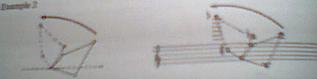
In 1960 Kagel published his contributions to music theory in the edition of "die Reihe 7 Form-Space" There he introduced his ideas of ‘translation’ and ‘rotation.’ (See appendix 1 for excerpts from this article). In this article Kagel visually manipulates the forms of traditional notation as a means of developing new music. By conceptualizing the visual representation of music in new ways he hypothesizes to create new musical structures. These representations are a combination of classical notation form and geometry. Kagel uses angular relationships to develop new variations utilizing harmonic proportions. His written publication serves as the major contribution on his part to western academic music theory.
Kagel’s theories manifest them selves in a work entitled "Ludwig Van." This piece serves as an homage to the famous German Composer Beethoven; it incorporates numerous references to Beethoven’s works, but recontextualized into a new piece. The result of this phrase-based orchestration is dodecaphony. The term "dodecaphony" was derived from an early ancient Greek 14 note modal system, but by the 1960’s it had come to be commonly defined as ‘atonlity’ or music which lacks harmony –harmonic goals-build and release of harmonic tension. This lack of release and harmonic goals would also make the composition fit for the pointalist classification, as listeners are encouraged to listen to harmonies present at the moment rather than in relation to a harmonic goal or key signature tonic chord. In the west this type of pointalist serialism was accepted as an esthetic, while in the east it was frowned upon and unpublishable.
In the east serialism was a very delicate matter, as its creator Schonberg had defected to the west and many eastern block composers sought to maintain their cultural identity rather than circum to what they perceived to be an inferior western dominated culture. Krzysztof Penderecki was one such eastern block composer who skillfully utilized the tools of serialism without the loss of direction or goal orientation. In this he was recognized by both east and west, and serves as a good example of eastern block composers.
Krzyszstof Penderecki (b. Debica, Poland 1933) studied during the 1960’s at the Krakow Conservatory. During the 1960’s he had two major works: "Anaklasis" written for the 1960 Donavenschingen Festival, and "St. Luke Passion" 1963-5. He taught composition at the Volkwang Hochschule fur Musik Essen, 1966 to 1968. In 1966 he won the Westphalia Prize, in 1968 the National Prize, first class, in Poland.
"
Schonberg sighted Penderecki as one of the most innovative avante gard composers. His music was widely popular due to his tendency towards formal unification. The form is unusually expressive and its outlines are immediately discernible: a number of different shapes flow by and are finally united in a powerful united cascade of consonant sound.""
His works use advanced vocal and instrumental effects while placing no long-term reliance on tonality. Penderecki skillfully utilizes the new sonic resources opened up by the music of Stockhausen, Boulez and Xenakis." Penderecki’s compositions demonstrate an effective amalgamation of new forms of music theory but always in the context of music that could appeal to the classical aesthetic.In his own words, "We the composers for the last thirty years, have had to avoid any chords which sound pleasant and any melody because then we were called traitors. I feel free, I don’t feel I have to do something which the people will expect from me or the critics will expect from me. Sometimes music has to stop and relax a little bit to find the other sources (with which) to continue. Sometimes it’s good to look back and learn from the past."
In his major work "Anaklasis" Penderecki uses the bold gesture of uniting melodic lines in parallelism and unison bringing goal orientation by an expanding and contracting of the harmonic relation between the melodic intervals. Penderecki uses dynamics and dissonance to create tension, which is released by harmonicity and still further dynamic transformation. Penderecki manages to utilize the techniques of the day but always keeps a reference to the timeless musicality.
Penderecki’s life in the east effected his musical development especially during the earlier stages of his career known as: "Exploration and Experimentation: the search for new musical language… the works which were composed between 1956 and 1962 will reveal that Penderecki was searching for new sounds. The very fact that Poland was isolated from the rest of Western Europe in the period after the war (1949-1956) gave him the unique opportunity to develop his own style.’
"Some have called this period in Polish music Farbmusik (lit. colour music), in which a distinctively experimental, avant – garde idiom produced new instrumental and vocal timbres. Some of the characteristics of this new style are free serialism (Psalms of David), three line tempo graph (Anaklasis), time – space notation (Dimensions of Time and Silence), semi – tonal clusters for sound density (Threnody), and new timbres from stringed instruments (String Quartet # 1)."
During his experimental phase: "Frabmusik," Penderecki made contributions to the world of timbre. Many of his pieces "Anaklasis" for instance utilize extended musical techniques especially for strings. Some examples of these extended techniques for strings include: play between the bridge and tailpiece; arpeggio on four strings behind the bridge; (percussion effect) strike the upper sounding board of the violin with the nut of the finger-tip; and playing on the bridge by bowing the wood of the bridge at a right angle at its right side. Given the musical resources at hand Penderecki sought to breathe life into the concert hall by bringing new instrumental timbres. Penderecki’s accomplishment’s in creating new musical timbre’s is not their invention, but rather their effective use and implementation.
Part of Penderecki’s skillful implementation of these extend music techniques was the development of a notation system to represent these ideas on the graphic score. (See appendix 2 for examples of Penderecki’s extended musical technique notation). What made these new symbols work so well was that they were an addition to the forms of notation that most musicians were already familiar with. These new musical symbols could fit onto the traditional musical stave without obscuring its meaning. Musicians only had to learn a few new symbols when interpreting Penderecki’s pieces, and the rest utilized the system structure which they were already familiar with. This meant less time was wasted mapping out abstract musical means, leaving more time for the refinement of interpretation need to create master works.
Mid way through the 1960’s Penderecki’s experimentation phase had been completed and he was to begin a new period where he really developed and refined his compositional voice, "Here he was taking a new path, but not without some backward glances: new sound – surfaces entered into meaningful relationships with traditional elements of form (St. Luke Passion), melodic materials in Gregorian style blended with boldly inventive layers of sound (stabat Mater), and the earlier experiments in controlled rhythm settled into a more indeterminate rhythmic character (De Natura Sonoris # 1). In this period, serialism as a tonal context is abandoned for modal, diatonic and quarter tone material, the sometimes fragmented sound events of earlier years flower into polyphonic idioms, and a generally more evenly balanced style emerges"
Penderecki’s move away from serialism towards modal tonality shows evidence of the over arching trend of avant garde music of this time. The densities of serial complexity in the progression of musical style would eventually yield to the ideas of minimalism. For Penderecki minimalism meant the simplicity of choral voices housed with in stone walls. With the numerous modal systems present in Eastern Europe ample compositional material is available for the composer working with these harmonic context.
This richness of diversity between differing approaches to musical composition only concretizes the true broad spectrum of musical study. Even within the context of western art music after so much research and development has taken place, expansive new vistas of musical research extend to the horizon on all sides. All the different approaches and evolution of approaches serve to lend the essential diversity of music that makes music study interesting by eliciting the multitude of possibilities for variation and progression.
Appendix 1: Description of Kagel’s principles of translation and rotation
Appendix 2: Examples of Pendereki’s notational innovations
|
Highest note of the instrument (no definite pitch) |
|
|
Play between the bridge and tailpiece |
|
|
Arpeggio on four strings behind the bridge |
|
|
Play on the tailpiece (arco by bowing the tailpiece at an angle of 90 degrees to its longer axis) |
|
|
Play on the bridge by bowing the wood of the bridge at a right angle at its right side |
|
|
Percussion effect: strike the upper sounding board of the violin with the nut of the finger-tip |
|
Bibliography:
Space Calculated in Seconds: The Philips Pavilion Le Corbusier, Edgard Varese. Marc Treib. Princeton University Press. New Jersey: 1996.
Krzyszstof Penderecki: A Guide to His Works. Ray Robinson. Prestige Publications, Inc. Princeton, New Jersey: 1983.
The New Grove Dictionary of Music
. Stanley Sadie. MacMillan Publisher. Hong Kong: 1980.Music and Musical Life in Soviet Russia. Schwarz, Borris. Indiana University Press. Bloomington: 1983.
"Die Reihe. 7 Form – Space" Herbert Eimert and Karlheinz Stockhausen. Theodore Presser Company. Pennsylvania: 1965.
Amy C. Beal, "Negotiated Cultural Allies: American Music in Darmstadt, 1946-1956," Journal of the American Musicological Society 53, no. I
"Panorama des Musiques Experimentales" Mauricio Kagel ‘Transition 1.’ Philips Modern Music Series. France: 1962
"Ludwig van. Hommage von Beethoven." Mauricio Kagel. Duetsche Grammophone Gesellschaft. Vienna: 1970.
"20th Century Music Composers" [email protected]. http://www.emory.edu/MUSIC/ARNOLD/penderecki_content.html
"
Krzysztof Penderecki: New Notation" Alex Newman. University of Southampton: 1997 http://www.soton.ac.uk/~modsem/alex_4.htm