HISTORY:
Podolia has been inhabitated since the early Neolithic period. Graeco-Scythian,
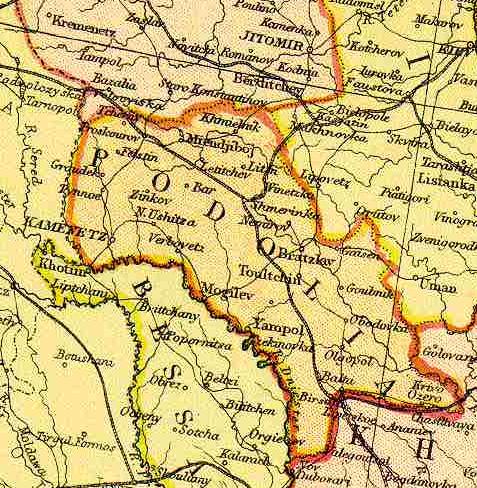 Dacians and
Romans left their marks and traces, and later Slavic tribes
and Avars too. Prince Oleg of Kiev (IX Century) extended his rule over
this
territory, wich became afterwards part of the Ruthenian principalities
of Volhynia, Kiev, and Galicia. In the 13th century, the Mongols
plundered the region; a hundred years later Prince Olgierd of Lithuania
freed it from their rule and annexed Podolia to his own territories.
Polish colonisation began in the 14th century and after the death of
the Lithuanian prince Vytautas the Great (1430) Podolia became part of
the Polish Crown, with the exception of the Province
of Bratslav, which remained in Lithuania until 1569. Ottomans occupied
Podolia in the years 1672-1699, then Poles retained Podolia until the
partitions of their country in 1772 and 1793. Between the years
1793-1917, the Habsburg Monarchy of
Austria and Imperial Russia annexed the western (sometimes referred as
Southern Podolia) and eastern parts (Подольская губерния = Podol’skaja
gubernija]
respectively, although Polish gentry continued to maintain local
control over a serf population primarily ethnically
Ukrainian. In 1906 Podolia's population of 3,543,700 was chiefly of
Ukrainians with a 31.5% Polish minority, 12% Jews, as 50,000 Moldavians
(Romanians), some Germans, and a few Armenians. With the collapse of
Austria-Hungary following WW I western Podolia was
included in the West Ukrainian People's Republic, but came under Polish
rule until WW II. In 1939, after the signing of the
Molotov-Ribbentrop Pact between Nazi Germany and the Soviet Union and
the Soviet invasion of 17 September 1939, the area became part of
Soviet Ukraine. Many local inhabitants were deported to concentration
camps. Following German invasion of the Soviet Union in 1941, most of
Podolia was occupied by Nazi Germany and incorporated into the
Reichskommissariat Ukraine. The area of Podolia between the Southern
Bug below Vinnytsia and the Dniester was occupied by Axis Romania as
part of Transnistria. In 1944 the Podolia again fell to the Soviets and
in 1945, when Poland’s eastern border was formally realigned along the
Curzon line, the whole of Podolia remained in the Ukrainian Soviet
Socialist Republic. Most remaining Poles and those Jews that survived
the Holocaust fled or were expelled
to the People's Republic of Poland.
Dacians and
Romans left their marks and traces, and later Slavic tribes
and Avars too. Prince Oleg of Kiev (IX Century) extended his rule over
this
territory, wich became afterwards part of the Ruthenian principalities
of Volhynia, Kiev, and Galicia. In the 13th century, the Mongols
plundered the region; a hundred years later Prince Olgierd of Lithuania
freed it from their rule and annexed Podolia to his own territories.
Polish colonisation began in the 14th century and after the death of
the Lithuanian prince Vytautas the Great (1430) Podolia became part of
the Polish Crown, with the exception of the Province
of Bratslav, which remained in Lithuania until 1569. Ottomans occupied
Podolia in the years 1672-1699, then Poles retained Podolia until the
partitions of their country in 1772 and 1793. Between the years
1793-1917, the Habsburg Monarchy of
Austria and Imperial Russia annexed the western (sometimes referred as
Southern Podolia) and eastern parts (Подольская губерния = Podol’skaja
gubernija]
respectively, although Polish gentry continued to maintain local
control over a serf population primarily ethnically
Ukrainian. In 1906 Podolia's population of 3,543,700 was chiefly of
Ukrainians with a 31.5% Polish minority, 12% Jews, as 50,000 Moldavians
(Romanians), some Germans, and a few Armenians. With the collapse of
Austria-Hungary following WW I western Podolia was
included in the West Ukrainian People's Republic, but came under Polish
rule until WW II. In 1939, after the signing of the
Molotov-Ribbentrop Pact between Nazi Germany and the Soviet Union and
the Soviet invasion of 17 September 1939, the area became part of
Soviet Ukraine. Many local inhabitants were deported to concentration
camps. Following German invasion of the Soviet Union in 1941, most of
Podolia was occupied by Nazi Germany and incorporated into the
Reichskommissariat Ukraine. The area of Podolia between the Southern
Bug below Vinnytsia and the Dniester was occupied by Axis Romania as
part of Transnistria. In 1944 the Podolia again fell to the Soviets and
in 1945, when Poland’s eastern border was formally realigned along the
Curzon line, the whole of Podolia remained in the Ukrainian Soviet
Socialist Republic. Most remaining Poles and those Jews that survived
the Holocaust fled or were expelled
to the People's Republic of Poland.PODOLIA AND HER JEWS
Acording to some sources, Podolia's earliest Jews were Sephardi or Oriental coming from Italy, Greece, Turkey or even Judea itself during Roman Conquest. In the 1400's, Ashkenazi Jews from Germany and Poland arrived and by late 1500's, when most of the Ukraine was annexed to Poland, Jews began to come in significant numbers. By 1569, approximately 750 Jews lived in 9 localities in Podolia. By 1648 (the year of the Ukrainian revolt led by Khmelnitsky) there were approximately 4000 Jews living in 18 localities. The Jews in the 17th century filled a middle class economic position between the Polish landowning aristocracy and the Ukrainian landless peasants, therefore being identified by the lower classes as accomplices to the Polish ruling class and therefore equally hated. The Khmelnitsky revolts, largely directed against Polish rule in the Ukraine, equally victimized Jews in it's barbaric destruction. In the period 1651-1655, tens of thousands of Jews were murdered in the Ukraine and eastern Poland and they were virtually eliminated from Podolia. Massacres occurred in Bar, Kamenets Podolsk and Polonnoye. Podolia came briefly under Ottoman control in 1672 and was reacquired by Poland in 1699. Poles and Jews returned to Podolia, the Poles as rulers and the Jews as the local administrators, merchants, innkeepers and petty traders. Jews lived a separate religious and national life, with their own virtual government within a government as they were prohibited from participating in the civic government created by the Poles. The Jewish leadership, known as the Kahal, had complete authority over the Jews and was responsible for collecting taxes and remitting them to the Poles operating, in effect, as a parallel institution. By 1765, there were approximately 45,000 Jews living in 554 towns and villages in Podolia. Life for them was relatively peaceful insofar as persecution by the Poles or Ukrainians was concerned. The grinding poverty and religious and cultural depravation of the region gave rise to the birth of Chassidism in Medziboz, Podolia, led by the Baal Shem Tov. But life was going to change irrevocably due to a "change of owners' of the land. Poland's progressive weakness in the 18th century made her gradually loose chunks of her territory to the Superpowers surrounding her: Prussia to the west, Austro-Hungary to the south and Russia to the east. In 1793, Russia annexed a part of eastern Poland, including Podolia. Russia created Podolia as a gubernia (province) of Russia. In 1804, a statute was passed that, among other things, required the Jews to acquire family names. The Kahals were initially accepted and recognized by the Russian government, largely because many of them had large, outstanding debts to Christian institutions and the government wanted these debts repaid before the Kahals were abolished. The Kahals were used by the government to collect these debts, collect taxes and, later, to enforce various Russian laws directed at the Jews. In 1827, Czar Nicholas I introduced the draft for the Jews (by 1856, Jews were a greater proportion of the Army's soldiers than they were of the general population). Jews were drafted at age 18 and served for 25 years. Some Jews were taken from their parents at age 12 for 6 years of preparatory training (these recruits were called "cantonists") prior to commencing their military service. Substitutions for draftees were allowed who also had to be Jews; in this way, the wealthier Jews were often able to bribe their way out of military service and the poorer Jews were even more victimized. The administration of the draft was the responsibility of the Kahals, causing much dissension and resentment within the Jewish communities and undermining their internal solidarity. Because one of the major objectives of the draft was conversion to Christianity (Russian, or Greek, Orthodoxy), the techniques employed by the Jews to evade the draft were many, varied and often drastic. The Russian conscription law also spawned the development of a new profession, that of the informer who reported to the authorities on efforts by the Jews to evade the draft. The Kahals were abolished in 1844 and the Jews came completely under Russian law. In 1856 the draft of cantonists was abolished and conversionist policies were ameliorated. Children were permitted to return to their parents if they had not been converted; those who converted were placed with reliable Russian Orthodox families. The census of 1840 counted 115,143 Jews in Podolia, out of a total population of 1,691,928 (about 7%). A similar census in 1888 counted 325,907 Jews out of a total population of 2,470,142 (about 13%). In 1897, a detailed census found the Jews to be 12.3% of the total population of Podolia. The peak proportion of Jews to the total population was likely about 13% as about half of the emigrants from Podolia in the period between 1881 and the outbreak of WWI are believed to have been Jews.
For most of the 19th century, the Poles were the dominant class in Podolia, being most of the landowners, factory owners and intelligentsia. The middle, or merchant, class was predominantly Jewish, and the agrarian, or peasant, class was almost exclusively Ukrainian. Relations between the Poles and Ukrainians, to the extent that there were any at all, were poor; the Jews often found themselves caught in between. Accordingly, conflicts between the Polish and Ukrainian peoples inevitably led to Jewish pain and suffering as both accused the Jews of siding with the other. Whenever it suited the Russian rulers, they exploited these inter-ethnic tensions, occasionally permitting and even encouraging matters to "boil over". Pogroms would result, in which the Jewish population would suffer beatings, rapes, murders and looting.
While the Jews were not initially adverse to the Russian annexations, having suffered considerable persecution under the Poles and believing the Russians couldn't be any worse, by the 1880's life in Podolia for the Jews (and, only to a slightly lesser extent, everyone else as well) had become highly problematic and virtually unbearable. The year 1881 saw the beginning of severely repressive laws directed specifically against the Jews. The economic improvement of the Jews' lot in the previous 20 years, during Alexander II's rule, was abruptly ended under Alexander III's rule. Restrictions were placed on the Jews' ability to earn a living and where they could live; pogroms became commonplace. Authorities, under instructions from above, stood by while Jewish homes and businesses were vandalized and Jews were beaten, raped and murdered. One of the long-stated objectives of the Russian government was now being achieved: emigration of the Jewish population. In the period 1881-1914 several millions of Jews left Russia for other parts of the world, primarily North America. Many of these emigrants came from Podolia, where several pogroms occurred. In the early 1880's a number of pogroms occurred throughout the Ukraine, 63 of which were in Podolia. Repressive government measures following the assassination of Czar Alexander II, which took place on March 1, 1881, and for which the authorities unjustly blamed the Jews, precipitated the pogroms and caused so much suffering amongst the Jewish population in the Ukraine that many chose to leave the country. Economic restrictions imposed on the Jewish population by the Russian government were almost always at the instance of, and in order to pacify, Ukrainian and Polish citizens who claimed that they could not compete, without the restrictions, with their Jewish neighbours. Not only the Jews, however, were dissatisfied with their lot in life in Czarist Russia. While Jews for the most part were displaying their disillusionment in the late nineteenth century by emigrating, some joined their gentile neighbours in the various revolutionary movements prevalent at the time. Central authority was weakening, as became particularly evident in Russia's defeat in the war with Japan in 1905. The government attempted, with limited success, to blame this defeat on the Jews, notwithstanding the uncontroverted fact that a disproportionate number of Jews served in the Imperial army in the war against Japan. Pogroms occurred throughout the Pale, 37 in Podolia. Such outrages are reported to have occurred in November and December, 1905 in Kamenets Podolsk, Zhmerinka and Bershad. Some Jews decided to fight back, resulting in the organization in Podolia of self-defence units. Jews also continued to emigrate at record levels, until it was halted by the outbreak of WWI.
Prior to the beginning of WWI, Podolia was the most southwesterly gubernia in Czarist Russia. Podolia's western boundary bordered on Galicia, which was part of the Austro-Hungarian Empire; her souther boundary bordered on Bukovina, also part of the Austro-Hungarian Empire. Czarist Russia and Austro-Hungary were enemies in this conflict and much of Podolia was occupied, firstly by Austro-Hungarian forces and later by German forces. Before the war officially ended, Russia withdrew from the conflict as a result of the onset of the Revolution. Shortly thereafter, the war ended and Germany and Austro-Hungary were defeated. Podolia was evacuated by the Germans and Austro-Hungarians, leaving a vacuum insofar as governmental authority was concerned. For the next 4 or 5 years, anarchy prevailed as various factions, amongst them Ukrainian nationalists and Russian Bolsheviks, fought each other for control of the region. Those few Jews who participated in the struggle for control of the Ukraine in the period 1917-1922 were mostly on the side of the Bolsheviks, though a small number threw in with the Ukrainian nationalists. In July, 1917, the provisional Ukrainian government declared its independence from Russia and granted autonomy to all minorities within its boundaries. The initial reaction of the Ukrainian Jewish communities was positive; however, the Kerensky regime, then in power in Moscow, and the Bolshevik regime which followed it both opposed Ukrainian independence. The seizure of power in Moscow by the Bolsheviks led to anarchy throughout the former Czarist empire, including the Ukraine, and Russia shortly thereafter invaded the Ukraine to put down the independence attempt. The majority of the Jews took no position in the dispute between the Ukrainian nationalists and the Russian Bolsheviks, rightly having come to the conclusion that none of the combatting factions offered them anything better than the miserable life they already knew under the Czars. There were numerous pogroms in this period as well, resulting in many deaths and further impoverishment of the Jews. Before 1919, the pogroms primarily occurred in the cities. After 1919, they were more prevalent in the villages. Again, the Jews were unfairly accused, this time of being pro-Bolshevik and anti-Ukrainian. Jewish self-defence organizations were established in many cities, towns and villages, as once again the "ruling" authorities were either unwilling or unable to prevent attacks by the various factions on the Jewish population. The defeat of the Ukrainian nationalists by the Bolsheviks was followed by numerous terrible pogroms against the Jews in the Ukraine; these actions were most often led by Ukrainian soldiers supported by Ukrainian civilians, and were "justified" as retaliation against the Jews for their support of communism. Of the three periods in which pogroms occurred in Ukraine, the worst period was from 1917-1921. In Podolia alone, 213 pogroms are recorded, the vast majority of them having been committed by supporters of one or another of the various Ukrainian nationalist movements that were operating at the time in the region. The Bolsheviks ultimately emerged as the victors of the conflict and the entire Ukraine shortly thereafter underwent a harsh, involuntary and forced adaptation to Communist domination that, some 75 years later, it has yet to overcome. Agrarian reform, for example, starved millions of Ukrainians, amongst them the Jews, to death. Many people were forced to emigrate from Ukraine to other parts of the USSR; emigration abroad was severely restricted to the point that very few people even attempted to leave the country.
The Jews of Podolia at the beginning of the Communist regime were for the most part town and village dwellers engaged in small businesses as tradesmen and petty traders. Communism virtually eliminated all of these occupations, causing the Jews to leave the small towns and villages for the cities where they sought work in factories and government-run stores as labourers and clerks. In the 1920s, some Jews were able to emigrate abroad. While western Europe and North America were largely closed to these emigrants in this period, South America, Argentina and Brazil in particular, were relatively open. Life was hard in Podolia in the 1930s as well as before, but political stability had by then been achieved, at a terrible cost in lives and dislocation. As part of the overall Communist plan, agriculture was collectivized and the middle class was abolished. The economic impact on the Jews of Podolia and their Ukrainian neighbours was catastrophic. The abolition of any religious practises other than Communism resulted in the closing, by the end of the 1930s, of virtually all of the synagogues and other Jewish institutions. Traditional Jewish life, as it had existed in Podolia for hundreds of years, by 1939 virtually ended. The vast bulk of the Jews were now proletarians who, but for their names and language (Yiddish) were indistinguishable from the other people in whose midst they lived.
In September, 1939, Germany invaded Poland from the west and, shortly thereafter, ostensibly for security and safety reasons, but in fact as part of a previously arranged pact with the Nazis, the Soviet Union entered Poland from the east. Germany and the USSR divided Poland between them and, for a time, eastern Poland was under Soviet domination. Almost two years later, in late June, 1941, Germany and her allies (Hungary and Romania, in particular) attacked eastern Poland and quickly advanced through this region and into the western Soviet republics, including the Ukraine. WWII came to Podolia in July, 1941. By the time this war ended, not only did Jewish life end in Podolia; the Jews, as a people, were identified, segregated and murdered by the German occupiers to such an extent that, after 1945, not even a semblance of Jewish life remained.
Germany and the USSR divided Poland between them in the fall of 1939. This move ended Poland's existence as an independent country and extended Soviet Russia's western boundary westwards to include Galicia. Jews seeking to escape German occupation moved from German-occupied Poland to Soviet-occupied Poland and thence to, among other regions of the USSR, Podolia. These Jewish newcomers were more religious and familiar with Jewish culture, customs and traditions than their Podolian brothers and sisters; they had not been subjugated in Poland to the same kind of Communist indoctrination that destroyed Jewish life in Podolia. Jewish life in Podolia in the period 1939-1941 was briefly invigorated by these newcomers, but this interlude ended with Germany's invasion of the Soviet Union in June, 1941.
Part of Germany's plan for the invasion and occupation of the USSR included the extermination of all of the Jews; therefore, not long after the beginning of the invasion, the outright slaughter of the Jewish civilian population of the occupied lands took place. The vast bulk of Podolia was occupied in the first few months of the invasion, by Hungarian and German forces. The organized murder of Jewish civilians was undertaken by special German forces, known as Einsatzgruppen, with assistance from regular German forces as needed and from local collaborators, of whom there were many. Jews were typically taken from their homes in the towns and villages of Podolia and led out of town to pre-prepared sites where they were stripped, lined up and shot, and then buried in mass graves. In some towns and villages, ghettoes were set up and able-bodied Jews were kept for slave labour, only to be murdered later, in the same fashion as the earlier "actions". The occupation of Podolia lasted until April, 1944, approximately 33 months. In that period, the Germans "succeeded" in destroying forever the Jewish communities that had existed there for centuries. The few survivors of these communities were persons who managed to evade occupation by evacuating to the east far enough to never be subjected to German rule. Most of these survivors either never returned to Podolia or, if they did, they left soon after they returned. They saw that nothing was left from before WWII, not even the cemeteries of their ancestors, let alone the friends and relatives they had left behind.
The continuing urbanization of Soviet society after WWII pretty much eliminated what little there was of a Jewish presence in the small towns and villages of Podolia. Then, in the 1970s and 1980s, with the advent of permitted emigration to Israel and the USA, those few remaining Jews who were still alive and living in these areas left and Jews virtually disappeared entirely from rural Ukraine. Visitors to these places in the 1990s can find almost no evidence whatsoever of the Jews' former presence, notwithstanding that they once comprised anywhere from 30% to 75% of the population in the small towns of Podolia.