BARGING ON INLAND WATERWAYSBUSINESS PLAN - Part 2© Copyright Dr Milson Macleod 1999 |
COMPARISON WITH EXISTING PRODUCTSTHE COMPETITION (NON-BARGE)
The Competition:
- The transportation industry is still largely dependent upon the petroleum industry, and consequently high or erratic fuel costs, although some sectors are slowly turning to energy-savings systems.
- Relatively short asset life, requiring more frequent capital expenditure.
- Subject to delays through heavy traffic, accidents or severe weather conditions, thus failing to meet deadlines.
MODE Asset
LifeDiesel litres
per100km
per ton carriedPerformance
Kg/1 PSTon distance
(*1) per
Energy UnitExternal
Costs
(*2)Energy
UsageCO2
Emissions
gm/ton/kmTRUCK 10 yrs 4.1 150 100km 5.01 85% (*3) 164 AIR 10% RAIL 30 yrs 1.7 500 300km 1.15 3% 48.1 BARGE 50 yrs 1.3 4,000 370km 0.35 1.2% 33.4
Notes:-
*1 Distance that 1 ton can be carried for the same expenditure of energy *2 Combined contributory costs of air pollution, accidents, noise, ground and water pollution *3 All road traffic, not just trucks
Sources:-
Die Deutsche Binnenschiffahrt Wasser- u. Schiffsfahrtsverwaltung des Bundes The River Shuttle Project OUR COMPETITIVE EDGE: The self-propelled river barge is the fast dependable, safe and economic transportation vessel of the future: immune to most traffic and weather-caused delays, and terrorist attacks (low-profile goods). Barging offers a very high price/performance ratio, highly advantageous usable weight/deadweight ratio, minimal energy requirements, relatively few crew, long-lived assets, and eco-friendly operation (no noise pollution, low CO2 emissions).
Optimal means of transportation. Has almost unlimited potential - can be used where rail or truck cannot cope with the size or weight of the cargo. On average may be slightly slower than rail or truck, but does arrive punctually. Contributes to easing the load on highways and the environment. There are no traffic bottlenecks on the waterways. The only hindrances would be a damaged lock; a collision in a restricted area; or an unusually low water-level. The safety record is unparalleled. Common uses are grain; containers; refrigeration; building materials. We would not carry dangerous goods.
One interesting feature is the environmental contribution: the movement of propellers increases the available oxygen in the water. There is also no noise pollution.
Barges have a useful life of 50 years. Advantages can be obtained by investment today in new high-tech construction, which would ensure us an edge on most of the competition.
FINANCE
Investing in this program equates to "Green Investing" or "Socially Responsible Investing" in today's business terminology, but in the new business environment no shares can or will be issued.
Financing needs have been based upon a moderate start to this project. However, the demand could well outstrip production capacity very quickly, as the first stage opens the way to a global market. The manufacturing facilities acquired initially should be suitable for future expansion. Once designs have been established for both new engines of varying sizes, and retrofit kits for existing engines, hopefully by the end of the first year, an income-flow will be established, and the excess of income over expenditure can be used to assist in further expansion.
COST OVERVIEW
The costs involved and the prices for products will vary so much that no estimate can be in good conscience provided.
We have decided therefore to budget $500 million to $1 billion for the first year of the project and to assess it further on an ongoing basis.
Eventually the operations will provide profit for further expansion.
PRODUCTS
Products will be zero-energy propulsion systems of varying sixes and retrofit kits for existing engines of all types.
There are many inventors today trying to find solutions: the most recent development proposals for automobiles can be seen at http://www.youtube.com/v/ry6w3mRm-FM or http://www.youtube.com/watch?v=RboLKikhy04 and http://www.youtube.com/watch?v=Qow9r5yhhBo/
STAFFING
Above average remuneration and benefits should attract and keep high quality technical and administrative staff, ensuring a minimum of staff turnover.
Benefits have been calculated at 10% of staff costs. It is planned to offer medical and dental plans to give added security to the families of employees, and a starting 4-week annual vacation plan. An in-house catering service is also planned for manufacturing facilities.
IMPLEMENTATION PLAN
There are three methods of surface transportation for cargo: rail, truck and sea/river. There are three basic types of commercial barges: ocean-going, tug-driven and self-propelled. In the future other types of barge might be considered.
Our target initially is the self-propelled barge. This technology can then be fairly easily transferred to propulsion systems for other barges and river-craft, as well as small motor yachts.
If new craft are built one would have to negotiate with a maritime agency to supply ship's crew (only TWO required for a barge!) and with cargo agencies for consignments. Administrative staff would be required to handle bookings and deal with crew requirements and replacements.
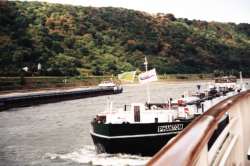
(a) Manufacture zero-energy propulsion systems for installation in self-propelled, hi-tech river barges moving environmentally-safe goods efficiently, safely, quietly and competitively from point A to point B, probably located on the River Rhine and covering the route from the Netherlands to Odessa. These may be acquired initially, or constructed from scratch with newly developed steering systems, as the currents on the River Rhine in particular are particularly strong and directional control is critical (see "A Close Call" photo below).
A CLOSE CALL Whilst a passenger on the Rhine steamer "Goethe" in September 1998, repeated frantic horn blowing indicated something seriously amiss.
Leaving the dining room I was just in time to photograph one barge overtaking another going downstream, just missing the pleasure steamer by a few feet.
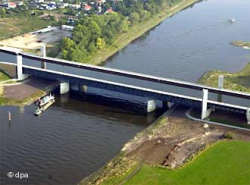
A newly built bridge allows river barges to pass at right angles.
Photos: © Copyright: Milson Macleod, 1998
(b) At the same time new propulsion systems for marine shipping will be designed and constructed and once initial tests have proven satisfactory such engines will be installed in the ocean liner "Queen of the Sea" - a project for which a Business Plan has been completed, but not yet published on the Internet.
(c) Other European river systems and the Great Lakes/St Lawrence region might also be considered.
TECHNOLOGY TRANSFER
The Consultant Engineers from the starship Capricorn have agreed to lecture on all aspects of design and construction. As they will also be helping the company E.E.M.F., this technology will be shared.
This brings up the question of who should be admitted to such lectures.
Those who have committed themselves to our program (employees and directors) will be the first to be taught, but there will be others extremely interested in learning this new technology.
The lectures will be initially under the auspices of 21st Century Science & Technology Foundation, whose Administrative Instructions will cover the procedures for lecturing and Security of Information matters involving both teacher and student.
The possibility that such technology might be used for negative purposes will be borne in mind and precautions taken to ensure that representatives of corporations or countries do not benefit from the information provided without the oversight and participation in such benefit by the Foundation.
Eventually this information will be so well-known that such precautions will be unnecessary.

back to the NESARA PROJECTS Page. © Copyright Dr Milson Macleod 1999 Contact: E-mail |
Your use of this site is subject to Terms and Conditions of Use See also our Privacy Policy |