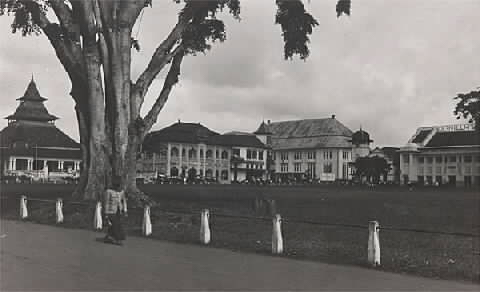
Aloen-aloen Bandung in
1930's
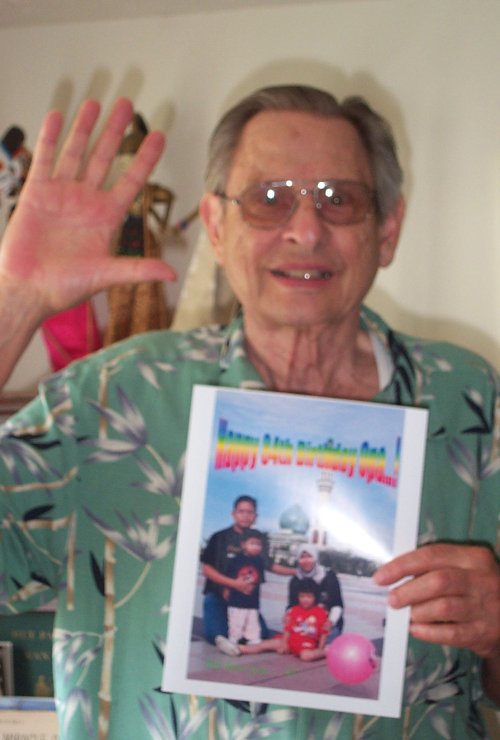
This page is dedicated for Opa (Grandpa)
Johan.
Opa Johan is one of Bandung citizen in the past. He was born in Semarang, on
1924, moved to Bandung on 1932, study in Holland on 1939-1949 period, and left from Bandung on 1954. His house in the past located in Lembangweg (Jalan
Setiabudhi) and his last office is in G.E.B.O company at Groote Postweg
accross of Alun-alun Bandung (right now Gedung PLN at Jalan Asia Afrika). Now he
lives in North Carolina, US and still remember most of details about his life
in Bandung..
Opa Johan
Please find his
interesting stories from
his emails:
In 1932 I
came to my aunty Nel (my mothers unmarried sister - school
principle – teacher English) who lived on the Helmers weg
(now: Jalan Dr Rajiman-gg) across from the branch HBS (high
school). I came with my sister from Purwonegoro (Central Java)
where my father was field manager and irrigation engineer for
the sugar plantation and factory Klampok. I loved the coolnes
of Bandung compared with the heat where I came from. I first
went to the BSV private school which was located
at the shore of the Cikapundung before the bridge to the
Bandung city center. Later
on, because of the economy
of the time (world crisis) my parents also came to Bandung and
I was moved to the government school “1 A” at the Sumatra
straat.
Meanwhile my
father, who also was an architect, built for the city
government of Bandung cheap housing for the victims of the
economy crisis from “ampas” (the compressed sugar cane
after it went through the sugar pres to remove the liquid).
Then he started to build his design of a villa for my
aunty Nel and for himself at the djalan Lembang about ten km
from the city of Bandung. The house was built
from brick and stone and solid teakwood .We the children lived with
Aunty Nel, because my father had meanwhile also a government
assignment to run a thee plantation “Sukamaju” near
Lembang. After I married and returned to Indonesia from the Netherlands I still lived in the bungalow of the big house.
You can see the picture of our big house in 1953 on the picture below. My
father standing on the gallery in front of the house and my wife Maria with
little Julia next to him. The other children in the yard are my brother's
children.
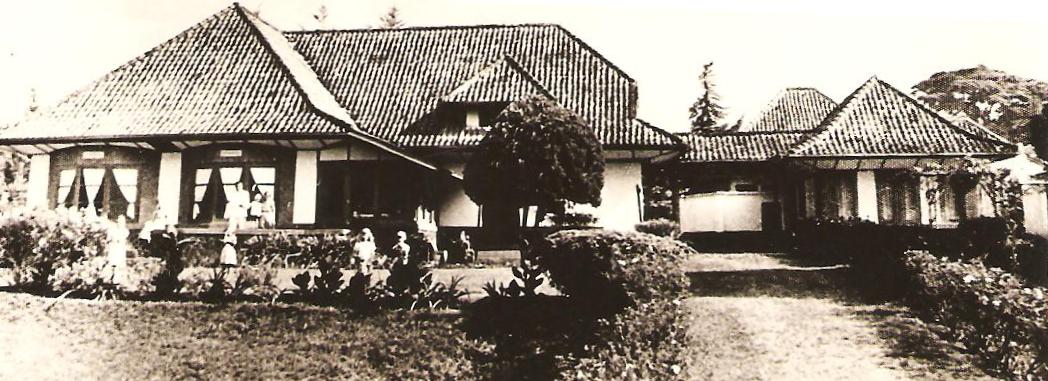
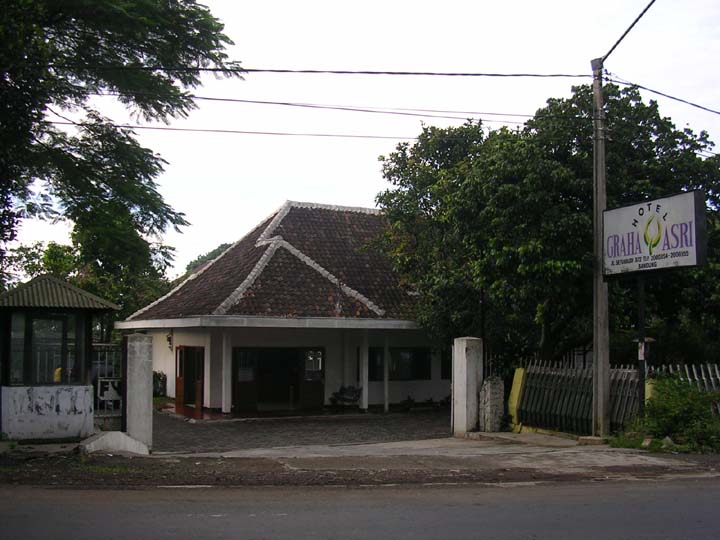
The pavilion in the right side of the picture and the bungalow, of which one sees the roof behind the pavilion have been demolished by the recent owner of what is now
Graha Asri Hotel, Jl. Dr. Setiabuhi 372. In the picture below you see the lobby of the hotel (entrance) which used to be the garage of the main building
There is interesting story
about the construction of this house, The huge teakwood logs were hand sawn at
the place and Chinese cabinet makers made the woodwork with great precision.
When the cap was in place the workers, as is tradition, placed all kinds of
fruit at the roof beams to please the spirits and bless the house. My sister
and I climbed onto the roofing beams and ate from the fruit. When, the next
day, the workers saw that the ‘spirits’ had eaten from the fruit they were
very pleased.
I have another interesting story when I was
student of Government school, one outstanding and stinking event happened on a
Saturday afternoon when I was to show up at a basketball competition back of
the school. (basketball was then played as the original game prescribed” a
real bushel basket without bottom, no backboard and on a grass lawn.. A real
challenge!). I came from km 10 on the Lembang weg (now: jalan Dr. Setiabudhi)
down with my bicycle to play the game. At one point I was close behind a truck
of the BMC, Bandungse Melk Centrale (office building of this company is still
exist at Jalan Aceh. See 1930 building's picture-gg).
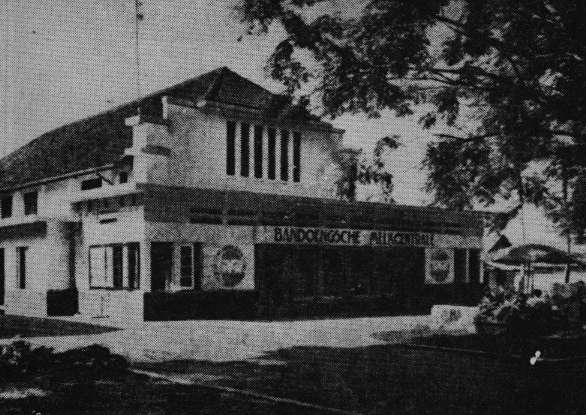
The truck was loaded with cow dung. Suddenly the
truck had to stop for something happening on the road. I could not stop fast
enough on the incline, hit the truck and was thrown over the bike into the
truck bed where I landed softly into the dung. To make the story short, the
driver was so nice to deliver me at the school. The school attendant was so
nice to hose me off and got me in the best shape he could. My play buddies,
however, would stay a mile away from me and reminded me of it for the rest of
my school days.
I left for Bandung for study
on 1939-1949 period. In the age 25th I came back to Bandung with my family and
live in Bandung with different political condition after Indonesia
Independence on 1945. Hereby below I send the picture of
us as young family on the Harley.
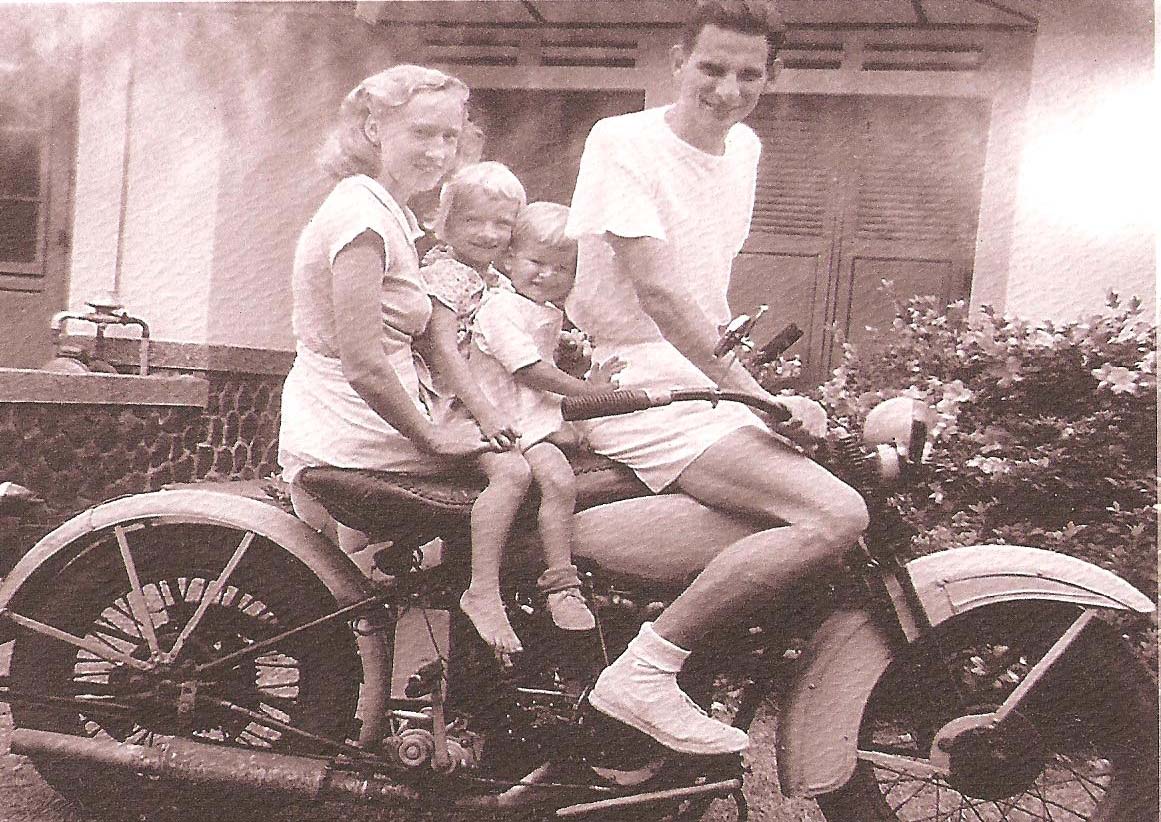
The
family on the Harley Davidson picture was taken in 1952 in
front of the Lembang house. I sit on the tank like the military
riders in WWII. I am there 28 years old. Behind me sits
Richard (2), Julia (4) and my Dutch wife Maria also 28. The
Harley is a true story in itself. I needed transport to go to
work in Bandung, but had no money to buy a car or even a motor
cycle. In the yard the japs had left a heap of car and motor
cycle parts. I found half a motor engine I recognize as that
of a 1927 Harley Davidson. 1000 cc head side valve. It was
full dirt and worms crawling out. It had only one cylinder
left that was frozen to the piston. That was what I started
with. My father (architect and engineer) said that I never
could do anything with that piece of junk. My brother
Arie (engineer) said the same. My cousin Leo Beretty ( student
engineer at your university) said that it would become a very
dangerous machine if I ever could make something out of it. I
was stubborn and a smart elik. To make a long story short. I
keep on collecting parts from benkels junk yards and even
the passar maling in Bandung. From all the parts I collected I
could use about one third. So this is how I built a very
useful, very trustworthy and very powerful vehicle that gave
me and my family the best service during my last years in
Indonesia. The frame was 1922. The engine was 1927 and
completely built up from scratch. The tank was old and leaking
and I repaired it by soldering a new skin over the old. The
gearbox was from a side span motor and I had to block the
reverse gear. I bought that in the passar maling in Bandung for
19 rupiah. ( tawar, tawar). The steering bar and fork came
from a 1942 Harley and a welder from my (G.E.B.O. ) company,
where I worked as a statistician, helped me to convert
the fork to fit the old frame and also helped me to put the
exhaust system ( made from piece of elctric pole and truck
exhaust pipe) together. The wheels were old fashioned big
diameter narrow tire wheel from an Indian motor cycle. I found
moder rims and converted the wheels by shortening the spokes
by way of a die that I made in my vise. ( I still have that
vise). The saddle was original Harley and I upholstered it
with goat leather and built in a cushion on the tank I could
sit on. The head lamp was from a militairy weapon carrier and
was very bright. Later I got a duo seat on which our children
maid could sit. Quite a sight with the 5 of us in a row. My
cost? 800 rupiah non inflation. When I left indonesia in
1954 I sold the Harley with the help of a bengkel friend of
mine to an indonesian teacher for 3000.00 rupiah. Who knows
perhaps the monster is still around.
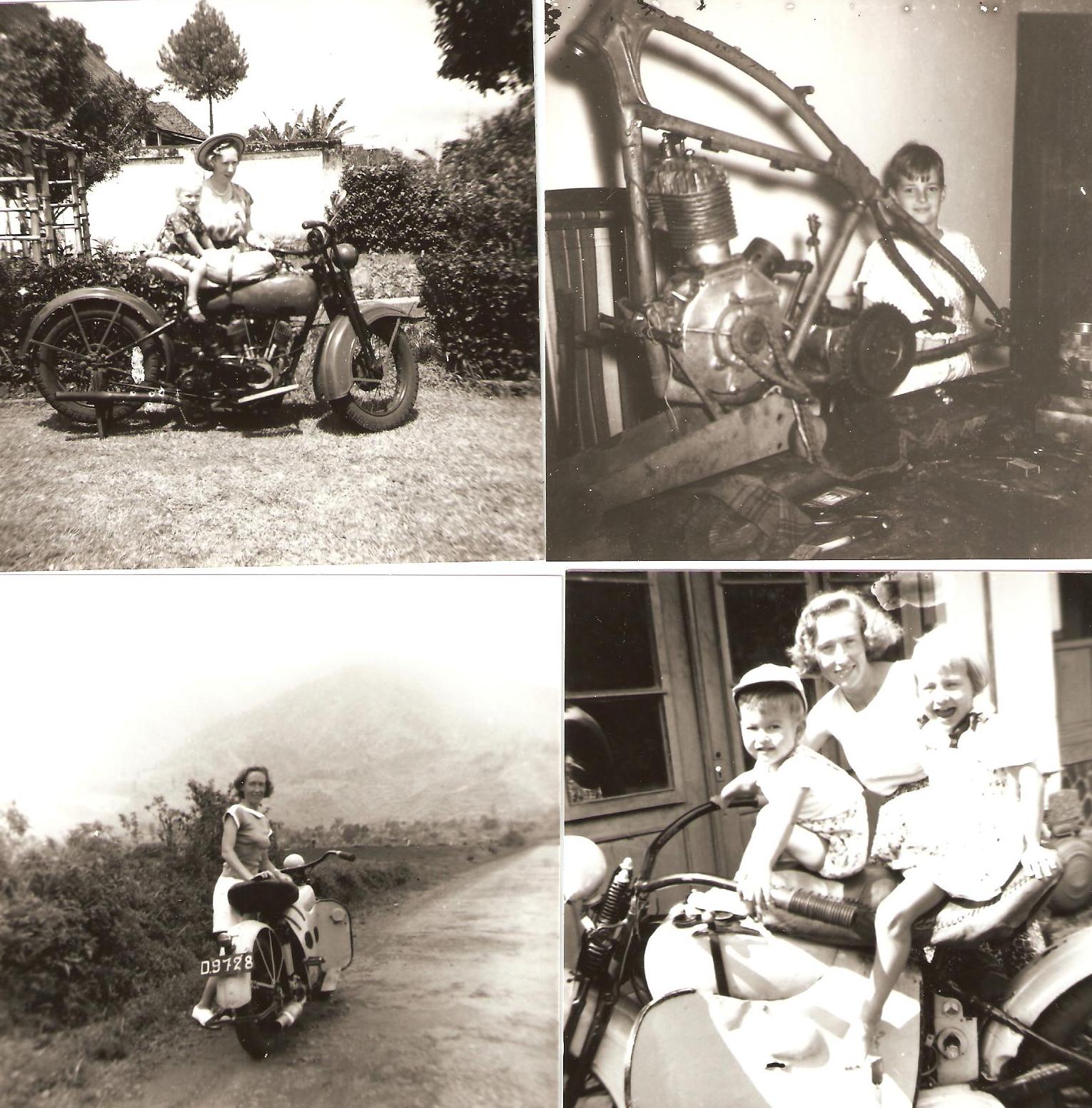
Digging in old pictures I found several
pictures from the harley and entourage. On the above picture from left top
and clockwise: Maria and Julia with the motor
cycle as it was in the beginning. Then next, you see the frame
and half an engine in it. The gearbox I bought at the 'passar maling' for 9
rupiah. The boy behind the frame was my neigbour who liked me very
much and what I did. Then Maria and the two kids on the Harley as I had
changed it . I made a cowl to protect my legs from the heat. You see the
motor cycle had hand gear shift. One also had to fill the oil tank with oil
often as the oil was not circulated but after use was sprayed on the
chain. You also can see the saddle I made from goat leather and
extended it on the tank.
Then above that Maria with the harley when
we made a trip together up one of those mountain roads near lembang. Notice
the registration number D9728, a small number because there were not
many vehicles in those days.
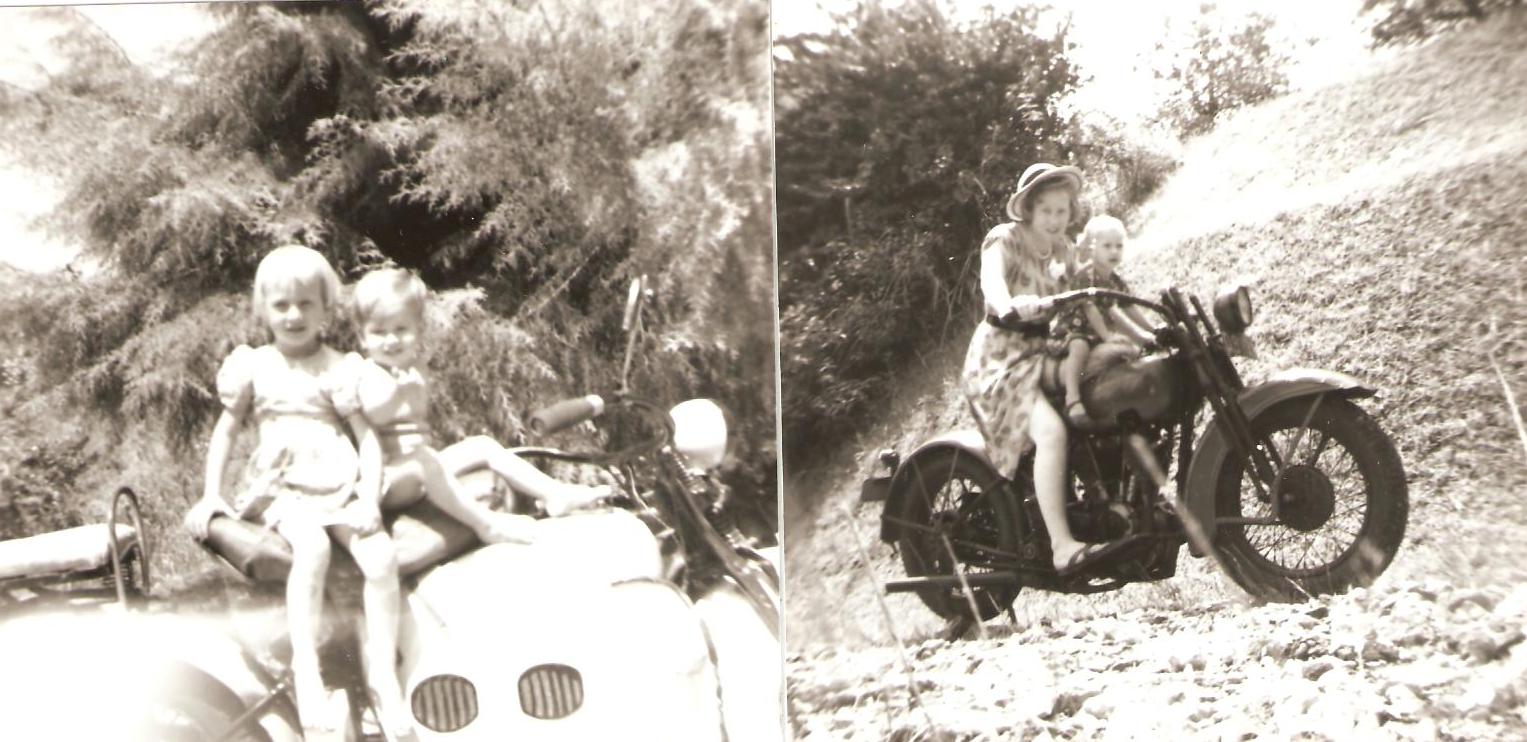
Above
picture shows the kids again sitting on the beast. The picture
in the right shows Maria and Julia acting if she was riding.
About my childhood in Bandung, when
we still lived on what was then the Helmers weg, there was a big open field
adjacent to the branch High school across from our house. We children played
there every afternoon until dark. Sometimes I liked to just lie on the
grass and look at the wonderful shapes of the clouds. It was then that I saw
many kites in the kite season dancing in the air. I wanted to do that
too, and my aunt gave me a beautiful kite with a long tail to make it more
stable. Soon I had mastered the skill of kiting (I thought). I was one
afternoon lying on my back admiring my kite when I fell asleep. When I
opened my eyes again there was no kite. I soon learned that Indonesian
kiters were kite fighters. The line attached to the kite has glass powder
glued to it. They manouvered their kites in such a skilled way as to
try and cut the line of the kite they are fighting with. Their kites are
very manouverable and unstable and require much skill to be handled. When a
famous fighter
kite would be cut and, carried by the wind came sailing down, many
boys and even men went after it jumping over fences and through yards and
climbing walls to claim ownership of that particular kite. I got so involved
in the game of kite fighting that I made my own line by pulling it through a
hot can of Kah, or wood lime, and then through a can filled with glass
powder. It took skill to manouver the kite without cutting your own fingers.
A little nudge was enough to make the kite go into a deep dive. Sometimes
disappeared behind the trees. Another nudge and it climbed up again. One
also could make the kite go horizontally to the right or the left or make a
loop-the-loop so as to snare the enemy's line and cut it.
When we lived in our new house above Bandung,
the mountain wind gave even more options. With a northern wind the kites of
the dessa above us came down and fought me right overhead. When the wind was
south, I flew the kite with a long line over the dessa of the enemy. Often I
even did not see my kite and just flew it by my feelings. It was a
happy and exiting time of my youth.
Our lady neighbours liked to
sunbathe in a surrounding tent wall in their back yard. From my neigbour boy
friend, I knew they were naked. One day I came upon a big champagne bottle
that was made out of presspapier and looked like the real thing. I tightened
that with a meter or two of line to the tail of my kite and started to fly
and manouver the kite over the sun tent. One should have seen the flight of
those frightened ladies in their bath towels etc. out of the suntent into
the house. Yes, I had to hear the reprimand for my impolite behavior. Hey,
teenager, what can you say.
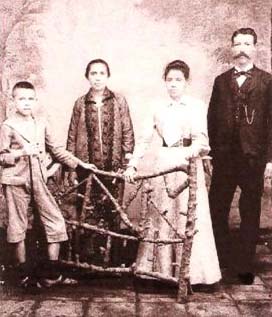
Here is a
family. picture of my father Julius Henri (age 12) next to him
Oma Juul, my oma. She was a daughter of a regent, Javanese. I
don't know her maiden name or from where.
You know, we
children looked at our father for guidance to become an
Indonesian citizen or not. Our family lived there already
since the 18th century. But in those days of take over
the government and also some people were belligerent toward
the belandas. I still remember clearly how on the day of take
over I stood by myself on the asphalt in the middle of jalan
Lembang at the bottom gate of our property. In those days
there was not much traffic. I realized then that I had no
country no more and I cried. I looked at the street and said
to myself: "You can't any longer call that your street
Johan. Holland was politically my country, but emotionally
Indonesia was". And look what happened; God blessed me
greatly and modern technology let me be back in a flash. Thank
you thank all of you. My old person is bathing in the same
sunshine that stays over my head as over yours thousands of
miles away. I think much about you all and old memories keep
filtering in.
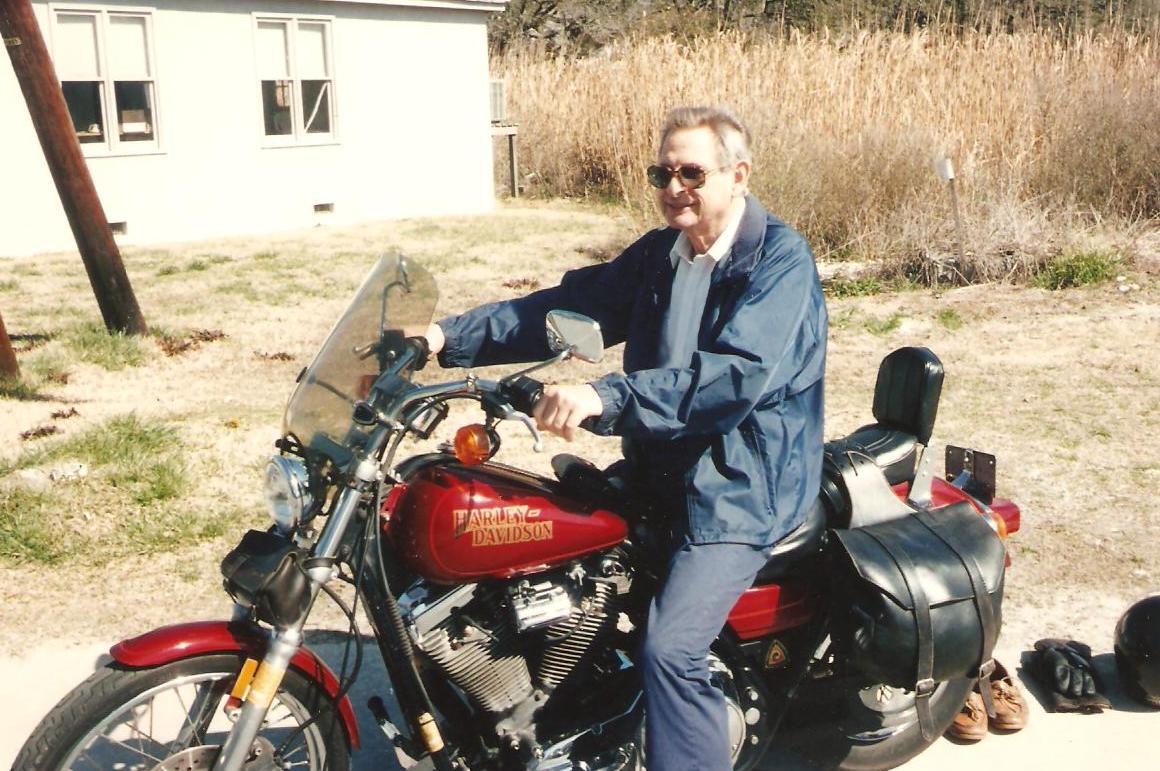
Opa, currently live in
Oriental USA, rode the newer harley.