Battle Analysis of
The Battle of Kursk
Name: 2LT Raymond P. Kelley
Class: AOBC 9804
Date: 27 March 1998
The Battle Defined:
The battle of Kursk was significant in that it was the 2nd largest tank battle in history and the turning point of World War II on the eastern front. The ten day offensive began on 4 July, 1943 and officially ended as an offensive on 13 July, 1943. It involved the 9th Army, 4th Panzer Army and Detachment Army Kempf of the Germans and the Central, Voronezh, and Steppe armies of the Russians. The main objective of the German offensive was to encircle the Kursk Bulge and meet on the high ground, east of Kursk (Rothwell 17), thereby cutting off and destroying a number of Soviet divisions and weakening the offensive power of the Red Army to a very considerable degree. (von Mellenthin 214)
Sources Evaluated:
Captain L.D. Holder/The Breaking of the Panzer Corps Secondary Source
pages 12-17 Suitable Unbiased Reliability Good
Stephen K. Rothwell/Bloodbath at Kursk Secondary Source
pages 16-34 Suitable Unbiased Reliability Good
F.W. von Mellenthin/Panzer Battles Primary Source
pages 212-234 Suitable German Viewpoint Reliability High
Juan Parotkin/The Battle of Kursk Primary Sources
entire book Semi Suitable Russian biased Reliability Medium
George M. Nipe Jr./Kursk - WWII Magazine on the Web Secondary Source
Article Semi Suitable Unbiased Reliability Good
Setting:
The terrain in the 5,500 square mile salient around Kursk consisted mostly of low rolling hills, forests and small villages. The rivers Seim, on which Kursk was located and Psel, approximately 25 miles south, flowed east to west. The front followed the north-south river Donetz up to Belgorod.
The key terrain in the area consisted of the hills east of Kursk, which would give whoever held it a distinct advantage in the defense.
Natural obstacles in the area included scattered small towns, heavy forests, 3 major rivers and marshland, found mostly near the rivers. Months of preparation by the Russians caused the entire salient to be one of the most fortified regions in history, complete with deep belts of entrenchment’s and minefields, supported by masses of artillery, mortars and anti-tank guns. In all, 400,000 mines and 6,000 antitank guns were employed to a depth of 65 miles behind the most likely points of the German push. (Holder 12) The weather also played a role in slowing down the German advance. Raining on and off since before the battle, caused the ground to be soft and muddy, hindering movement and exhausting the troops. Dawn in this area commenced at 02:30 and dusk started at 20:00, making for very long days and short nights
Germans utilized tanks for cover while advancing. The Russians had six months worth of engineering support as well as employing civilian labor to dig trench systems similar to those used during WW I. Neither minefields nor anti-armor troops could be detected until the first tank blew up, or the Russian antitank gun opened fire. (von Mellenthin 231)
Compare Opposing Forces:
German:
The Germans had a total of 900,000 men, 10,000 tubes of artillery, 2,700 Tanks and Assault Guns, and 2,500 Planes at The Battle of Kursk. The troops were well trained, mostly veteran soldiers and at the start of the offensive, highly motivated.
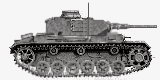 The Panzer III was the mainstay of the German armored forces early in the war. However, by the summer of 1943, this tank was no longer a match for the more advanced tanks employed by the Soviets. This tank was normally armed with a 5cm, KwK 39 gun and had frontal armor of up to 57 mm. Although outmatched by the heavier Soviet tanks, Panzer III’s engaged mostly T 70’s, to great effect.
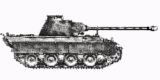 The Panther D, had the fire power to knock out Soviet T 34’s and with 100 mm frontal armor, could withstand their return fire. The Panther did have major drawbacks, in that the drive train was unstable and frequently broke and the full system was inadequately protected, resulting in more than a few fires inside of the vehicle.
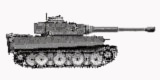 The Tiger I, considered an awkward vehicle in the mountain passes of Italy, was best suited for the open terrain of the eastern front. With its 8.8 cm KWK 36 gun and 110 mm thick armor, the Tiger was almost invincible on the battlefield.
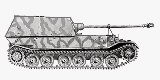 The Pz Jg VI, more commonly known as the Elephant, was an extremely well protected tank destroyer, with 200 mm of frontal armor. Its 8.8 cm PaK 43/2 gun could take out any tank before the other tank could even engage the Elephant. Its one major drawback, was that it was not equipped with a coaxial machine gun.
The most common tactic of the Germans on the advance was to fight as a combined arms unit, with Infantry and Tanks moving together, as well as the newly devised Stuka antitank planes providing support. Germans were noted for their precision, timeliness and fierceness on the battlefield. German doctrine included heavy use of reconnaissance, night assembly marches, last second concentration, and heavy air support.
The Red Army:
The Red Army had a total of 1,337,000 men, 20,220 tubes of artillery, 3,306 tanks and assault guns, and 2,650 planes. Although a good percentage of the Russians were veterans, a large percent were fresh recruits.
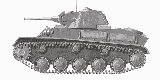 The T 70 was hopelessly outmatched on the battlefield during the summer of 1943. Its main gun was only a 45 mm M38 and it only had frontal armor up to 60 mm in thickness.
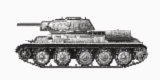 The T 34 was the mainstay of the Soviet army in 1934. It carried a 76.2 mm F-34 gun and had frontal armor up to 70 mm in thickness.
During The Battle of Kursk, the Russians adopted and became past masters of the German tactic, the Pakfront. (von Mellenthin) The Pakfront was a group of up to ten antitank guns, controlled by a single officer. The Pakfront would defend the area in front of them with antitank ditches and minefields. The Pakfront would practice severe weapons control and not open fire until a sure kill could be made, by using all the guns against a single target. The Russians used the Pakfront extensively during the battle.
Russian armor attacks were not very sophisticated, basically they threw in masses upon masses of tanks and infantry against the Germans, until the Germans broke, and if the Germans repelled the first wave, the Russians threw another wave in again and again. The Russians relied heavily on centralized control and heavy use of artillery.
Causes of Conflict:
During the Winter of 1942, the Russians launched a massive counter offensive against the Germans all along the Eastern Front. Stalin had kept many troops in reserve for just this purpose. This attack, as well as the winter, caught the Germans by surprise. As a result, the Germans were pushed back all along front. By the end of January 1943, the offensive had petered out against strong German resistance. By the time the counter offensive ended, a large bulge had formed around the city of Kursk. Much of the Soviet armor was concentrated in this area. The Germans believed that an attack from the North and from the South at the base of the bulge, would cut off the Soviet forces in the salient and make those units vulnerable and easy to destroy.
Chronology:
Dates/Period Event
04 July 1943 15:00 Operation Citadel commenced, with an attack on forward Russian lines, preceded by a short artillery and air bombardment.
05 July 1943 Gross Deutschland attacked, but was bogged down by swamps, air attacks, and the defenders holding the high ground.
06 July 1943 The 4th Panzer was still bogged down and making slow progress along front.
7 July 1943 Gross Deutschland broke through on both sides of Ssyrzew. Russians withdraw to Gremutshy and Ssyrzewo. Germans advance as far as Gremutshy.
8 July 1943 Hills north of Wechopenje reached. Elements of Gross Deutschland wheel left to help 3rd Panzer division due to large threat on left flank of corps. Gross Deutschland repulses seven counter attacks in the area. 11th Panzer defending against counterattacks from the east. 2nd SS Panzer Corps claim 290 Russian Tanks Destroyed. 76 Panthers have broken down.
9 July 1943 3rd Panzer advances west of Beresowka. Gross Deutschland advancing through hills north of Wechopenje. 11th Panzer defending against counterattacks from the east. 3rd Panzer enters Beresowka from the west, 3rd’s northward advance stalled north of Beresowka
10 July 1943 3rd Panzer still held up in forest north of Beresowka. Elements of Gross Deutschland continues north and west towards hill 247 south of Kruglick, while main body drives southwest to attack from the rear the Russians holding up 3rd Panzer. 11th Panzer continues to hold off counter attacks along eastern flank. In the North, 9th Army unable to advance further than 7 miles. Russians commit reinforcements.
11 July 1943 3rd Panzer relieves Gross Deutschland around hill 247. Gross Deutschland regroups south of Nowosselowka. Heavy Russian counterattack from west, 3rd Panzer thrown out of initial defensive positions.
12 July 1943 3rd Panzer on defensive against Russian counterattack. Gross Deutschland regroups, resupplies and makes repairs. Massive armor engagement at Prokhorovka.
13 July 1943 Hitler orders Operation Citadel to be called off immediately due to Allied threat in Sicily.
METT-T
Mission:
German: To cut off massed Russian troops and destroy them in the Kursk salient.
Russian: To defend against probably German offensive and to prepare for a large counter offensive
Enemy:
German: The Russians were firmly entrenched and outnumbered the Germans.
Russian: The Germans, although outnumbered, had better equipment and had largely better trained and experienced troops.
Troops:
German: Units were at full strength before the battle. Troop moral was high, due to excellent training and the belief that the Germans were a superior fighting force.
Russian: Units were at full or near full strength. Troop moral was good. Unit commanders did not believe Germans capable of a sustained attack.
Terrain: The area in and around Kursk was dotted with small rolling hills, forests, and small towns. Three major rivers flowed in and out of the area, giving rise to extended marshy areas.
Time: The German offensive began on 4 July and ended on the 13th of July, although German units fought retreating battles for two more weeks.
Cause and Effect:
As a result of the Germans losing a good portion of their armor and not decisively destroying their objectives, they were no longer able to launch an offensive operation in the east. The initiative was lost and the Germans began to fall back all along the front.
Hitler’s determination and wavering lack of will, determined the outcome of the battle, long before the first shots were fired. Had Hitler gave the go ahead, or better yet, let the Field Marshals do their job, the Kursk salient would have months earlier been cut off and the exhausted Russians would have been easy targets for the Germans.
The Russian’s policy of using pure force against the enemy almost proved disastrous at Kursk. It was believed that Prokorovka was a significant German defeat, but was actually a stunning reversal for the Soviets because they suffered enormous tank losses.
Lessons/Insights
By the time the offensive started, the Germans had long since thrown away any vestige of either operational or tactical surprise, and the Soviets had several months during which to prepare and dig in.
During the Battle of Kursk, German aircraft were used for the first time to engage armor formations directly, with successful results, resulting in a trend that continues to today.
Tanks are least effective when used as battering rams. They are better employed as a shock force, that show up, deep inside enemy lines.
A hasty surprise attack in a timely manner may be better than waiting to be reinforced and allowing the enemy to reinforce his positions and prepare for a known advance.