| Official Name: Republic of Sudan
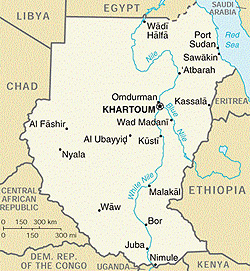
Capital: Khartoum
Type of Government: Islamic Military Regime
Population: 2.5 million sq km
Area: 2.5 million sq km
Major Ethnic Groups: Black, Arab, Beja and 570 additional groups
Languages: Arabic, Nubian, Indigenous Languages, English
Religions: Islam, Indigenous beliefs, Christianity
Unit of Currency: Sudanese Pound
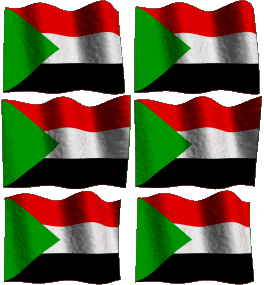
National Flag: Three horizontal stripes of red, white and black with a green
triangle at the pole
Date of Independence: January 1, 1956
For at least 9000 years farmers and herders have lived along the Nile River in
what is now Sudan. Ancient fortresses, castles and temples dot the banks of the
Nile in the north. The importance of the Nile River has meant that Sudan and
Egypt have culturally influenced one another since ancient times. The Kingdom
of Cush, which is now the north-east corner of Sudan, was Egypt's rival for over
1000 years.
In the sixth century A.D. the region flourished as the Kingdom of Nubian, gradually
embracing Christianity. At this time Nubian was a great source of ivory, gold,
gems, aromatic gum and cattle for the Middle East. Later, Islam spread throughout
the northern region during the 1400s to 1700s. Other African kingdoms, such as
Shilluk and Azande, and herding peoples including the Dinka and Nuer, thrived
in southern Sudan.
Ottoman-Egyptian rulers controlled Sudan with British help, from 1821 to 1885.
In the 1880s, a Sudanese religious teacher named Muhammad Ahmad ibn Sayyid Abd
Allah proclaimed himself the Mahdi, or guided one, and launched a jihad, holy
war, against the Ottoman rulers. The Mahdists captured Khartoum in 1885 after
a long siege in which British General Charles George Gordon was killed. In 1899
Anglo-Egyptian forces regained military control of Sudan which was under joint
British-Egyptian rule for over 50 years.
Sudan proclaimed its independence on January 1, 1956. The civilian and military
national governments that followed kept the deep-seated differences between the
mainly African south and the Arab north. Sudan's current leader, General Omar
Hassan al-Bashir, took power in a military coup in 1989. His government abolished
the constitution and all political parties and made Arabic the language of instruction,
replacing English.
Sudan has survived famine for more than 10 years and civil war for 40, causing
many people to flee. Peace talks have so far been unsuccessful. Most of the south
is controlled by rebel forces.
Sudanese public schools have gone through huge changes recently,
moving from a Westernized curriculum taught in English, to an Islamic curriculum
taught in Arabic. The government of General Bashir announced sweeping educational
reforms in 1990. Now all schools use a Muslim curriculum and all course elements
are drawn from the Qur'an.
Most schools in Sudan are clustered around Khartoum, where they originally followed
a British model. There are still some Italian-run Christian missionary schools
in Sudan. Canadian Jesuits operate a theological school and there is also a school
run by French nuns in Khartoum.
Most of the colleges and universities are in the northern regions. Skilled technical
workers are needed in southern Sudan, but civil war erupted before the vocational
schools were completed and many teachers and students fled. More universities
tailored to Sudan's needs were opened in the capital region in the late 1980s.
As with health care, recent privatization has made education less affordable
and accessible. The continuing warfare has closed schools for long periods of
time in some parts of the country. Did you know?
In the Muslim areas of Sudanese villages, the local religious leader or imam
often runs a religious school for the children called a khalwa, where the holy
teachings of the Qu'ran or Koran are studied.
The current campaign Arabization is highly controversial, particularly
in the south and has significantly contributed to resentment and hostility towards
government
policies. Islamic education has traditionally been available in the north. In
the past, girls' education was primarily of this religious kind, although many
girls received secular schooling, too. More women than men entered professions
such as medicine, law and economics, the only professions open to women in the
1980's.
Sudanese extended families include uncles and cousins going back several generations.
They determine a great deal about one's life, work and marriage opportunities.
Traditionally the focus for Sudanese people has been the local village or nomadic
community. These relatively small communities are made up of extended families
based on lineage of male relatives and ancestors. The members of a lineage act
in the group's interest, safeguarding territory or forming important ties with
other families by marriage. Usually a family leader is a respected elder.
For people in the north who are herders, family status still depends on the size
of the herd. In settled villages, certain families hold the rights to own land.
In the past, colonial governments sometimes gave powerful positions to certain
families. These family groups have gradually become part of the modern political
system, but traditional ideas about power and status endure.
Most Sudanese families hold strong traditional values in a rapidly changing world.
Whether in rural or urban society, the woman's world has been domestic and the
man's world, public. From everyday meals to formal socializing, such as a wedding
feast, men and women are segregated. Men and women lead far less separate lives
in the south.
It is difficult to say how years of war; famine and migration have changed families
in Sudan. Some rural Sudanese have recently moved to cities, where family and
ethnic groups mix at school and work. Upper-class families living in big cities
like Khartoum and Omdurman tend to be closely connected to the government, business
and the professions Top of the page
|
|