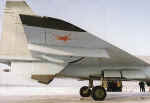
| "During the past two years, considerably more has been revealed about advanced fighter designs pursued by the bureaus at Sukhoi and Mikoyan than In any period before ft. As we now know, preliminary evaluation began In 1981 on a program referred to as 1-90, which stood for Istrebitel (fighter) for the 19909, and the Soviet government subsequently Initiated development of two Mikoyan "fifth-generation" projects In 1986. These were known as MFI (mnogofunktsyonalniy frontovoy Istrebitel, meaning "multifunction tactical fighter"), which called for development of a heavy aircraft, and a lightweight platform referred to as LFI ("L" for Lyogkiy, meaning "light"). In 1988, work on the latter was terminated when It was decided the necessary technologies would be developed for the MFI and that a simplified, lightweight derivative would be developed from that at a later time. Paralleling the 1.42 project, Sukhoi commence design of an advanced, heavy-fighter concept In 1983. Referred to as the S-32, It featured a forward-swept wing. In the contest for funding, the Mikoyan aircraft won out, although the government decided the S-32 should remain, for the time being, a lower-priority, experimental project. In 1991, Mikoyan completed design of the MFI, which it designated izdeliye 1.42 (Product 1.42), and began construction of a flight demonstration vehicle designated the 1.44. However, a lack of capital slowed the project and ultimately forced its stoppage. By that point in 1994, the aircraft was close to completion but lacked control-system actuators and the Russian Ministry of Defense had simply failed to provide promised funding. The aircraft was placed in a storage hangar and remained there for several years as Mikoyan decided it would not continue development without payment from the state. The fiscal crisis that began to engulf Russia in the early 1990s also adversely impacted Sukhoi's project. However, the company's general designer, Mikhail Simonov, decided to go forward by financing the new jet from export contract profits earned from sales of the company's Su-27 and Su-30 'Flankers.' The lack of available funds has, however, resulted in simplification of some systems in the prototype, including installation of temporary engines (AL-31Fs; from the Su-27) and, most likely, a much less sophisticated flight control system. Before making its first test flight on 25 September 1997, the S-32 was re-designated the S-37 Berkut (Golden Eagle). It has since made close to 50 flights, most with Igor Votintsev at the controls and, according to reports, state funding for the aircraft resumed in 1999. Both the 1.44 and S-37 are experimental platforms it is hoped will lead to a new heavy fighter. However, the necessary military avionics and weapons systems have yet to materialize. Unlike the S-37, the MFI has been designed to fill the roles of air-superiority fighter, interceptor, strike aircraft and reconnaissance platform, and a multi-channel fire-control system is envisaged that will be capable of engaging multiple targets and directing several missiles simultaneously. For now, it is supposed to be capable of carrying all current air-to-air and air-to-surface missiles. Sukhoi's successful flight prompted Mikoyan to resume work on the 1.44 project and its first flight was expected by October 1999 with Anatoly Kvotchur at the controls. The three "Ss" Drive Mikoyan's Thinking Development of the MFI called for super sonic performance, supermaneuverability and stealth characteristics. The first "S:" sverkhzvuk, mandated supersonic cruising capability during combat, which has to be attained without afterburning, and the ability to sustain high g-loads during supersonic flight. This also necessitates a faster fire-control system because reaction times will be shorter. Given Russia's enormous geographic size, the ability to respond and be on station quickly, as well as operate effectively in regions where airfields are sparse, is of paramount importance. Supermaneuverability calls for the aircraft to be capable of sustained controlled flight at angles of attack (AoAs) of between 60 deg and 70 deg. Needless to say, such a requirement makes great demands aerodynamically as well as on the fire-control system but is deemed essential for modern air combat, as the fighter should be capable of attacking a target from any position, including behind. One solution is thrust vectoring. Although a beyond-visual-range (BVR) attack is always the preferred method for a heavy fighter designed for long- and medium-distance missions, close-in air combat will be a reality on those occasions when BVR has not achieved the desired result. Judged to be third in order of importance, stealth technology will be employed in the MFI only when it will not compromise the attribute previously mentioned. Little data is available for accurate comparisons between the 1.44 and S-37, and all of the values shown in the accompanying table are either estimated or have come from semiofficial sources. However, the 1.44 was developed with adjustable intakes to meet a strict military requirement for a top speed of 1,350 knots (2500 km/h), whereas the Su-37, with fixed intakes, has a reported maximum speed of between 1,080 and 1,188 knots (20002200 km/h). In any event, the final aerodynamic form Russia's "fifth generation" fighter might take will be determined only after exhaustive flight-testing of both aircraft. However, judging from comments already made, it seems likely a design more closely resembling the 1.44 could be expected. In fact, the S-37 has endured some criticism for the technological problems created by its forward-swept wings. According to Russia's Central Aero and Hydrodynamics Institute, the 1.44's design is favored because it offers better maneuverability at supersonic speeds than that of the S-37. Being a canard airplane with a delta wing, the 1.44 has a dozen or more control surfaces including canard foreplanes, wing leading-edge flaps, elevons, rear flaps between the engines and tail beams, rudders and movable rear sections in the ventral fins. All of the control surfaces and movable engine nozzles are controlled by the KSU-142 (kompleksnaya sisterna upravleniya) digital, fly-by-wire control system. Mikoyan's own press release states: "The wing, fuselage, control surfaces and vectored thrust, combined with the KSU control system, form a uniform aerodynamic surface capable of adapting itself for all conditions of flight." The 1.44 is powered by two Lyulka-Saturn AL-41F low-bypass-ratio engines, rated at about 39,340 lb (175 kN) each with afterburning, the same that are supposed to power the S-37. On the 1.44, they are fitted with 3-D nozzles that probably provide � 15 deg of vertical and � 8 deg of horizontal movement but it is proposed the engines that finally power the production aircraft will have flattened, movable nozzles to reduce considerably the fighter's infrared signature. The degree to which stealth technology has been implemented in both aircraft is minimal. Some radar-absorbing materials were used, however, and the airframes might be coated with radiation-dissipating paint. The engine ducts have been designed such that they shield the compressors, and the missiles will be carried in conformal pods under the fuselage, in the case of the 1.44, and within the fuselage in the case of the S-37. In fact, many Russian designers consider the stealth technology that has been applied to the F-1 17A and B-2A to be disproportionately expensive when judged in terms of its cost and benefits. They also contend that such measures affect the flying qualities of aircraft to an unacceptable degree. Accordingly, they reportedly continue to seek alternative ways of reducing radar cross sections, including the possibility of enveloping the aircraft in a cloud of artificial plasma. Comparative Specifications Param. Mikoyan 1.44 Sukhoi S-37 Length 71.2ft (21.7m) 74.1ft (22.6m) Wingspan 53.8ft (16.4m) 54.8ft (16.7m) Takeoff weight (normal) 61,728lb (28000kg) 52,910lb (24000kg) Takeoff weight (max.) 77,160lb (35000kg) 77,160lb (35000kg) Powerplant 2 x AL-41F 175kN ea. 2 x AL-41F 175kN ea. Temporary .. 2 x AL-31F 123 kN Maximum speed 1,350 kts (2500 km/h) 1,080-1,188 kts (2000-2200 km/h) Cruise speed 810-918 kts (1500-1700 km/h) 810-918 kts (1500-1700 km/h) Supersonic range 1,553 miles (2500 km) N/A Subsonic range 2,795 miles (4500 km) Over 2,484 miles (4000km+) g-limit 9 N/A |
 |
 |
 |
 |
 |
 |
 |
 |
 |
 |
 |
 |
| mig 1.42 vs. sukhoi 37 berkut |
   |
|
|
| Lightweight Fighter Priority: Birth of the LFS While the urgency for a lightweight "fifth-generation" fighter was downgraded in favor of a heavier platform during the early 1990s, the position is now reversed. As a 1.42 or S-37-type aircraft is not expected to be commissioned into service for at least another 12 years, Russia recognizes the need for a smaller, highly advanced aircraft, similar to America's Joint Strike Fighter (JSF). Conceptual work on the LFI resumed in 1994, at which point it was renamed the LFS program. This was significant because the switch from "I" to "S" in the designation indicated a change of direction. Istrebitel, which strictly refers to an air-to-air fighter was replaced with samolyot, meaning "aircraft." In other words, the lightweight platform is now viewed as a multirole fighter, like the JSF, which will employ many of the characteristics and technology solutions of its larger cousin but will be much less expensive. Its weapons systems and engines, for instance, could be expected to be similar. At this point, a design for the aircraft has been sought from design teams at Mikoyan, Sukhoi and Yakovlev, and the intention is that one will be selected. At that point, the winning design team will become the prime contractor and the other two bureaus will be retained as subcontractors responsible for individual components of the aircraft. According to unofficial sources, Sukhoi's proposal is for a scaled-down version of the S-37 with a conventional rather than forward-swept wing, to be powered by one AL-41F turbofan. However, the bureau has also promoted its S-54 concept in several forms, the latest of which calls for a tandem tri-plane (that is canard, wing and tailplane) powered by a single AL-41 F engine with 3-D thrust vectoring. Meanwhile, the Mikoyan team is considering both single- and twin-engine options and is reported to favor a design powered by two 17,984-lb st (80-kN) engines (possibly RD-33/RD-133 turbofans, or even foreign engines for export copies). To reduce development exposure costs, a tried and tested engine is considered of paramount importance to this team. This may not be the view of the Russian military, however, based on official declarations that new Russian aircraft should have in common the AL-41F engine (heavy and lightweight developments, plus the Su-27IB striker). With no firm specification data about LFS projects yet available, one can only speculate what its takeoff weight might be. However, assuming one AL-41F providing 39,340 lb st (175 kN) is fitted and that the requirement of Russia's air forces for a thrust-to-weight ratio of 1.3:1 is followed, then an aircraft in the range of 30,900 lb (14000 kg) could be envisaged. This might mean a maximum takeoff weight of between 39,700 and 44,100 lb (18000-20000 kg) for a warplane with short takeoff and landing (STOL) characteristics, as opposed to the short takeoff and vertical landing (STOVL requirement for the JSF It is expected that the fire-control system will be based on an active phased-array radar and optical sensors, and that a standard set of air-to-air missiles (based on the R-77 AA-12 'Adder') be fitted within the fuselage or inside conformal pods. Mikoyan has also been working on a compromise between MFI and LFS, designated the MiG-35 and derived from the MiG-29, in case the air forces ultimately decide to settle on a single-fighter fleet. Powered by two 22,480-lb st (100-kN) engines and offering better range and more modern weapons and avionics systems, it now seems unlikely the project has garnered much enthusiasm from official circles. 701 Long-Range Interceptor During the 1980s a successor to the MiG-31 was pursued. This envisaged a heavy, supersonic, long-range, multirole interceptor, dubbed MDP (mnogofunktsyonalniy dalniy perekhvatchik) or izdeliye 701 (Product 701). Some data on the project became available in 1993 when the proposed derivative 701P supersonic business jet was discussed. This tailless aircraft with small, forward destabilizes, would be powered by two engines fitted with dorsal-type air intakes. The designers claim a range of 4,347 miles (7000 km), cruising at between 1,240 and 1,350 knots (2300 and 2500 km/h) at an altitude of about 56,000 feet (17000 m). A subsonic range of 6,800 miles (11000 km) is touted. With a length of some 98.4 feet (30 m) and a wingspan of 62.3 feet (19 m), the 701 P would be much larger than the MiG-31. However, work on the project did not advance much and is not expected to do so. Any further development of the MiG-31 is more likely to take the form of the MiG-31BM variant, fielding more advanced radar and missiles, as well as provision for in-flight refueling. In any event, an MFI-category aircraft would be expected to replace the MiG-31 class of aircraft within 15 to 20 years." (source: Combat Aircraft, January 2000, pp. 456-460) |