Azad Reading Room


NEW ADDRESS:
AZAD READING ROOM
Aman Vedika, 11-1-809/1, Chinta Bavi
(lane beside Sridevi cinema hall),
Chilakalaguda, Secunderabad,
AP-500061 INDIA
Cell phone: 011 91 934 6988 639
91 40 2007 0143 (Land line phone)
E-MAIL: [email protected]

Azad Reading Room
[Secunderabad]
NEW
India
Report
NEW
Bharat Samajh - Understanding India
INDIA'S STRUCTURAL BACKGROUND:
This is a short statement regarding the basic and determining features of contemporary
India. The statement, in outline form, focuses on three aspects of contemporary
Indian society. They are agrarian conditions, industrial conditions, and the
workers. These three societal elements influence, perhaps fundamentally help
determine, the outcome of current changes in India.
The profile that emerges should be considered a tentative one in that the statistical
basis is incomplete. However the contours are clear and can assist in arriving
at some relevant though proximate conclusions.
AGRARIAN INDIA
Out of a total population of 913 million, the proportionate agricultural population
in '94 was reported as 65% or a total of 593 million people. Of the total agricultural
population the economically active population stood at 191.4 million in '94. In
other words about 32.2% of the agricultural population was classified as economically
active. Of the total economically active population, about 139.4 million were
males and about 52 million females. These figures do not provide separate numbers
for child workers but given the suggestion that there are a reported 100 million
child workers in India, it is likely that between 30-60 million of the total agricultural
workers are children.
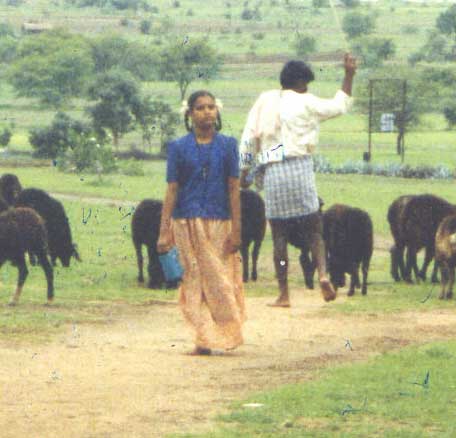
Agriculture contributed about 27.9% of India's Gross Domestic Product (GDP) in
1995-96. If the overall Per Capita Income (PCI) is about US$340.00 (US $1400.00
purchasing power parity international), it is obvious that the agricultural PCI
is considerably lower. Agricultural incomes are mainly derived from land holdings--specifically
its control (including ownership), distribution and use. A widely recognised condition
for the viability of India's economy, prticularly the agrarian component, has
been the question of the disparity in land holdings, input use, and thus in the
thrust of legislative adjustments known as land reforms. These land reforms have
been present since the decade of the 1950s.
What is the contemporary condition regarding land reforms? We present
summaries of three accounts which document the position between the late '70s
and late '80s. These are the most recent factual structural pictures available.
1. In the late '70s, Dalip Swamy sketched the following:(1)
(a) RICH PEASANTS MAKE UP 10% OF THE RURAL HOUSEHOLDS.
This segnment of the rural households own/control a dominant share of agricultural
land--approximately 59%. In addition, they exercise hegemonic control over agricultural
inputs (water, fertiliser, and credit). They are the effective masters of the
countryside.
(b) MIDDLE PEASANTRY CONSTITUTE 29% OF THE RURAL HOUSEHOLDS.
This segment of the rural households cultivate 34% of the land, employ 43% of the agricultural laborers, use/control 39% of the irrigation facilities, and 50% of all cattle.
(c) POOR PEASANTS, INCLUDING AGRICULTURAL LABORERS, MAKE UP 61% OF THE RURAL HOUSEHOLDS.
34% of this segment are land-poor (cultivate uneconomic holdings) and 27% are landless. The land-poor cultivate 9% of the land area, use 15% of the irrigation facilities, own 14% of the cattle, 16% of the buffalo, 10% of the wooden ploughs, 7% of the iron ploughs, and less than 2% of the electrical pumps.
2. The newspaper, THE HINDU (June 14, 1989) reported the following:(2)
(a) Less than one third of the targeted surplus land has been distributed.
(b) ceilings under the existing land legislation have been ignored and neglected.
(c) intermediary interests continue to proliferate
(d) BENAMI ("no name") holdings continue
(e) land records remain in chaotic conditions
(f) official policy continues to stress the "fine tuning" of existing legislation.
3. The ECONOMIC & POLITICAL WEEKLY, in Sept. '94 published a fairly detailed study of land reforms between 1953 and 1982. The main findings of the study are:(3)
(a) glaring inequalities persist both in terms of area owned and operated.
(b) in virtually all the states, land concentration is more pronounced, especially at the middle levels.
(c) A preponderant number of households at the bottom of landownership remain unaffected by the process of land reform.
(d) Land ceilings implementation results in fragmentation or very small holdings or operational units. It is necessary to simultaneously inaugurate cooperatives, input support and agriculturally related activity (for example, dairying, pisiculture).
(e) measures to secure tenacy and consolidate holdings are essential to strengthen the institutional structure of agricultural production.
INDUSTRIAL INDIA
The proportion of India's non-agricultural population was reported as 35% in
1995-96. Of this proportion, industry (including manufacturing, mining, power
& construction) employed 19.4% of the working population--about 44 million people.
Industry contributed 26.2% of the Gross domestic Product (GDP)
in 1995-96, while manufacturing's share was 15.8% of GDP in 1995-96. These indicators
demonstrate that 50 years after independence, industry engages a minority of
India's working population and contributes only a small proportion of the total
output. In other words, INDIA, as it prepares to enter the 21st century, is
PRIMARILY AN AGRARIAN COUNTRY. (4)
What is the nature of India's industrial sector? During the
early 1980s a survey of the country's position in global economic rankings observed:
"The relative decay is equally noticeable in industrial production: her share
in world industrial output has shrunk from 1 percent in 1950 to a mere 0.8 percent
today."(5) In the same survey,
similar declines were noted with respect to India's share of world per capita
income, world trade, and world output.
The structure of India's industrial sector is characterised by a small, concentrated
segment of large scale manufacturing companies (some engaged in Transnational
operations) and another, somewhat dispersed small-to-medium scale companies.
The latter are often and increasingly linked to the large scale companies as
ancillaries, licensees, and subordinate financial associates.
A closer examination of manufacturing activity through a focus
on companies shows:
(i) The number of companies reached 400,000 in 95-96, up from 56,000 at the
end of '79-'80.
(ii)At the end of '95-'96 there were 1216 government companies which accounted
for just 0.3% of the share based companies. Whereas private limited companies
made up 86.1% of the total. Small companies (below a capitalisation of Rs. 500,000)(6)
dominated the non-government sector--making up 2/3 of the total.
(iii) Industrial activity is concentrated in a small number of states and within
the states in a small number of districts. 70% of the companies are located-registered
in 5 states. 16 districts, with more than 2000 companies each, accounted for
almost 3/4 of the non-government companies at the end of 92-93.
(iv) despite the expansion of industrial activity the share of manufacturing
companies, in the private sector, declined from 56.8% in 79-80 to 27.4% in 95-96.
The service, finance, and trade-related companies are not only the fastest growing
activities, but by 95-96 accounted for close to 40% of the non-agricultural
economy.
(v) Unequal and uneven growth is the central feature of industrial India. This
aspect of Indian industry is undoubtedly an important contributor to the proces
of consolidating narrow pockets/ribbons of industrial growth around the following
four clusters of urban centers-- (a) Delhi/Kanpur/Ludhiana; (b) Mumbai (Bombay)/Pune/Ahmedabad;
(c) Bangalore/Hyderabad/Chennai (Madras); (d) Patna/Ranchi/Calcutta.
Workers:
The total labor force is estimated at 318.13 million, of which 301.73 million
were reported as employed. This report has suggested, as in the above segments
on Agrarian and Industrial India, that 65% of the workers are in agriculture
and 35% in industry. In other words, about 191.3 million people (139.3 million
men and 52 million women) work in agriculture and 44.2 million people (32 million
men and 12.2 million women) work in industry. The remaining 66.23 million being
engaged in the services sector.
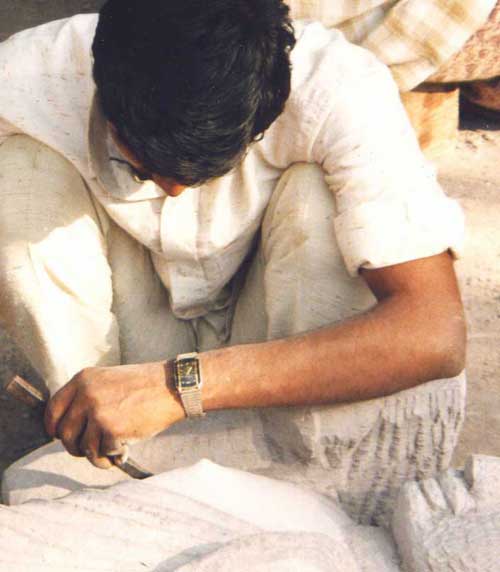
Officially 23 million workers are reported as unemployed and underemployed. These figures are substantially underestimated, as shown by independent studies. (7)
The number of child workers is officially stated to be about 25 million, however independent studies show that the actual numbers could be between 44-100 million. (8)
Since the mid-1980s and particularly after the economic reforms of 1991 (Structural Adjustment Program), the pattern and condition of work has shown the following features:
(i) A rapid growth of the unorganized sector (also called the "informal economy") and a significant shift of the workforce from the organised sector to the unorganised.
(ii) Services are the fastest growing area of employment and lead industrial employment in terms of the proportionate share of the workforce.
(iii) Both unemployment and underemployment have risen sharply. Independent studies indicate that the average rate may be as high as 20-25%.
(iv) Over the past decade both real wages and incomes have been falling.
(v) In an increasing number of economic activities, the security of employment is weakening as work becomes part-time, flexible and the workforce segmentation intensifies. These changes also contribute towards an erosion of unity among the workers.
India has a very small number of workers organised in unions--perhaps 10-12 million. Even if one includes non-registered organisations (urban & rural) that have emerged in the past two decades, the numbers remain very low--possibly 20-25 million. In other words, less than 10% of the employed workforce is unionized. CLEARLY MUCH REMAINS TO BE DONE IN ORDER TO SECURE THE RIGHTS OF WORKERS IN CONTEMPORARY INDIA.
INDIA TODAY--A PROFILE SUMMARY
Based on the information outlined regarding agriculture, industry, and the working people in Inda, we construct the following profile:
1. India is an agrarian economy of millions of small producers and resource poor tillers of the soil. These families approximate 80-85% of the agricultural population.
Agriculture is dominated by a relatively small familial segment of food producers (cereals, sugarcane, and tea) alongside of non-food producers (cotton, oilseeds, and jute). These families control and influence societal conditions in the countryside--at most they constitute an approximate 15-20% of the agricultural population. While the share of agriculture in India's GDP has been declining, it is still the dominant segment of the economy.
2. The industrial sector remains small. It is dominated by a few score large scale manufacturing/financial/trading companies like the Tata's, Birla's, Goenka's, Ambani's and others. These families account for an approximate 5% of the industrial families. Linked to the above companies are thousands of small/medium scale companies in satellite/subordinate connections of sub-contract producers, finance, and trade. These families make up 95% of the industrial families.
3. Since the mid-1960s, a shifting antagonism has been evident between two social groups, (i) made up by the urban industrial barons plus segments of the bureaucracy and intellectuals and (ii) constituted by the new rich commerical agricultural producers allied to a segment of small scale traders, financiers, and manufacturers.
4. Coalition politics of the past three decades is couched in and mainly conditioned by the social forces described in 1, 2, and 3 above.
This is not to suggest a simple linear connection but a complex, dialectically interactive, process whose outcome is often unintended. (9)
The likely outcome of the contemporary political contests, regardless of which group of parties emerge victorious, is a continuing consolidation of market liberalism with a nationalist flourish.
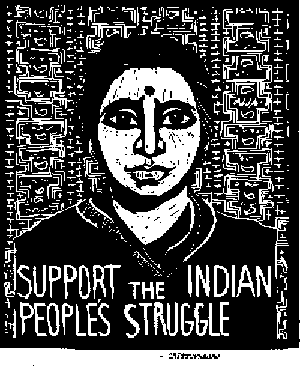
In conclusion, efforts towards forging alternatives which clearly articulate
collective decisions, emphasize social choice, and point towards constructing
relatively viable socialist organization remains the task ahead.
NOTES
1. For further details see (i) Sage Publications (India) are putting
out state-wise studies on Land Reforms; (ii) Appu, P.S> LAND REFORMS IN INDIA,
1996. New Delhi, Vikas; (iii) Basu, Kaushik (ed) AGRARIAN QUESTIONS. 1997 New
Delhi, Oxford U Press. return to main text
2. SOURCE; Swamy, D. "Differentiation of the Peasantry," in S.A.
Shah (ed) INDIA; DEGRADATION AND DEVELOPMENT. 1982-83. Hyderabad, M.V. Foundation.
return to main text
3. Sharma, H.R. "Distribution of Landholdings in Rural India, 1953-54
to 1981-82." ECONOMIC AND POLITICAL WEEKLY, Sept. 24, 1994. return
to main text
4. While industrial output has grown and diversified in the 15
years since the early 1980s, the share of industry/manufacturing remains small.
return to main text
5. Sau, Ranjit. "India a Receding Economy," SUNDAY. Sept. 27, 1981.
return to main text
6. The approximate exchange rate in 2004 was Rs.45.00
equals US $1.00. return to main text
7. See: PIRG. THE STATE OF INDIA'S ECONOMY. NEW DELHI, 1995; Delhi
Science Forum. ALTERNATIVE ECONOMIC SURVEY, 1996-97. New Delhi, 1997. return
to main text
8. See PIRG. THE STATE OF INDIA'S ECONOMY. New Delhi, 1995; Krishna,
Sumi. RESTORING CHILDHOOD. 1997. New Delhi, Konark Publishers. return
to main text
9. See: Shakir, Moin. STATE AND POLITICS IN CONTEMPORARY INDIA.
1986. Delhi, Ajanta; Satyamurthy, T.V. (ed) CLASS FORMATION AND POLITICAL TRANSFORMATION
IN POST-COLONIAL INDIA, 1996. New Delhi, Oxford U Press; Doornbos, M & S. Kaviraj.
DYNAMICS OF STATE FORMATION. 1997. New Delhi, Sage.) return
to main text
ALL PHOTOS BY A. AZAD
ART: CHITTOPRASAD
About
the Azad Reading Room India Report Publications
Support
the Azad Reading Room
Corporate Globalization
Other
sites of Interest
HOME