Azad Reading Room


NEW ADDRESS:
AZAD READING ROOM
Aman Vedika, 11-1-809/1, Chinta Bavi
(lane beside Sridevi cinema hall),
Chilakalaguda, Secunderabad,
AP-500061 INDIA
Cell phone: 011 91 934 6988 639
91 40 2007 0143 (Land line phone)
E-MAIL: [email protected]

Azad Reading Room
[Hyderabad]
NEW
Bharat Samajh: Understanding India
India
Report
NEW
NEW
INDIA
REPORT
No. 24
JULY 2007
INTRODUCTION:
Former (and present) corporate CEO’s and centrist
journalists are singing/echoing praises for “Rising India”.
The earlier imagery of “shining India” is replaced with an
attempted debunking of jobless growth accompanied by
a marginalized noting about the plight of the urban
and rural poor. However none of this slick camouflage
can detract from the realities of displacement, division
and degradation faced daily by nearly 80% of India’s
current population. Of course for about 20% of the
population (affluent/rich) it indeed has never been so
good.
Both the grim reality of the lives of the majority as
well as the opulence of a minority underscores the
consolidating rule of capital (dominant controllers/owners of
physical & financial resources – roughly estimated to be
100,000 individuals or 25,000 families) characterized by
deepening inequalities, uneven socio-economic
growth punctuated by a deteriorating quality of the
daily lives of the vast majority of the people of India.
The editor of this report traveled to and in India
between November 06 and April 07. Several regions
were briefly visited where film screenings and discussions
took place. During the stay in India, a deeper involvement
has developed in the context of the alliance with Aman Vedika
(Peace Forum/Education) and particularly through the
stewardship of the current ARR coordinator.
The report includes segments on the economy, politics
Society, books, films, plays, toons, pics and concludes with
ARR’s annual appeal for support
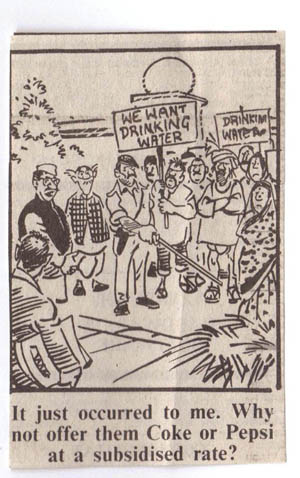
ECONOMY:
The multimedia often reports the existence of “two India’s” with the accompanied noting of “two economies” the “New India” and the “wretched India”. Superficially such a description pretends to be balanced. In reality the “rich” and “poor” are parts of a single system – in conventional terms a market economy with integrated structures necessitating each other. In this sense the rule of capital generates/reproduces the affluent minority (at best about 20% of the population) on the backs of the poor and struggling majority (approximately 80% of the population). The investigative reporter Greg Palast states it clearly: “What about the New India, the new manufacturing colossus that lifted India’s gross domestic output by 48% per worker in just six years (1997-2003). In that same six years, wages in this modernized manufacturing sector went from 25 cents an hour to – 23 cents. Who got the gap? That is, who pocketed the value of the extra output, which, obviously, didn’t go into wages. One hundred per cent of the value of new manufacturing output went to India’s richest one per cent, the new pashas of subcontinental industry, who’ve doubled their slice of the nation’s income over the past decade” (Greg Palast. Armed Madhouse. 2006. N.Y. Dutton – Penguin, p. 156). In the words of economic argument, a well known economist notes: “—the agendas of an egalitarian, democratic and sustainable development for a New India cannot be evolved and implemented on the basis of a dream of an 8 to 10 per cent annual rate of growth of GDP and the pursuit of the status of a global super power, especially by relying too heavily on the unregulated interplay of market forces”. (Kamal N. Kabra. Alternative Economic Survey, 2005-2006. 2006. New Delhi, Daanish Books. P.27; the reader may also wish to see the flawed basis of computing GDP growth rates in, Arun Kumar. Alternative Economic Survey, 2005-2006. New Delhi, Daanish Books. Pp.29-44).
The annual budget exercise for India in February-March, 2007 is another revealing source indicating missed opportunities, built-in inequality and confusing strategies for economic change: “Overall, therefore the budget is not only a major missed opportunity it also reflects a disturbing inability on the part of this government to hear the voice of the ordinary people and be sensitive to their needs”. (Jayati Ghosh. “Budget of Missed Opportunities”. Deccan Chronicle. 3 March 2007. p.7). Commenting on the National Rural Employment Guarantee Act and the Integrated Child Development Services the economist Jean Dreze underscores the budget inequities by pointing out the failures to implement programs to benefit the rural poor farmer and disadvantaged children. (Jean Dreze. “Empty Stomachs and the Union Budget”. The Hindu. March 9, 2007. p.10. Also see, M.J Akbar. “The 2.5% rate of Growth”. Deccan Chronicle. April 3, 2007. P.6.) A former Finance Minister of the national government concludes his examination of the budgets (Union & Railway budgets): “Thus the 2007 -08 budget is an anti-development, a hodge-podge of financial allocations without any strategy, stated objectives, priorities or direction. The former ’Dream Budget’ merchant is going to cause nightmares for the people”. (Subramaniam Swamy. “A Critique of the Two Budgets“. The Hindu. March 4, 2007. P.12.).
Information technology and the slick association of its growth enabling India to be in the mainstream of an economic take-off in the 21st century needs the following qualifiers. The employment in this sector covers a little over 1 million persons or only one third of 1% of the workforce. Furthermore the conditions and consequences of work are highly stressful leading to substantial health disorders. (See: Shobha John. “Call center employees run the risk of epileptic fits”. Times of India. November 20,2006. P.1; Prayag Akbar. “The Night Errant”. OUTLOOK. 16 October 2006. Pp.104-106).
In summation the economy exhibits substantial inequality, generates massive displacement and contributes to widespread degradation of human and physical resources (Barbara Harriss-White. INDIA's MARKET ECONOMY, 2005. Delhi -Gurgaon. Three Essays).
POLITICS:
State level elections in both the Punjab and Uttar Pradesh during the first 6 months of 2007 have delivered clear defeats for the Congress Party and its allies of the National Democratic Alliance (NDA). While the politics of coalition governance are likely to continue, the currents of statecraft are rife with turbulence and instability.
One of the important tendencies over the past decade is the tilt towards the USA. Earlier in 2006-07 there has been a great deal of media coverage regarding the US - India nuclear understanding (See: Radha Kumar. “Poles Attract”. OUTLOOK. 16 October 2006). The geopolitical thrust of India has been the expectation of the country to emerge as a leading regional heavyweight. However examining the details (so far made public) of the Military Technology Control Regime (MTCR), Brahma Chhellaney notes: “While the nuclear deal will permit the US to have its cake and eat it too. India is being called upon to open itself to action from both ends of the MTCR stick – to formally adhere to the regime from the outside, yet remain one its principal targets. This is just one example of how the vaunted deal squarely puts India on the debit side of the ledger”. (Brahma Chellaney. “Missile Trap in a Nuclear Plot”. Deccan Chronicle. 27 January 2007. P.7; Also see: Seema Mustafa. “A Dream Shattered”. Deccan Chronicle. 16 December 2006. P.6).
The US continues to strengthen its military presence/capability in the South Asian region. The recent 10-year Acquisition and Cross Servicing Agreement (ACSA) between the USA and Sri Lanka provides for logistics supplies plus refueling facilities. Following the existing US military base in Diego Garcia the ACSA introduces an additional basis for a strengthened military pressure by the USA. Finally how the USA uses its political/economic leverage is exposed, in a recent publication by Ashok Mitra (former Chief Economic Adviser to the Government of India), where he describes the manner of choosing Finance Minister(s) – appoint the US preference or suffer economic consequences. Economic warfare is alive and well! (M.J. Akbar. “A Prattler’s Tale”. Deccan Chronicle. 4 February 2007. P 6. Akbarï’s article being a review of, Ashok Mitra. A Prattler’s Tale: Bengal, Marxism and Governance. 2007. Kolkata, Samya.).
Of course the process of political domination is not going unchallenged. The survivors of the Bhopal gas disaster (December 1984 – Union Carbide) organized as the Women’s Resistance Group staged a rally on December 2, 2006 to demand full compensation, rehabilitation, secure jobs and clean drinking water. (Lalit Shastri. “Gas Victims Take out Rally”. The Hindu. December 3, 2006. P.11). Peasants in a cluster of villages in Nandigram, W. Bengal continue their opposition to the construction of an automobile assembly plant on land confiscated from the villagers. (Gargi Parzai. “It’s a Peasant movement in W. Bengal”. The Hindu. January 4, 2007. P.12).
In Hyderabad, Andhra Pradesh a candlelight vigil/protest was organized by Aman Vedika with a coalition of other organizations to protest domestic violence against women as well as the neglect of the rights of children (many of them street based homeless children. (Kalpana Sharma. “No Civilised Debate”. The Hindu. January 8, 2007. Magazine. P.3.)
Resistance to market led oppressive outcomes continues to emerge in hundreds of locales.
SOCIETY
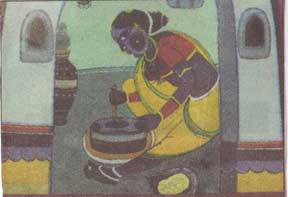
The story goes, visibly deployed by the audio-visual-print media that the middle class is growing rapidly – one observer guess-estimates it to have reached 500 million or nearly 50% of India’s total population. (Pavan K.Varma. “New Middle Class”. OUTLOOK. 16 October 2006. P.26). Other careful studies indicate that the middle class is, at best, constituted by about 20% of India’s population. There are some interesting and shocking social features that have evolved with the growth of the middle class.
1. Space (land and its use allocation) is rapidly being dominated/controlled by big box shopping malls and gated housing developments. Both developments contribute to the exclusion/displacement of the majority of urban residents. This pattern of land use expansion intensifies the consumption styles of “keeping up with the Patels & Ambanis” as well as fuels the drive for mergers plus takeovers by the likes of Wal Mart’s. Segments of the middle class take on the role of middlemen “fixers” facilitating an interface between political favours and commerce. (See: Madhu Gurung. “Left out in the cold”. The Hindu. March 4,2007. Magazine. P.4; “Happy Realty”. Times of India. November 22,2006. P.6; Naresh Fernandes. “The Big Sellout”. OUTLOOK. 16 October 2006. Pp.94-96; Reuters (New Delhi). “Wal-Mart makes retail foray via Bharti”. November 27, 2006.).
2. The communication explosion is underlined by noting that over 130 million people use cell/mobile phones in India. While access between people and some other convenience factors can be acknowledged it needs to be emphasized that security, privacy, sales blitzes and unwarranted surveillance have rapidly expanded: “--- the recent mobile phone boom is directly linked to the wars that have devastated Central Africa which holds the largest reserves of coltan, a mineral used in the manufacture of mobile phones and laptop computers” ---- ”Amongst the things that the mobile phone made possible in India was a dramatic increase in all sorts of formal as well as informal surveillance processes.” (Shuddhabrata Sengupta. “Sound is an Image”. OUTLOOK. 16 October 2006. Pp. 108-110).
3. The condition of women continues to remain as second-class citizens. (See: Jaya Mehta. “Women”. Alternative Economic Survey, 2005-2006. op.cit. 2006; Dharam Shourie. “India ranks low in MP’s“. Deccan Chronicle. 4 March 2007. P.3; Kalpana Sharma. “Muslim Women criticize Sachar Report”. The Hindu. January 28,2007. P.9),
Prisoners as part of the workforce are underpaid and poorly fed. (U. Sudhakar Reddy. “Prisoners paid Rs.10/- for a days work”. Deccan Chronicle. 31 January 2007. P.3. Please note that Rs.10/- is about 25% of US $1.00 or 25 cents at the current exchange rate).
Casual construction labourers in urban areas like Mumbai are literally homeless and subsist on very low wages while subject to a variety of health and security risks – these workers make up millions of India’s work force. (Anil Raina. “Aakhri Rasta”. Mumbai Mirror. November 19, 2006; Also compare the chapters by Keshab Das, Alpana Sagar, K.B. Saxena and Prakash Louis in Alternative Economic Survey, 2005-2006. op.cit. 2006
AZAD READING ROOM
During the past year ARR carried out or initiated the following programs.
1. Film screenings were held in Hyderabad (Central University & Osmania University), NALSAR (Law School), Mysore Film Society and Kolkata (International Film Festival). An average of 40-45 people participated.
2. Book readings for children were carried out in several localities (bastis) of Hyderabad. The children showed great enthusiasm. Over 200 children participated in the program.
3. Films from the ARR archives as well as books from ARR holdings are being used by individuals and community groups.
4. Joint publication activity is being explored. Sales of existing publications are expanding – Rs.500/- was deposited in the ARR account.
5. With Aman Vedika and other city based organizations extensive mobilization has been carried out to protect women & children from violence as well as secure rights for street children. The various campaigns were able to reach over 20,000 people.
6. Subscriptions have been made for 3-4 Indian magazines.
7. Exploration for a speaker series is being discussed
8. Community members have expressed interest in donating resources for ARR. One visitor donated Rs.200/- and another visitor from Italy donated Rs.500/-
Please see our APPEAL page to continue your valued support.
Address:
AZAD READING ROOM, C/O Aman Vedika
1-3-183/40/46/16, New Bakaram, Gandhinagar,
Hyderabad, A.P. 500 080. INDIA
Tel.: 91-40-27707179;
FAX: 91-40-7808808;
E-MAIL: [email protected]
Coordinator: Ms.Ambika,
Tel.# 011 91 9346988639 (cell phone)
NEW - 011 91 40 2754 4933 (Land line phone)
[email protected]
[email protected]
BOOKS:
Gita Hariharan. IN TIMES OF SEIGE. 2006.
Pankaj Mishra. TEMPTATIONS OF THE WEST. 2006.
Monica Ali. ALENTJO BLUE. 2006.
Rajkamal Jha. FIREPROOF. 2006.
Sukanta Chaudhrie & Chee Sing Lee (eds.). SHAKESPEARE WITHOUT ENGLAND. 2006.
Kamla Patel. TORN FROM THE ROOTS: A PARTITION MEMOIR. 2006.
C.K. Meena. BLACK LENTIL DOUGHNUTS. 2006.
M. Asadudin (ed.). THE PENGUIN BOOK OF CLASSICAL URDU STORIES. 2006.
Tara Gandhi (ed.). A BIRDS EYE VIEW. 2 Vol�s. 2006.
Manreet Sodhi Someshwar. EARNING THE LAUNDRY STRIPES. 2006.
Mukhtar Mai with Marie Geng. IN THE NAME OF HONOR. 2006.
Rinki Bhattacharjee. (Ed.). JANANI: MOTHERS, DAUGHTERS, MOTHERHOOD. 2006.
Tishani Joshi. COUNTRIES OF THE BODY. 2006.
Vivek Narayanan. UNIVERSAL BEACH. 2006.
Anita Rau Badami. CAN YOU HEAR THE NIGHTBIRD CALL? 2006.
Premchand. (Translator – David Rubin). THE SECOND WIFE. 2006.
Sivasankari. (Translator – Rekha Shetty). PORTABLE ROOK. 2006.
A.N. Sattanathan. PLAIN SPEAKING: A SUDRA’S STORY. 2006.
Shivanand Kanavi. RESEARCH BY DESIGN. 2006.
Rammohan Gandhi. MOHANDAS: A TRUE STORY OF A MAN. 2006.
Kama Maclean. POWER & PILLAGE: THE ALLAHABAD KUMBH MELA. 2006.
Yashodra Dalmia & Salima Hashmi. MEMORY, METAPHOR, MUTATIONS: CONTEMPORARY ART OF INDIA & PAKISTAN. 2006.
Malvika Singh (ed.). FREEING THE SPIRIT: THE ICONIC WOMEN OF INDIA. 2006.
Sarnath Banerjee. THE BARNOWL WONDROUS CAPERS. 2006.
Riverbend(Pen name). BAGHDAD BURNING. 2007.
Sudhir & Katrina Kakkar. THE INDIANS, PORTRAIT OF A PEOPLE.
Niven Govinden. GRAFFITI: MY SOUL. 2007.
Deepti Mehrotra. GULAB BAI, THE QUEEN OF NAUTANKI. 2007.
Khaled Hosseini. A THOUSAND SPLENDID SUNS. 2007.
Charles. Tilly. DEMOCRACY. 2007.
Dean Baker. THE UNITED STATES SINCE 1980. 2007.
Ramchandra Guha. INDIA AFTER GANDHI. 2007.
FILMS:
Hyd---Bad Nawabs. Dir. – Lakshmikanth Chenna.
Nayi Neralu. Dir. – Girish Kasravalli.
Dor. Dir. – Nagesh Kukunoor.
Traffic Signal. Dir. – Madhur Bhandarkar.
Amrita Pritam. Dir. – Deepti Naval.
Alam. Dir. – Rishi Mehta.
Parzania. Dir. – R. Dholakia.
Honeymoon Travels Private Ltd. Dir. – Reema Kagti.
Gandhi Park. Dir. – Tom George Kolatte.
PLAYS:
Hidden Fires. Dir. – Rashi Bunny
Walking Through The Rainbow. Dir. – Rashi Bunny.
Dukh Dariya. Producer – Ajoka.
Border, Border. Dir. – Shahid Nadeem.
Buhe Buriyan. Dir. – Neeta Mahindra.
Altoon, Paltoon. Dir. – Adwati Kamik.
Crab. Dir. – Arghya Lahiri.
Turel. Dir. – Sunil Shanbag.
Click here for new India Toons
Click here for World Pics
ARCHIVE:
Click here for India Report No. 21 (July 2004)
Click here for India Report No. 22 (July 2005)
Click here for India Report No. 23 (July 2006)
About
the Azad Reading Room
Support
the Azad Reading Room
Bharat Samajh: Understanding India
India Report
Corporate Globalization
World Social Forum
Publications
Other
sites of Interest
HOME