Azad Reading Room


NEW ADDRESS:
AZAD READING ROOM
Aman Vedika, 11-1-809/1, Chinta Bavi
(lane beside Sridevi cinema hall),
Chilakalaguda, Secunderabad,
AP-500061 INDIA
Cell phone: 011 91 934 6988 639
91 40 2007 0143 (Land line phone)
E-MAIL: [email protected]
Azad Reading Room
[Hyderabad]
NEW
Bharat Samajh: Understanding India
India
Report
NEW
INDIA
REPORT
No. 22
JULY 2005
INTRODUCTION:
Over the past year since the national elections of 2004 the main character
of the country is the one about deepening disparities and heightened latent/open
social conflicts. The Tsunami disaster of December 26, 2004 sharply defining
the unequal societal divisions amidst the massive and tragic human along
with infrastructure destruction.
Of course the mainstream media (audio, visual & written) continue
to emphasize the economic growth rate, the large pool of high-tech labor,
lavish life styles of the "rich" and mega projects of bijli,
sarak aur pani (electricity, roads & water) further displacing the
earlier quest for roti, kapra aur makan (food, clothing & shelter).
Notwithstanding the actually existing stark burdens of not being able
to meet the basic needs adequately for a majority of the people of India.
This report has consistently noted that the story of India is about the
persistent, deepening inequalities between 15-20% of the rich/affluent
and the 80-85% of the rest of the population.
The editor of IR, during 2004-2005, traveled to and within India to West
coast area between Mumbai (Bombay, Maharashtra) and the lush waterways
of South-Central Kerala. Later spending time in Andhra Pradesh and travels
to 9 cities in different parts of India.
This report will highlight aspects of the economy, politics and social
conditions. There will also be the usual segments about books, films,
plays, toons & pics as well as our annual appeal.
IR is pleased to bring to your attention news about the developing prospects
regarding a second location for Azad Reading Room in Hyderabad (the existing
location being in Secunderabad). Details regarding the specific location
will be posted on our web site as soon as they are complete.
Coordinator:Ms. Ambika
Tel.#: 011 91 934 6988 639 (cell phone)
Azad Reading Room -A Resource Centre
The grassroots organisations and activists that belong to diverse faiths,
castes, class and gender, will be supported actively in a variety of ways
by Azad Reading Room . It is necessary for it to identify firstly existing
organizations that are working on peace, secularism and justice issues,
and necessary support services will be provided. In the event that there
are gaps or additional need, the major activities of this resource centre
are listed below.
A governing body will be constituted with individuals/representatives of
different organizations of various backgrounds for collective management
of the resource center. Through this resource center the following
activities will be taken up
o Exchange and share human resources and information with movements in
other states about polarization, communalization and efforts at peace
building.
o Network/co-ordinate with resource centers in Andhra Pradesh as well
as other states.
o Collect and create resource material to disseminate to various partners
and new organizations.
o Monitoring of visual and print media to be informed of trends and incidents
of polarization as well as peace building efforts.
o Explore, collect and create appropriate forms of cultural expression
and prepare theatre activists to campaign for peace building, promote
pluralism and arrest polarization.
o Collect films from various sources and make them accessible to peace
volunteers and organizations. Arrange screening, generate discussion to
motivate people to understand the need of maintenance of social fabric.
o Arrange talks by eminent people and sharing of experiences in promoting
communal harmony.
o Take up study of a) situational analysis b) Educational material and
textbooks.
o Arrange/co-ordinate orientation and sensitization training for teachers
in collaboration with resource agencies who are already in this line of
work.
o Link/organize political orientation sessions for activists, volunteers,
representatives of organizations and CBOs, public representatives, govt
officials, development workers, teaching community and others.
o Arranging organizations/institutions to prepare materials for teaching
in slums.
o Prepare materials for campaign like posters, pamphlets, banners, badges
etc. and motivate forums to exhibit them.
o Help other groups to access material forms.
o Encourage and co-ordinate field trips for groups and individuals to be
exposed to efforts at peace building.
o Form and co-ordinate the activities of vigilance committee to keep track
of the situations and tensions created with communal agenda in general,
and to go to areas of communal tensions to enquire into incidents in particular.
ASPECTS OF THE ECONOMY:
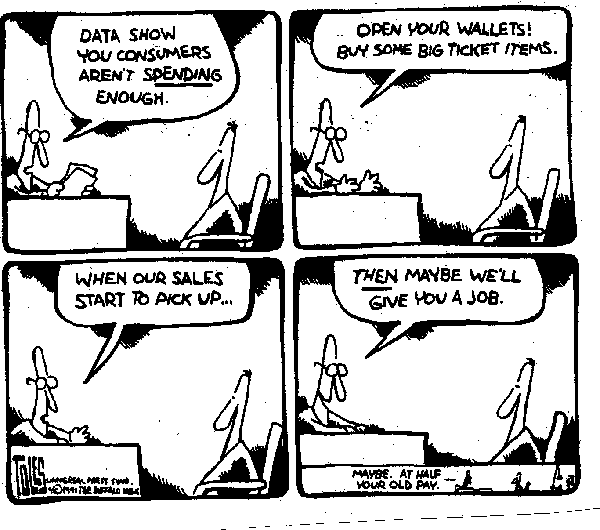 The summer of 2005 marks over 12 months of the UPA rule/governance under
the leadership of the Congress party. Well meaning observers/analysts,
both in India and several parts of the world continue to either support/praise
the economic programs and/or search for its progressive features. However,
the ground reality continues to demonstrate conditions of stagnation and
degradation with a proviso that, perhaps, between 15%-20% of India’s
population has reaped a concentrated share of income and wealth. A detailed
review of conventional macro-statistics covering GDP, NDP, Income &
Wealth, Employment, Industry, Agriculture, Health, and Education among
other features of the Indian economy leads to the CENTRAL conclusion of
economic growth serving the interests of the few (See: Alternative Economic
Survey. MAGINIFYING MAL-DEVELOPMENT. New Delhi, 2004). Complementing the
above study the explicitly political analysis of RUPE, ASPECTS OF POLITICAL
ECONOMY #’s 36,37 & 38 (Mumbai, 2004) notes that the past decade
of economic programs (under both the NDA & UPA) has consolidated a
parasitic economic system/structure.
The summer of 2005 marks over 12 months of the UPA rule/governance under
the leadership of the Congress party. Well meaning observers/analysts,
both in India and several parts of the world continue to either support/praise
the economic programs and/or search for its progressive features. However,
the ground reality continues to demonstrate conditions of stagnation and
degradation with a proviso that, perhaps, between 15%-20% of India’s
population has reaped a concentrated share of income and wealth. A detailed
review of conventional macro-statistics covering GDP, NDP, Income &
Wealth, Employment, Industry, Agriculture, Health, and Education among
other features of the Indian economy leads to the CENTRAL conclusion of
economic growth serving the interests of the few (See: Alternative Economic
Survey. MAGINIFYING MAL-DEVELOPMENT. New Delhi, 2004). Complementing the
above study the explicitly political analysis of RUPE, ASPECTS OF POLITICAL
ECONOMY #’s 36,37 & 38 (Mumbai, 2004) notes that the past decade
of economic programs (under both the NDA & UPA) has consolidated a
parasitic economic system/structure.
For the first 30 years of independent India the popular image of India’s
economy was summed up by a quest to achieve tolerable levels of ROTI (food),
KAPRA(clothing), MAKAN(shelter). The economic programs followed led to
growing disparities and widespread oppression. Over the last 25 years
a decisive shift has taken place such that the quest is to focus on BIJLI(electricity),
SARAK(roads), PANI(water). Disparities have continued accompanied with
human and resource degradation.
In the early months of 2005 there was considerable anticipation regarding
the budget of the UPA government. A leading analyst, after examining the
main segments of the budget, concludes: "--- are the Congress and
the UPA so ideologically committed to neo-liberal reforms that they fail
to see the writing on the wall? Budgets that fail to give economic policy
a pro-people direction will alienate people over time, even if there is
a solid electoral bloc and a charismatic leader, like the RJD had in Bihar".
(Kamal Mitra Chenoy. " Where is the Union Budget?" DECCAN CHRONICLE.
March 1,2005.pp.1& 6).
The Indian economy continues to remain agrarian, despite the falling proportion
agriculture represents in the annual GNP/NNP (gross and net national).
Over 70% of the population resides in the countryside and agricultural
products (wage goods and raw materials) sustain substantial segments of
the industrial, trade and services sectors of the economy. In other words
agricultural activity is a key factor in the economic health/well being
of the nation.
Annually the months of June, July and August are replete with accounts
about the monsoon and its impact on agriculture. This year, 2005 is no
exception. At this writing the vagaries of the monsoon rains remain critically
uncertain for peninsular India and indirectly for other parts of the country
(See: N.Chandra Mohan. "Chasing the Monsoon". OUTLOOK (on-line
edn.). June 15,2005).
In some regions of India a consequence of poor rainfall has been the disaster
of crop failure and the tragedy of suicide deaths. "In the past few
years, over 4000 farmers have killed themselves, trapped in a vicious
cycle of debt, crop failure and penury----". What is the government’s
response? A declining allocation to the agricultural sector. "From
16.4% in 1979-’80, plan outlay for agriculture slumped to 6% in the
1980’s and to 4.9% in the Ninth Plan – 1997 to2002" (Paromita
Shastri. "A Harvest of Misery". OUTLOOK. July 4,’2005;
also see: RUPE. ASPECTS OF INDIA’S ECONOMY. #38. Mumbai, 2004. pp.13-16).
Within the services sector, along with its links to industry, the information
activities (IT segment) are often praised and highlighted as having brought
India into world-class economic levels. As such the IT services are emphasized
akin to a locomotive driving the economy to higher growth rates. However
a analysis of IT services in the Indian economy notes: "--- a sector
whose presence in terms of contribution to GDP and its contribution to
India’s currently comfortable balance of payments position is indeed
substantial, cannot make much of a direct difference to a substantial
section of India’s population". (C.P. Chandrasekhar. "IT
Services as Locomotive". FRONTLINE. June 4-17, 2005. Emphasis
added).
A major English language news-daily in its opening page of the weekend
edition for January 2005 describes some of its concerns regarding growing
health insecurity, the widening political divisions, drought and scarce
water resources. (See: "Memos for the Future". THE HINDU –
Magazine. June 2,2005; also Cf. "Happy New Year". NEW SUNDAY
EXPRESS – Magazine. June 2,2005). All of this where about 20% of
India’s population experiences degrees of well being/affluence while
the rest of the nearly 80% remain in the shadow of economic insecurity,
political & social violence as well as cultural commercialization.
So what about the modernizing quest for water (pani), roads (sarak) and
electricity (bijli)?
Water scarcity is of growing concern and in some parts of the world assuming
critical urgency. (See: Varda Burstyn. WATER Inc. 2005. London/New York.
Verso; "Water Rights and Wrongs". TERRAIN – Northern California.
Winter, 2005; M.Radhika. "And the Government Gamble Goes On".
TEHELKA. February 2,2005).
In India cities and towns are confronted with increasing water shortages.
Recent reports from Hyderabad (A.P.) are highlighting that the city administration
may supply household water once every 2-3 days. Mumbai (Bombay) is exploring
‘privatizing’ to alleviate the shortage of water. Delhi now
appears poised to introduce privatization water a-la the World Bank proposals.
The likelihood of the success of privatized water provision schemes is
questionable. (See: "Pvt. H2O: Mumbai’s new water story".
TIMES OF INDIA –New Delhi. November 30,’04; "Water Way
To Go". TIMES OF INDIA – New Delhi. December 12,’04; Rajesh
Ramchandran. "Smell A Water Rat". OUTLOOK – online edition.
August 1,’05).
The major and minor river systems are polluted and because of poor control
over seasonal water flow major cause of land degradation/destruction.
The Yumuna (Jamuna), one of India’s major rivers crossing the northern
plains from west to east, is described as "--- hardly a river now.
Its more of a junkyard for India’s capital". The description
in the report is both shocking and a horrific example of the degradation
of riverine water resources. (See: "Fast Flowing into Oblivion".
HINDUSTAN TIMES – New Delhi. January 31,2005).
Travel in urban India is a nerve-wracking experience of clogged roadways,
chaotic traffic, rising number and rates of vehicular accidents as well
as polluted atmosphere. A report, about Delhi, typifying cities notes:
"More private vehicles, poor roads and public transportation and
lack of parking space makes Delhi a driver’s nightmare" (See:
Caught in a log jam". SUNDAY TIMES – New Delhi. January 30,2005;
also Cf. "Progress Inc." DOWN TO EARTH. January 31,2004).
While neglect characterizes urban transport there are mega-road projects
such as the ‘Golden Corridor’ linking Delhi-Mumbai-Chennai-Kolkata.
This project launched in the early years of the 21st century was to be
completed by June 2003, postponed to December 2004 and now is claimed
be accomplished by the end of 2005. Cost over-runs have sky rocketed.
Corruption is widespread in the awarding of contracts. (See: "Whatever
happened to the super-highways?" HINDUSTAN TIMES. January 30,2005).
Power cuts, transmission leakages (faulty lines & theft), rising costs/prices
of producing/consuming electricity, corruption and environmental pollution
are typical of the power sector in India. The case of the ENRON power
project in India highlights both the misdirection as well as the mis-management
of the generation, distribution and consumption of electricity. A path
breaking study of the ENRON project in the 1990’s documents the misconception
of the project, the subversion of legislation, corruption of the process
of costs/prices and the callous disregard for the needs of large segments
of the population. (See: Abhay Mehta. POWER PLAY. 1999. Mumbai, Orient
Longman).
Current attempts to address the serious problems of providing electrical
power via privatization has further accentuated the inequalities between
the smaller urban and rural consumers and the powerful industrial and
agricultural users. A continuing dependence on resources like coal/oil/gas
to generate electricity degrades and pollutes the environment. (See: Surinder
Kumar. "Power Sector". In, Alternate Economic Survey. MAGNIFYING
MAL-DEVELOPMENT. 2004. Delhi, Rainbow Publishers. Pp. 113-116).
ASPECTS OF POLITICS:
Politically India has been a liberal system and structure since independence.
This system was regulated through planning and a ‘strong’ central
government – this phase lasted through the late 1970’s. Since
the early 1980’s, with a quickening since 1991, the regulations are
being chipped away and/or eroded. In contemporary India market norms dominate
politics in the context of a regional shift of the centers of power. (See:
Himanshu Roy. "Party Systems in Indian Provinces" FRONTIER.
October 3-30,2004; Kamal Mitra Chenoy. "Systems of political Thought".
THE HINDU – folio. September 12,1999).
In 2004, soon after the Congress led UPA government came to power, significant
defense/security agreements were forged between India and the USA. The
recent visit of Manmohan Singh (India’s Prime Minister) to the USA
further underlines the closer alignment with the USA. (See: Seema Sirhoi.
"The Power of N". OUTLOOK – online edition. August 1,2005;
and Cf. the reports by Prem Shanker Jha and V.Sudarshan in the same issue
of OUTLOOK).
Both the long-term systemic foundations and its structural features reinforce
tendencies toward political polarization, a deepening network of corruption
& oppression accompanied by rather weak voter participation. (See:
John Harriss. "Political Participation, Representation and the Urban
Poor". ECONOMIC & POLITICAL WEEKLY. March 12,2005; Mona Srinivas.
"Political Distribution System". TEHELKA. May 2,2005; Sumanta
Banerji. " Need of the Hour – Beyond Detoxification". ECONOMIC
& POLITICAL WEEKLY. June 4,2004; Alam Srinivas. " A share in
Power". OUTLOOK. June 2,2004; Seema Mustafa. "The Ostrich".
DECCAN CHRONICLE. February 26, 2005; Fali S. Nariman. " Tidal Wave
of Corruption". DECCAN CHRONICLE. December 17,2004; Ashok Mitra.
"Humane Mask". THE TELEGRAPH – Kolkata. June 29,2004.
It is not surprising that currently the interface of politics and economic
reform continues to distort/block necessary and needed improvements in
the everyday life of a majority of India’s population. (See: N.Chandra
Mohan. "Paralysed Reforms". OUTLOOK – online edition. July
29,2005; Supriya RoyChowdhury. "Economic Reforms in Political Space".
ECONOMIC & POLITICAL WEEKLY. June 20, 2004).
ANDHRA PRADESH:
Hyderabad, the capital of Andhra Pradesh, is an attractive city with a
moderate climate. Over the years the city has been subjected to several
market driven shocks leading to a denuding of green areas along with depleted
water resources (rivers, lakes and tanks). (See: I. Malikarjuna Sharma.
"Rape of a Lake". FRONTIER. Oct.3-30, 2004).
During December 2004 Hyderabad hosted a regional anti-war (Iraq) assembly.
Several hundred participated in the workshops and plenary sessions. A
rally, drawing about a thousand people concluded the assembly, which included
delegates from Iraq, Palestine, S.E.Asia, Africa and other regions of
the world.
Expectations, under the recently elected Congress government, about the
possibilities to improve administration and the daily life of Andhra Pradesh
citizens have not materialized. (For a background see: K.Balagopal. "Andhra
Pradesh: Beyond Media Images: ECONOMIC & POLITICAL WEEKLY". June
12,2004).
Disparities within Andhra Pradesh were highlighted by the persisting,
desperate conditions of farmers (particularly in Telengana) in the context
of amassed wealth/income of politicians. (See: Moolah Matters". SUNDAY
DECCAN CHRONICLE. December 19,’04; V.Sridhar. "An Agrarian Tragedy".
FRONTLINE. June 19-July 2,’04).
A recently constituted organization, AMAN VEDICA (regional affiliate of
the national organization AMAN BIRADARI) has been expanding its peace/communal
harmony activities throughout Andhra Pradesh. The organization is mobilizing
people around cultural events, women & children’s issues as well
as in the movement to stop the mining of uranium. A recent documentary
about the effects of uranium mining, titled ‘Radiating Lies’
has been released and Azad Reading Room has acquired a copy.
Azad Reading Room organized two sets of film screenings – one at
the Center for English & Foreign Languages (CIEFL) and the other at
the University of Hyderabad. The screenings were received enthusiastically
by a large number of participants.
ASPECTS OF SOCIETY:
Indian society is complex. Elements of ‘good’ and ‘bad’
social conditions exist side-by-side. However at the end of 2004, Transparency
International released its annual Global Corruption barometer noting:
"For us in India it was most unflattering ---- India’s place
in the CPI (Corruption Perception Index, range 10 – Highly Clean
to 0 – Highly Corrupt) scoreboard --- (was) assessed between 2 &
3 ---." (Fali S.Nariman. "Tidal wave of Corruption. DECCAN CHRONICLE.
December 17,2004. P.10).
Mid-year 2005, more than 7 months after the Tsunami disaster. What is
that? (See: "Beyond Tsunami". DOWN TO EARTH. January 31,2005).
Media reportage eager to scoop the most current story has long moved on.
At best, tourism with its emphasis of revived exotic destinations occasionally
graces the travel section. Yet ground level conditions in the 11 worst
hit nations remain grim as evidenced from Aceh (Indonesia), Andaman Islands
(India) and the eastern coast of Sri Lanka. (See: "Fisherman cool
to Center’s package". NORTHERN INDIA PATRIKA. February 3,2005;
Norman Greenway. "Relief not getting to the poor". THE PROVINCE
– Vancouver, B.C. June 26,2005; Jeff Sallot. "Canadian relief
for tsunamis still flowing in a trickle". THE PROVINCE – Vancouver,
B.C. June 26,2005).
Examining aid/assistance for the Tsunami disaster a analyst concluded:
" The slow progress being made in aid delivery combined with the
lack of full participation of the communities most affected by the tsunami,
demonstrate the undemocratic and unsustainable manner in which reconstruction
efforts are being carried out, six months after a devastating tsunami
ravaged the coastal communities of South and Southeast Asia". (Debayani
Kar. " The Tsunami Aftermath: Reconstruction or Economic Opportunism?"
www.fpif.org June 23,2005).
Finally, India Report salutes to well known women of India. On the long
road to gender equality these 2 women have tirelessly championed the various
causes upholding the rights of women. One of them is a leading historian,
Romila Thapar – Professor Emeritus, Jawahar Lal Nehru University,
New Delhi. The other, Nandita Das, is a leading actress and social worker.
Both reside in New Delhi. (See: R.Champalakshmi. "Forgotten Themes".
THE HINDU – Magazine. December 19, 2004; H.Balakrishnan. "Her
Own Person" THE HINDU – Magazine. December 19,2004).
BOOKS:
TUTOR OF HISTORY. Manjushree Thapa. Penguin
FORGET KATHMANDU. Manjushree Thapa. Penguin.
DEEPENING OF DEMOCRACY. Madhu Kishwar. Oxford U. Press.
TALKING SONGS. Javed Akhtar. Oxford U. Press.
VEDIC AGE. Irfan Habib & Vijay Kumar Thakur. Tulika.
SURFACE. Siddharta Deb. Picador (India).
THE IDEA OF PAKISTAN. Stephen Cohen. Oxford U. Press.
COLLAPSE. Jared Diamond.
BIG BREASTS & WIDE HIPS. Mo Yan
THE CUBAN ECONOMY AT THE START OF THE 21ST CENTURY. (Eds.) Dominguez,
Jorge, Omar Eveleny-Perez & Lorena Barberia.
THE NEW IMPERIAL CHALLENGE. Vols. 1&2. Merlin Press.
COMIC CENTURY. Gautam Bhatia. Penguin.
NO GUNS AT MY SON’S FUNERAL. Paro Anand. Roli.
WAR TRASH. Ha Jin. Pantheon.
THE ROAD TO RAISINA. K. P. Singh. Harper-Collins (India).
GENDER DIMENSIONS IN DISASTER MANAGEMENT. Malalgoda Ariyabandhu &
Maithree Wickramasinghe. Zubaan.
SIGNIFYING THE SELF: WOMEN & LITERATURE. (Eds.) Malashri Lal, Shromistha
Panja & Sumanyu Satpathy. Macmillan India.
IRANDAM. (Tamil). Jamangalin Kathai. Salma.
ISLAM, MUSLIM & THE US. Asma Barlas. Global Media.
REVISITING INDIAN NATIONALISM. D.A.Low. Oxford U. Press.
DOTS AND LINES. Jayant Kalkini. Indialog.
GOOD MUSLIM, BAD MUSLIM. Mahmood Mamdani. Permanent Black.
MULK RAJ ANAND OMNIBUS. Saros Cowajee. Penguin Viking.
AMU. Shonali Bose. Penguin.
VINEGAR SUNDAY. Kankana Basu.
SANGATI (Events). Bama. Translated From Tamil. Oxford U. Press.
MANAGING WATER SCARCITY. (Eds.) A.Vaidyanathan & H.M.Oudshoom. Manohar.
INDULEKHA. (Translated from Malayalam). O.Chandumenon. Oxford U. Press.
BRICK LANE. Monica Ali.
PRITHVIWALLAHS. Deepa Gahlot.
TWO PLAYS. Girish Karnad. Oxford U. Press.
AFTERMATH – AN ORAL HISTORY OF VIOLENCE. Meenakshi Verma. Penguin.
THE STRAWBERRY PATCH. Nanda Chatterjee. Penguin.
FILMS:
PAGE 3. Dir. – Madhur Bhandarkar.
BLACK. Dir. – Sanjay Lal Bhansali.
BLACK FRIDAY. Dir. – Anurag Kayshap.
SWADES. Dir.- Gowariker
LITTLE TERRORIST. Dir. – Ashwin Kumar.
SHWAAS (Breath). Dir. – Sandeep Sawant.
AITRAAZ (Objection). Dir. – Abbas Mustan.
KHAMOSH PANI (Silent Waters). Dir. – Sabina Sumar. (Pakistan)
KAYA TARAN. Dir. – Sashi Kumar.
TURTLES CAN FLY. Dir. – Bahman Ghobadi. (Iraq/Kurdistan).
CHAI PANI (Tea Party). Dir. – Manu Rewal.
CHAND BUJH GAYA. (Gujrat riots).
RAINCOAT. Rituparno Ghosh.
PLAYS:
KALI BARAF (Urdu). Dir. – Mushtaq Kak.
ADHAANTAR (Marathi). Dir. – Jayant Pawar.
MANTO ISMAT HAZIR HAIN. Dir. – Naseeruddin Shah.
PAYING GUEST. Dir. – Rajiv Nigam.
THE COLLAGE. Dir. – Naseeruddin Shah. (Three Tales).
AAPKI SONIYA (Your Soniya). Dir. – Javed Siddiqui.
Click here for new India Toons
Click here for World Pics
Click here for India Report No. 21 (July 2004)
About
the Azad Reading Room
Support
the Azad Reading Room
Bharat Samajh: Understanding India
India Report
Corporate Globalization
World Social Forum
Publications
Other
sites of Interest
HOME