
Musical Instruments | Updates | Cairo Opera House | Links
| |
Home | Composers Index
| Musical Epochs
| Musical Forms | Contact Musical Instruments | Updates | Cairo Opera House | Links |
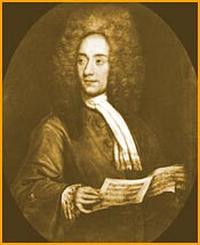 |
Tomaso Albinoni was an important Italian composer from the Baroque period. While there are few unique characteristics in his style, he still managed to impart individuality to his music via his structural schemes and his tendency for repetition. With his Balletti a tre (1701), Op. 3, Albinoni reached a plateau in the instrumental genre occupied by few of his peers. Two of his four sets of twelve Concerti a cinque, the second (Op. 7) from 1715, and the third (Op. 9) from 1722, are among the most important and influential instrumental compositions of their time.
Albinoni was born in Venice on 14 June 1671, to (Giovanni) Antonio Albinoni and Lucrezia Fabris. Young Tomaso, the oldest of eight children, initially decided to follow his father in the stationery business. Eventually, however, his musical studies led him to composition. Albinoni dabbled in composition throughout his teen years and into his early adulthood, producing an a cappella Mass, his only surviving composition from this early period. The first work bearing an opus number came in 1694, the Twelve Suonate a tre (Trio Sonatas), for two violins, cello and keyboard. In 1694, he produced his first opera, Zenobia, regina de' Palmireni, staged later that year in Venice. This is one of his few surviving operas, and Prodigio dell' innocenza (1695) and Primislao, primo re di Boemia (1697) were both lost.
Albinoni may have gone into the service of the Duke of Mantua in the latter half of the 1690s. His Op. 2, Sinfonie e concerti a cinque, appeared in 1700 and carries a dedication to the duke. His operas Aminta and Griselda, were both staged in Florence in 1703, the latter with the composer conducting. In 1702, Albinoni's first vocal works were published, a collection of twelve cantatas.
In 1705, Albinoni married Margherita Raimondi, a prominent opera singer. Two years later, he turned out his Concerti a cinque, Op. 7, and, in 1712, his oratorio Maria Annunziata was premiered in Florence. Other important works were to follow. In 1715, his Op. 7 appeared, the Twelve Concerti a cinque, and shortly thereafter, the operas Eumeme (1717) and Cleomene (1718). The Op. 7 Twelve Concerti are notable because they contained the first published set of oboe concertos.
The composer's wife, Margherita, was also quite busy during these years, appearing in opera productions as far away as Munich (1720). She was apparently in the midst of a major career, despite having given birth to seven children. On 22 August 1721, Margherita, only about thirty-seven years of age, died suddenly. Despite his enormous grief, Albinoni managed to keep busy during this tragic period, composing more operas, the Six Balletti e sonate a tre, Op. 8 (1722), and his remarkable Op. 9 effort (1722), another Twelve Concerti a cinque.
With the appearance of the Opp. 8 and 9, the composer's career horizons had seemed to broaden. Actually, he could confidently look beyond Italian borders now, since his reputation in opera, vocal and instrumental music was clearly spreading throughout Europe.
By the early years of the next decade, Albinoni's inspiration began diminishing. After his opera Candalide (1734), his next, Artamene, which he would not complete until in 1741, would be his last. The composer had turned back to the instrumental realm in the 1730s, producing his Op. 10 collection, another Concerti a cinque, in the years 1735 - 36. Albinoni suffered from diabetes in his later years and began failing in 1749. He died on 17 January 1751.