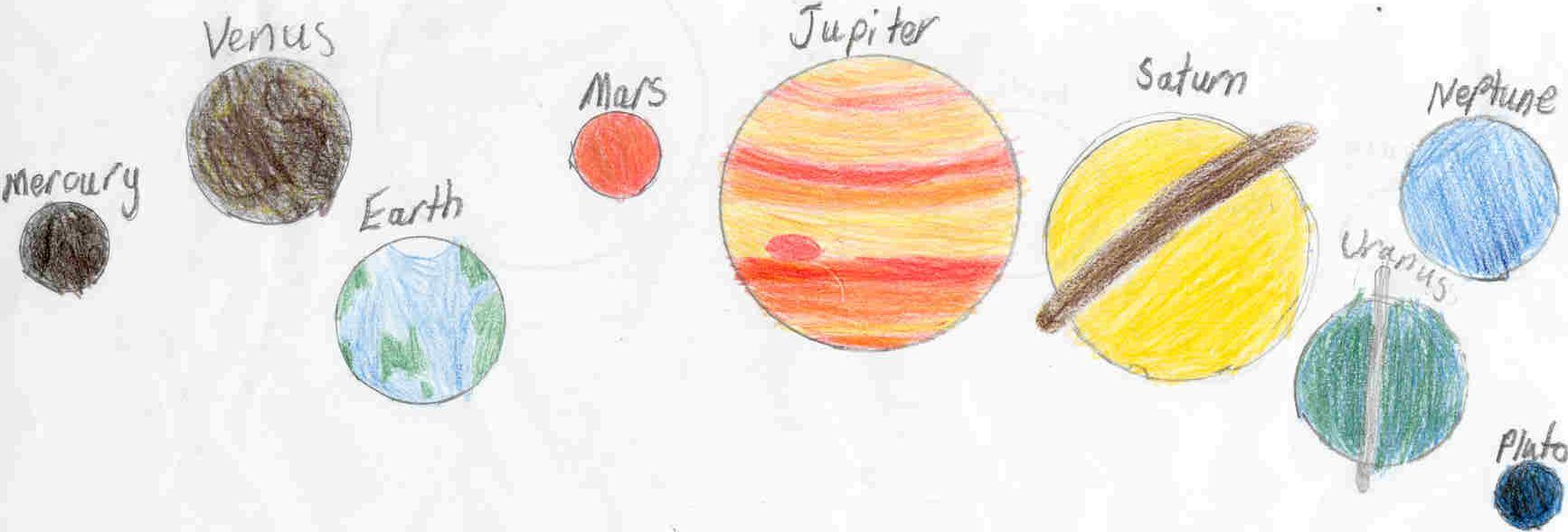
MERCURY Mercury is the closest planet to the sun. It is VERY hot. The temperature can get to 450 degrees celcius! Mercury is the 2nd smallest planet. It is so small in fact, that it is not much bigger than the moon. It looks like the moon too, because it's covered with craters of varying sizes. Mercury is 58 000 000 km from the sun.VENUS Venus is one of the brightest objects in the night sky. Venus is only just smaller than Earth, but it's a LOT hotter. Venus's average temperature is 480 degrees celcius. One reason is the carbon dioxide in its atmosphere. The carbon dioxide acts as a blanket to hold heat in. Venus's atmosphere is made up of gas.EARTH Earth is the only known planet that can support life. 2 out of 3 parts of the Earth is water. Earth is the only planet that is not named after a god.
MARS Mars is fairly easy to spot in the night sky. This is because of its rusty red colour. Its colour has earned it the name the "Red Planet". Mars has 2 moons, namely, Phobos and Deimos. Mars has many channels that may have once had water in them, but now, the only water is frozen in Mars' Polar Ice Cap. One of Mars' canyons is as long as the U.S.A!

JUPITER Jupiter is the biggest planet by far. It could swallow 1,300 earths! Jupiter's great red spot is a storm, thousands of miles wide which may have been there for thousands of years.
Nothing can land on Jupiter, because it is just a big ball of gas. This is why Jupiter is often called a "Gas Giant".SATURN Saturn is also often called a "Gas Giant" because it, too, is made of gas. Saturn is a beautiful planet, with many rings. Its rings are made of ice, rock and dust. Because of the gases in its atmosphere, Saturn would be able to float in a bath tub - if you could find one big enough!URANUS Uranus spins tipped on its side. For this reason Uranus is sometimes called the "topsy turvy" planet. Uranus is another of the "Gas Giants". The methane in its atmosphere makes Uranus appear blue.NEPTUNE Neptune is also a blue "Gas Giant". One of its eight moons is pink and it has a temperature of MINUS 236 degrees celcius. Neptune is 4 496 700 000 kms from the sun.PLUTO Pluto is the smallest planet. It is no bigger than our moon. Pluto's own moon Charon is half of Pluto's width. Pluto's average temperature is MINUS 230 degrees celcius.click here to visit NASA!
This page was put together by Rachel and her Mum.
Content purely by Rachel!If you like this page, please e-mail me

Rachel is a typical Auzzie kid. She likes reading and singing and she loves public speaking. She hopes one day to be an author. Rachel would like to thank her mum and her brother, Gabriel for their help on this page. If you have some spare time, you might like to visit Rachel's Mum's other web pages :
Cool Sites
For KidsA web based
'Treasure Hunt'
on ThirroulPoetry written
by children
from Thirroul
Public School