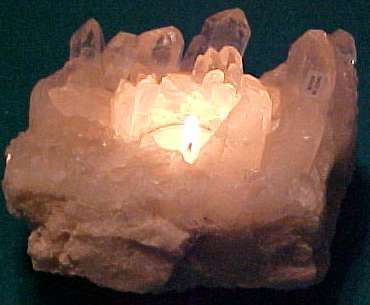
Magic Rocks: The Raystones of The Avalonian Catholic Church
Rune-Caim (Excerpt)
Copyright 2002 Jon Ryner
The runic Caim is well designed,
surrounding the most Holy Tree.
Horn'd bishops' lore has been well-mined:
These stones cry out Christ's majesty.
For His sweet Blood sainn'd these strong stones,
our Earth Mother's beautiful bones.
Together They for us have sown
marvels until now quite unknown.
A Few Notes from Research Into Ancient Practices
Stonehenge and "Celtic" Stones
Stonhenge (ca 35 paces across): outer circle=sarsen, a durable quartzitic sandstone; inner circle=Preseli bluestone. Sarsen horseshoe within bluestone circle+bluestone horseshoe within sarsen horseshoe. The mineral elements of Stonehenge are dominated by the presence of lead and zinc. Carnac is dominated by the presence of silica. These are especially important regarding electrical ionization and relay circuitry - particularly in relation to each other, to harmoniously establish and sustain a balance between Matter (Masculine) and Feminine (Spirit) energies. Either structure stands alone, as a base of free-flowing power between the Earth and the Heavens, but it is their conjunctive qualities that best facilitate the horizontal (third dimension) flow of energy within the third (physical) dimension.
The Pyramids
In a message dated 98-06-08 12:32:51 EDT, you write: << Mica is an excellent insulator, or dielectric, which can be used to form very high quality capacitors. If the pyramids were created by the gods (aliens) as a source of free energy used to power their spaceships and mining operations, I would not be surprised if mica was used in the construction of the pyramids. I am not an expert on pyramids by, but weren't most of the pyramids covered by a shiny material that was taken off by later civilizations? What was the composition of this shiny material that covered the pyramids in Egypt, and possibly others? Steve>>
The Great Pyramid at Giza was covered with very hard, very smooth limestone 'casing stones'. I wonder what the capstone was composed of? Sitchin, in the book "The Wars of Gods and Men", says that the "god" Ninurta (one of The Anunnaki) dismantled the capstone and "smashed it" .... at the end of a war between the rival factions of the Anunnaki ... the Enki faction vs. the Enlil faction. Sitchin thinks that incident happened around 8000 B.C. or so. He also says (and he is quoting from ancient texts, remember) that Ninurta stripped the 'crystals' out of 'The Grand Gallery' inside The Great Pyramid, at that same time. This probably "de-activated" much of the 'functions' of The Great Pyramid.
Carl P. Munck has discovered a very direct and stunning relationship between The Great Pyramid, The Pyramid of the Sun, and Stonehenge. The Grid Latitude of The Pyramid of the Sun (see Munck) is ....19 deg x 41 min x 30.01050301 sec North= 23378.18185 North.
Now; if we divide that figure by the Pi constant, we will get.... 7441.506403 ..... which "just happens to be" the *precise* area, in terms of Square Feet, of The Sarsen Circle at Stonehenge. To get the exact radius of The Sarsen Circle, in Feet, we divide 7441.506403 by Pi, and take the Square Root of the result : 7441.506403 / Pi = 2368.705056 Square Root of 2368.705056 = 48.66934411 Feet, radius of The Sarsen Circle at Stonehenge.
Now; if we divide 48.66934411 into the Grid Latitude of The Pyramid of the Sun, we will have the original height in Feet, including the capstone, of The Great Pyramid (again, see Munck): 23378.18185 / 48.66934411 = 480.3471728 Feet, original full height of The Great Pyramid.
Suppose we divide 480.3471728 into the area (in Square Feet) of The Sarsen Circle? 7441.506403 / 480.3471728 = 15.49193339
The figure 15.49193339 is the precise azimuth in degrees of orientation, of "The Avenue of the Dead" at Teotihuacan, where The Pyramid of the Sun is located.
15.49193339 Squared = 240, the length of The Great Sphinx in Feet, at Giza. <>
Isle of Man
Pre-Christian Remains. Megalithic. 1. At Billown, about 1/2 m. w. of the
Church, are remains showing great boulders of quartz arranged in groups over
a circular area of 35 ft by 25 ft. Five such groups can be distinguished,
each about 9 ft. in diameter, the stones so arranged as to form rectangular
chambers opening towards the centre of the ring. Several stones have fallen
and some have been removed. Traces of fire were noted--Mx. Soc. v, p. 64.
O.S. XVI/7 (the link has Christo-Pagan burian practices, etc.!)
~ from Malew List of Manx Antiquities, 1930 at
http://www.isle-of-man.com/manxnotebook/fulltext/Ima1930/mw.htm ~
The Hidden Church of the Holy Grail
"#421: "The Round Table was constructed, not without great significance,
upon the advice of Merlin. By its name the Round Table is meant to signify
the round world and round canopy of the planets and the elements in the
firmament, where are to be seen the stars and many other things."
--LA QUESTE DEL SAINT GRAAL"
~ from
http://www.ealaghol.com/demon.co.uk/celtenc/celt_g2.htm ~
Avalonian Catholic Praxis
+Leadbeater briefly mentioned in passing that using stones that are not at the head of rays would require larger stones, but he failed to state precisely what sizes he had in mind. Based on preliminary research, we find the size of raylights to be quite powerful, and suspect +Leadbeater was thinking of jewelry-sized stones, which, in the case of such stones as diamond, sapphire, ruby and emerald, would, indeed, have been too costly for the fledgling LCC.
The Liberal Catholic Church claims that the seventh ray on each of their altars is activated by the cross in the middle, and assigns blue to it, perhaps in homage of Freemasonry. The Avalonian Catholic Church finds this repugnant, as we argue that if the cross is the Cross of Light and Life, it therefore should contain all colors within it, and thus be assigned white or, at least, the boosting power of clear quartz. At present, we assign both stones to it. We argue that the Cross of Light contains both genders and is yet beyond them. In Medieval times, even the exoteric Church enshrined the belief that the dew on plants in the morning dropped down from the stars (suns). We therefore see it as quite fitting that we ascribe the stones which purify and boost energies, and which we ascribe to sun and moon to the Cross of Light.
Another fatal flaw in the LCC system is revealed by its Theosophical insistence on a seven-ray system for the altar candles. The problem is that they continue to require 12 candlesticks on the altar for Mass, with no proper explanation of the "mystical side" of those in the front row. Their use of a thirteenth on the altar (instead of a bugia) when a bishop celebrates may well indicate that they know the deficiency of their system, and that it really should be astrologically based.
+Leadbeater argued for goldplated candlesticks to make the energies travel through the air (and, presumably, the ethers). The Avalonian Catholic Church has expanded the effectiveness of this by adding clear quartz boosters to our system. This is also helpful if the candlesticks holding the raylights or the runebowls at a church consecration are not goldplated.
The Avalonian Catholic Church uses a freestanding altar of sacrifice, whenever possible. Experience has shown that great energy can be raised by utilizing the circumambulations, found so frequently in the Eastern rites. To refuse to employ this wonderful and most ancient technique seems to us to be both foolish and wasteful. In addition, there is evidence that the worshipers and keepers of the Holy Grail utilized a round altar for astrologically symbolic reasons.
Placement in the Caim
Our original conception was to place 3 raylights on the freestanding altar and 7 on the floor around it (the seven candlesticks of the Book of Revelation), but currently the better arrangement seems to be to place 4 raylights in the quarters (the Wiccan colors), place "The Seven" on the "tabernacle table" (i.e., old "high altar") and leave the remaining ones on the freestanding altar (which includes a clear quartz booster light). This takes raylights off the floor, which will be safer for many of our fledgling chapels. It also seems advisable to place the raylights throughout the Caim, thus treating the entire Caim as the "battery cell" than to segment it as the Liberal Catholic Church did. The crosses are thus not as essential in our scheme, though it should be noted that at St. Michael's we've placed the quarter lights on ornate metal shelves which boost their power tremendously and looks quite cool, but which does tend to make lighting them a little bit tougher! ;)
Further Experimentation
Our next step will be to see if the quartz booster is really needed on the altar, since the altar itself has a white marble top (We suspect not.)
Also, we'll be playing with the "duplicate" stones, such as purple flourite and amethyst, brown citrine and petrified wood, etc., to see if there is any advantage in using additional stones that are of the same hue.
Recommended Raylights
Click-pick the appropriate ray color on the Rays page.
All written material in this site is copyrighted by the Most Rev. Jon Ryner, except where noted.