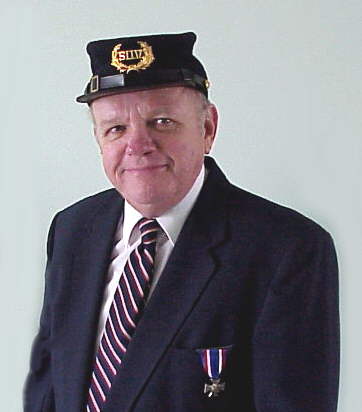
WILLIAM LOWE
36th Indiana, Infantry, Private, Company C
Great Uncle of BILL LOWE
William Lowe was born and raised in New Castle, Indiana, the son of a respected builder, George and Mary Ella (Roach) Lowe. George was also very active in his local Methodist Church, where he is credited with establishing their Sunday School. George was born in Limerick, Ireland, and came to the U.S. in 1834, settling in Morgantown, West Virginia, then a part of Virginia. Mary Ella was born in Rockbridge County, Virginia. William, who was always known as �Will�, grew up with his family going to church every Sunday and during the week, and when not in school, was with his father on a construction job. This became a pattern for much of the rest of his life.
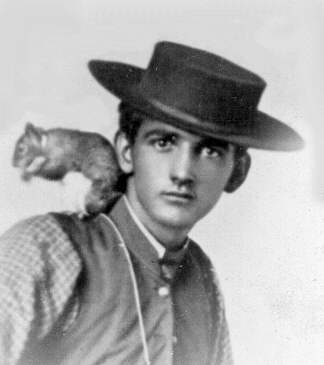 This photograph of Will with his pet squirrel was taken on his 18th birthday in 1861. The Civil War had just begun and he hastened to join the 36th Indiana Infantry when it organized in August of that year. The regiment was mustered in September 16th in Richmond, Indiana.
The next few months saw many days of training in central Kentucky where they were assigned to The Army of the Ohio, which was later merged into The Army of the Cumberland. In February 1862, the 36th along with thousands of other Union troops converged on West Point, Kentucky. There they were boarded on river transports to be taken down the Ohio River and up the Cumberland River to assist General Grant in taking Forts Henry and Donelson. However, before the armada of transports arrived, both forts surrendered and the troops were not needed.
Accordingly, the flotilla continued on to Nashville, capitol of Tennessee, which was still in the hands of the Rebels. Caught unaware of the rapid advance of the Union troops, the citizens of Nashville were attending church on Sunday morning as the transports approached the center of town. Called from church, the Mayor hurried to the boat landing and surrendered the city to eliminate a battle. The 36th Indiana was the second regiment to occupy the town, following the 6th Ohio Infantry, another regiment of their Brigade, and Nashville was occupied without firing a shot.
A few weeks later, The Army of the Cumberland, under General Don Carlos Buell, was again called to join ranks with General Grant�s troops as they were heading for a southern railroad center in Corinth, Mississippi. This time, no river transports, but a hard march overland from Nashville via Columbia, Tennessee, and on toward Corinth. Rain produced swollen rivers and the retreating Confederates were quick at burning bridges as they pulled back. Travel slowed and it wasn�t until the evening of Friday, April 5th, that the 36th Indiana's 4th Division, led by General William Nelson, reached the Tennessee River by Savannah, Tennessee. The 4th Division was the lead unit of Buell�s Army and the 36th was the point regiment.
Early that morning the rumble of cannons upriver signaled the beginning of the first time most of these men would experienced combat� Shiloh!!! With no steamers available to take them the approximate seven miles to the battle, the 4th Division started through a swampy lowland of woods along the east side of the river while the remainder of the army waited at Savannah for the transports. Arriving opposite the battle in mid afternoon the Division began shuttling across the swollen river on supply boats, arriving on the west bank about 4:30 PM.
As they were crossing the river their first view was hundreds of Union troops, officers and enlisted men, deserting in face of the enemy, some trying to swim or float away and others hiding crouched under the bluff. As their boats approached the scene it must have been disturbing to hear their own officers repeatedly shouting, "Shoot the bastards! Shoot the bastards!" To these experienced officers, running in face of the enemy was unheard of.
The 36th Indiana was the first regiment to ascend the bluff that evening, coming to the aid of General Grant. They spent their first night on a battlefield huddled in the rain. They were less than fifty yards across a gully from the enemy, listening to their conversations and hearing the sound of shells pass overhead that were fired from the Union gunboats on the river. The next morning they advanced and eventually drove the enemy from the field.
A few weeks later, after Corinth was occupied, The Army of the Cumberland was again separated from Grant and proceeded along the Tennessee/Alabama border, their objective to take Chattanooga. At the same time, Confederate Armies under Generals Braxton Bragg and Kirby Smith had moved north to attack Louisville and Buell�s entire army was diverted north to intercept them. Neither Bragg nor Smith and their armies reached Louisville.
Next came the Battle of Perryville, followed with a chase down the eastern side of Kentucky to ensure the Rebel army no longer threatened the area. The Army of the Cumberland then headed back for Nashville, passing through Murfreesboro, not knowing they would battle Bragg there again before the end of the year.
It was mid-December and The Army of the Cumberland, now commanded by General Rosecrans, once again headed off to take Chattanooga only this time they met Bragg with 38,000 Confederate troops at Murfreesboro. At the end of that month and into the first few days of 1863, they fought what is known as the Battle of Stone�s River.
Following this battle both armies fell back to re-coup for several months. Union troops were near Cripple Creek, east of Murfreesboro, and Confederates were south near Tullahoma, Tennessee. Both were destined to meet again in September at Chickamauga, Georgia.
Following that battle, as most of the Union troops retreated to Chattanooga, the 36th was diverted more to the west, just west of Lookout Mountain, thus escaping the near starvation siege of the Union troops in the city of Chattanooga.
The United States Signal Corps was organized in the fall of 1863. At that time Will was detached from the 36th Indiana and served the remainder of his military career as part of a signal team.
Medically, Will was fortunate, his only injury was on a night march in early 1863. Marching in a column, in total darkness, several fell into a ravine and Will was injured in the stomach, groin and hip. Records do not indicate if he lost any time on �sick call� but his injuries plagued him the rest of his life. Disease also took its toll as with so many that served in the western armies, especially from contaminated water. In 1862, he was treated repeatedly for diarrhea, commonly know to soldiers in that area as �The Tennessee Quick Step� or �The Tennessee Trots.� His pension application in the 1880�s listed the physical problems he had at that time as high blood pressure, a hernia, chronic diarrhea, and kidney and bladder problems.
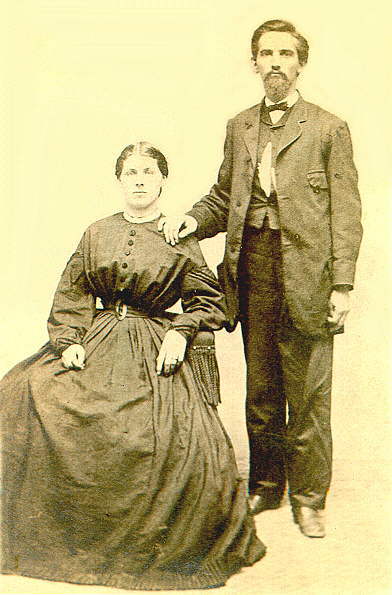 Returning to Indiana after his discharge, he departed for Warrensburg, Missouri, established a home, and started to work with a local contractor. Less than a year later he returned to Indiana to marry Anna Peed of Tippecanoe, Indiana. After the wedding ( left ) they returned to Warrensburg, where they lived the remainder of their lives. They had four daughters, Mable, Maude, Georgia and one that died at birth.
Will built a respected and prosperous construction company and in a few years added a lumberyard and a cement and stone business. Their life is perhaps best chronicled by what was printed about him.
The History of Johnson County Missouri had the following:-
Mr. Lowe: �commenced life as a poor boy, but by energy and pluck, succeeded in building up a good trade and at the same time established a reputation for honesty and square dealing that many might be well proud of.�
A Local Newspaper contained the following:-
�Seeing this �decidedly western town with plenty of saloons, two little churches and nary a school house� blossom into a city of schools and churches during his ( Will's ) lifetime must be one of his major satisfactions. Historical accounts credit him with building more than 300 houses in the county, the Methodist Episcopal Church, the Baptist Church and the Cumberland Presbyterian Church, finishing the Normal School (State Teachers College) and building Foster School."
In 1895 Mr. Lowe received the contract for building the Science Hall at Warrensburg Normal. It was the main building of all the buildings in the project that constituted the College. It was also the only building in the project that was completed on schedule and at the agreed to cost.�
Throughout his life, Will never forgot his hometown or those he served with. He returned to New Castle frequently, especially for the reunions of the 36th Indiana, and served several years as President of that organization. Following the death of his parents he donated his portion of the family farm he inherited to the city and to this day it is known as Lowe Park.
 Warrensburg must have been an interesting place after the war, about half of the veterans were members of the United Confederate Veterans and the other half of The Grand Army of the Republic. Active in the local GAR Post, Will held many local offices and went on to three Department offices including Department Commander.
In 1913, in what had to be an outstanding occasion for that time period, the Lowe�s provided lunch on their lawn for 2000 delegates and guests to the Missouri Department Encampment. An unbelieving challenge even today with caterers and modern appliances.
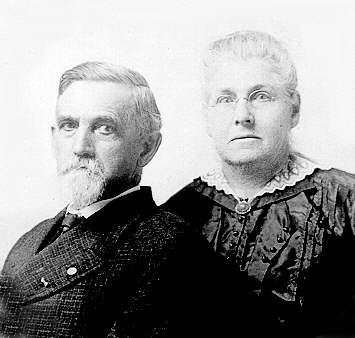
Affectionately and amusingly, Private Lowe received many honorary �promotions� as reflected in various newspaper accounts of his activity. Discharged as a Private, at one time he was known as �Sarg�, later he is called �Major� Lowe and in the years before his death he was called �Colonel� Lowe, such was the respect paid him. In 1916 Will and Anna celebrated their Golden Wedding Anniversary. ( right )
Anna died in 1927, Will in 1930, both are buried in the family plot along with their four daughters.
Selecting the cemetery stones himself, Will saw to it that his headstone was clearly marked,
Co. C, 36th Ind Infantry
Return to Austin Blair Home Page