NANGWARRY SANDSTONE CAVES
These caves are to be found near the bank of the Shoalhaven River
within 50 kilometers of Nowra. Previously they were known (vaguely in local rumours) to exist and these rumours eventually filtered through to Robin Steenson, Brian McQuillan and John Renwick (who were all, at that time, members of UNSWSS, as NSWITSS, which they helped to found, had not yet been formed).On the 19-20/2/72 the above three headed for Nowra, and out along a fire trail, where they commenced searching for a cave entrance from the bottom of a 30 m cliff. They eventually found the lower entrance to what became known as Weta Cave. They explored and surveyed it to
CRG 2 (see Renwick, 1972). On several subsequent trips the entrance to 3 other caves (later named Fooncey's Cave, Spider Hole and Kangaroo Cave) were found by examining the cliff top.Peter Mason (UNSWSS) led an UNSWSS trip to Nangwarry on 29-30/4/72 for the purpose of surveying the entire system (see Mason, 1973), which they did, as well as negotiating 1) a second connection between Fooncey's Cave and Weta Cave and, 2) a tight third entrance to Fooncey's Cave and also 3) locating a large entrance to Kangaroo Cave, lower level. (This was not, at that time, realised to be a new discovery by the person involved and was therefore not reported). Later difficulties in interpretation of the field notes, led to the need for the area to be resurveyed.
Since its formation in July 1972, NSWITSS ran several trips to the area, and on 31/3-1/4/73 I took a small group to the area for the purpose of re-surveying it. The party consisted of R. Mannell (UNSWSS, NSWITSS), Robin Steenson (NSWITSS), B. McQuillan, (NSWITSS), Gary Waghorn (NSWITSS) and Ian Collin (NSWITSS). The Weta-branch of Fooncey’s-Weta Cave was surveyed to
CRG 6 (i.e. Forestry compass and Clinometer to 0.5 degrees and Fibreglass tape).The following Saturday (i.e. 7/4/73) Peter Radcliffe (UNSWSS) and I surveyed Fooncey’s branch of F-W Cave to CRG 6 and tied it into the Root Chamber. On Good Friday (i.e. 20/4/73), Peter and I returned, along with John Carmichael (UNSWSS) and Gary Mathews (UNSWSS) and surveyed Kangaroo Cave to CRG 6 and Spider Hole to CRG 4 (i.e. hand held compass, estimated inclination, fibreglass tape). The survey of Kangaroo Cave was again rejected, due to various errors.
Susan Reid and I returned on 8-9/9/73 and resurveyed Kangaroo Cave to
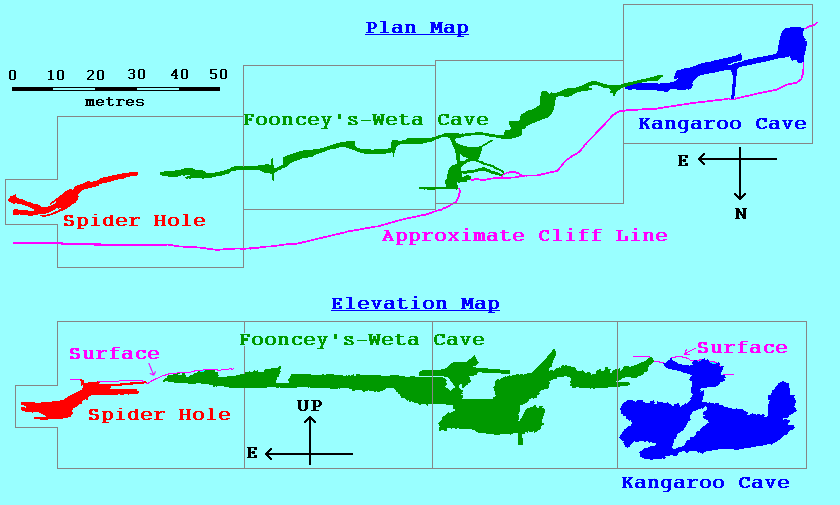
CRG 6 (this time successfully).The caves are in Permian Sandstone (Nowra Sandstone, Shoalhaven Group) and are generally rift-like. They run approximately parallel to the cliff line and are no more than 15 m from it, in several places opening out onto the cliff face. It appears that large blocks have broken away from the cliff and have begun to move down the slope towards the river, but on examination of the relief of the two walls, it seems that generally there has been very little vertical movement, although horizontal movement averages about 1 m. The roof and any false floors were probably formed when smaller blocks were wedged into the rift.
a) FOONCEY’S-WETA CAVE (total length - 240 metres (i.e. 787 feet));
Formerly considered to be 2 caves; The eastern half (Weta Cave) has two main entrances; one, a large chamber in the cliff face, and the other on the cliff top and providing access via a steeply sloping 50° pitch. A third entrance is to be found on a ledge halfway down the cliff. These converge on a T-junction; heading east about 100 m to a daylight chamber (i.e. the boulder choke roof is incomplete); heading west about 25 metres to a chamber about 4 m x 2 m containing tree roots (Root Chamber). The western half (Fooncey’s Cave) has three entrances, the western one about 4 m from Kangaroo Cave, the central one being a tight sloping
b) KANGAROO CAVE (total length - 113 metres (i.e. 372 feet))
Five metres west of the western F-W entrance is the main entrance to the UPPER LEVEL of Kangaroo Cave. This passage goes east about 6 m to a 2.5 m drop into a well lit chamber containing several more entrances. At the bottom of the drop is a hole which drops another 2.5 m. The passage is then followed down an unstable slope into another rift.
Through a vertical 2 m hole in the floor one gains access to a small rockpile chamber, in the west of which is an impassable(?)
squeeze into the LOWER LEVEL. The lower level can also be reached via a squeeze 1.5 m west of the bottom of the second 2.5 m drop. This squeeze is followed by an 11 m ladder over a very unstable ledge and down a very narrow rift. The lower level is about 21 metres long, with two rock-fall-filled entrances accessible via a 5 m pitch. Also, halfway along the lower level passage and 4 m from the floor is a passage leading to an entrance in the cliff face.c) SPIDER HOLE (total length 48 metres (i.e. 157 feet))
Main entrance is through the roof of the rift. There is a second entrance via a very tight
Several common Horseshoe Bats (Rhinolophus megaphillus) have been observed in both Fooncey’s-Weta Cave and Kangaroo Cave, one male specimen being observed at very close range.
Cave
Wetas (Order Orthoptera, Fam. Rhaphidophoridae) and at least 3 species of spider have also been observed.There are very few prospects for extending this system. Perhaps it is possible to join Fooncey’s-Weta and Kangaroo Caves by
digging or to extend Spider Hole by pushing the squeeze. BUT ... Other sandstone caves are rumoured in the area.The system has a total of 407 metres (1,316 feet) of sandstone caves.
Nangwarry Sandstone Caves
http://www.ling.mq.edu.au/~rmannell/personal/caving/nangwarry