INFORMATION ABOUT THE WAY TO SAINT JAMES
THE COMPOSTELA AND THE CREDENTIAL.
HOSPICES AND SHELTERS FOR PILGRIMS
The Way is a road the pilgrim walks along. The starting point is our home. Subsequently, there should be as many ways as homes. But from the beginning the pilgrimage to St. James has been, due to its Christian meaning, an open decision for the community taking into account its goal - the Apostle's Tomb -, its fulfilment - with the community - and its meaning: to build the Kingdom of the Lord. That is why the Way is a meeting point for people with similar goals in life. It is a place of love and solidarity between pilgrims and the inhabitants of the villages they go through. And also - by means of the monuments - a permanent remembrance of the efforts and sorrows of those coming to Compostela. The Pilgrimage to St. James was determined by the European Church in the 8th century. That was the time when the Apostle's Tomb was discovered. A time when the ways to the Holy Places were blocked by Islam's progression. In the Holy Places ruled the Redemption and Toledan Syncretism, whose representative was the Archbishop Elipando with the support of other bishops. This movement tried to confuse Christianity and Islam. The discovery of the Tomb led to the creation of a European movement around the Jacobean heritage. Obviously, only the Hispanics from the northern coast could go on pilgrimage to St. James, since it was not under the Muslims' control. Here lies the importance of the French Way, consolidated after the conquer of La Rioja by the Navarrese in the 10th century and protected by law. The so-called 'Camino del Norte" (Northern Way) was a less common alternative because of its hardness. Just remember the descriptions in Codex Calixtinus and La Historia Compostelana. The ways coming from the South began to arise at the end of the Middle Ages, as the progression of Christian Kingdoms made the pilgrimage possible. Sea routes are linked to the development of sea travels from England and Ireland. Do not forget that sea navigation, in its splendour in Roman times, underwent a hard decline in the Middle Ages and did not recover until the end of that time.
The Ways to Saint James
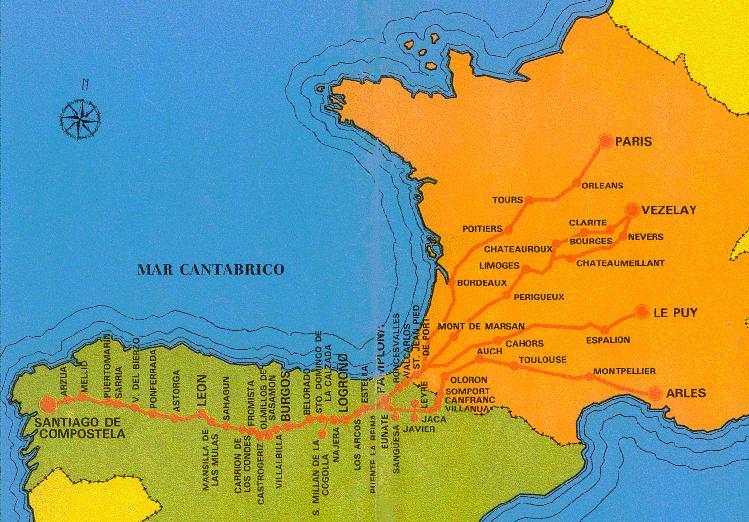
It led non-Spanish Christians through France to Saint James. It crossed France from three different points, where pilgrims from all over the world met. Obviously, these starting points gave rise to the creation of four main routes:
a) From Paris, through Tour and Poitiers (Touronensis)
b) From Vezelay, through Limoges and Perigeux (Limosina)
c) From Le Puy, through Moisac and Conques (Podiensis)
d) From Arles (Toulesana)
- The first three (a, b, c), before entering Spain, come together in Ostabat. From there, pilgrims get to Saint Jean Pied de Port, Valcarlos and Roncesvalles.
The fourth one (d) comes to Spain crossing over Somport pass, Canfranc and Jaca.
It is in Puente la Reina (Navarra) where the Ways to Saint James continue as a single road (Codex Calixtinus). Here is the small hermitage of Eunate, whose exceptional octagonal form has awakened so many people's imagination. Its form along with the fact of being the meeting point of all the roads reminds us of the Sacrament of Baptism. In fact, ancient baptisteries usually had an octagonal ground plan and all roads to man's happiness turn into a unique one by accepting Jesus and receiving the Sacrament of Baptism.
The distance from Saint Jean Pied de Port to Saint James de Compostela is approximately 775 Km. It can be completed in 25 stages on foot and in 12 stages by bicycle. You could also need a couple of days to rest. From there and Roncesvalles the pilgrim goes through a number of villages with refuges and other religious services at pilgrims' disposal. Most refuges are free and in other cases it is convenient to give some contribution. As reference point here you have the names of the Spanish dioceses existing along the Way. Click here for information on every diocese: Jaca, Pamplona, Calahorra-La Calzada-Logroño, Burgos, Palencia, León, Astorga, Lugo and Santiago.
a) "Camino Primitivo del Norte de España" (Primitive Way of the North of Spain) through Asturias entering Lugo through different places.
b) "Vía de la Plata", starting from Seville, through Mérida, Cáceres, Salamanca, Zamora, joins the French Way in Astorga or enters Galicia through Orense.
C) Portuguese Way. It comes to Spain through Valença (Portugal) and Tuy, starting from Oporto via Braga or Viana do Castelo.
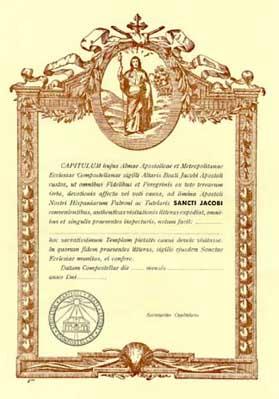
Since the pilgrimage to St. James. Tomb, which spontaneously arose in the 9th and 10th centuries, was institutionalised under specific religious-social circumstances, it has been necessary to certify its completion. For this purpose pilgrims first made use of badges that could only be acquired in St. James, such as the scallop shell. Due to the number of fakes St. James. prelates and even the Pope had to impose excommunication penalties against the falsifiers. From the 13th century onwards the so-called evidential letters have been used due to their well-proved efficiency. These are the direct roots of the Compostela. In the 16th century the Catholic Monarchs constituted the Foundation of the Royal Hospital and ordered to erect the building nowadays occupied by the Hostal de los Reyes Católicos. In 1954 it was turned into a state-run parador. Pilgrims were allowed to stay free for three days by presenting the .Compostela.. Pilgrims. sanitary needs . with the necessary enlargements . converted the institution into the most important hospital in Galicia and later into the central office of the famous medical school of St. James.
The appearance of motor vehicles and the popularisation of tourism in the 20th century brought about a crisis in terms of pilgrimage. The effort and sacrifice as a sin expiation involved in the traditional pilgrimage changed into a pleasant holiday activity. Civil authorities in other sanctuaries began to draw up visit certificates imitating the .Compostela. . e.g. in the Holy Land the Israeli Ministry of Tourism draws up a certificate of that kind. Thank heaven the Chapter of the Metropolitan Church of St. James continued drawing up the .Compostela. and claiming . almost unsuccessfully . the fulfilment of the foundational engagement from the Hostal de los Reyes Católicos. In recent times, the .Compostela. would be limited to those pilgrims who walk or go on horseback for at least the last 100 km or cycle for the last 200 km up to the Apostle.s Tomb in St. James.
The text is written in Latin. Here is the translation:
"The Chapter of this Holy Apostolic Metropolitan Cathedral of St. James, custodian of the seal of St. James' Altar, to all faithful and pilgrims who come from everywhere over the world as an act of devotion, under vow or promise to the Apostle's Tomb, our Patron and Protector of Spain, witnesses in the sight of all who read this document, that: Mr.......has visited devoutly this Sacred Church in a religious sense (pietatis causa).
Witness whereof I hand this document over to him, authenticated by the seal of this Sacred Church.
Given in St. James de Compostela on the (day)..(month)..A.D. ...
Chapter Secretary"
It recognises you as a pilgrim in the refuges and everywhere along the Way. It must also be presented in St. James to certify that you have walked, cycled or come on horseback. The credential should function as a kind of recommendation letter of your parish, association, church group, etc. There is a specific place where to put the stamps on belonging to the refuges or parishes. The credential can be obtained in the Diocesan Delegation responsible for Pilgrims in your place of origin or in St. James. Diocesan Delegation.
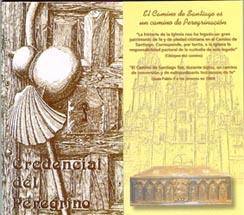
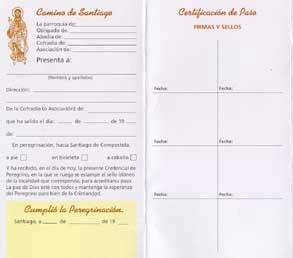
The pilgrim has to abide by the rules above mentioned if he/she wants to obtain the .Compostela.. The recent revival of the Way has caused the creation of an official model of the pilgrim's credential.
Printed in thin cardboard, it consists of 14 pages to be opened as an accordion. The first and the last ones are at the left side of this page. The second . below . is a form that functions as a recommendation letter and has to be filled in the pilgrim's parish, in a Christian association, abbey, confraternity, etc. At the bottom, there is a specific place for the last stamp with the corresponding date once you are in the Pilgrims. Office, where you will also be given the .Compostela..
In the following pages the pilgrim will find a place where to put on the stamps of the refuges, parishes, confraternities, etc. On the other side there is a series of maps with the different Ways to St. James. Finally, one of the pages contains the following directions for use:
Necessary reflections
This credential is destined for those who aim to walk, go on horseback or cycle to St. James as an act of religious devotion or at least as a spiritual search. It is intended to identify the pilgrim. Therefore, the presenting institution has to be a parish, a confraternity and the like. The credential does not generate any right to the pilgrim. It has two practical goals:
-The admittance to the refuges offered by Christian hospitality along the Way and
-To obtain the .Compostela. from the Cathedral of St. James, which is the official certificate of the pilgrimage. It is only awarded to those who have come in Christian terms: devotionis affectu, voti vel pietatis causa - .being the motivation devotion, vow or piety.. In order to get the "Compostela", you also have to walk or go on horseback up to the Apostle's Tomb for at least the last 100 Km or cycle for at least the last 200 Km.
Thus, the pilgrim credential can exclusively be drawn up by the Church through its institutions . that is to say, Bishopric, Parish, Confraternity, etc. or institutions authorized by the Church. This is the only way to obtain the .Compostela. in the S.A.M.I. Cathedral of St. James (Jornadas sobre el Año Santo: noviembre 1993).
Refuges do not receive any subsidy; therefore pilgrims should collaborate on their maintenance, keeping their austerity in mind . cleaning, facility care, economic contributions.
Organized groups on bicycle or with supporting car please look for alternative lodgings.
The bearer of this credential abides by these rules.
Blessing
"In the name of our Lord Jesus Christ, receive this pouch, habit for your pilgrimage, so that, castigated and corrected, you hasten to prostrate at Saint James' feet, where you yearn to arrive and, after having completed your journey, you come to us delighted with the help of God, who rules over the world without end. Amen.
Receive this staff as support for the journey and your efforts during your pilgrimage so that you are able to defeat the throngs of enemies and thus arrive safely at Saint James' feet and, after having completed your journey, you come to us delighted with the consent of the same God, who lives in and rules over Heaven without end. Amen."
Compostela was conferred a special privilege towards the year 1120. The oldest preserved (concessive) Bull, the Regis aeterni, issued in 1179 by the Pope Alexander III, alludes to a privilege conferred by the Pope Calixto II (1118-1124). This Pope was the brother of Don Raimundo de Borgoña and so uncle of King Alfonso II. He was a great benefactor of Saint James' Church. This privilege, confirmed by Alexander III, reads as follows: When July 25th, feast of St. James, falls on Sunday that year is Holy Year and St. James' Church grants the spiritual graces of the Jubilee.
Jubilee Year = A Year of Conversion
Jesus began his ministry announcing: "The time has come. The kingdom of God is near. Repent and believe the good news!"(Mark 1,15).
Holy Year or Year of Jubilee is a time when the Church grants special spiritual graces to the faithful in imitation of the biblical account of the Israelites' year of jubilee: every seventh yeas was a Sabbatical Year in which those who from necessity had sold their lands regained them. Slaves also obtained their freedom. Every 50th year was a Year of Jubilee (Leviticus 25).
Jesus said that He was coming to preach a year of grace of the Lord (Luke 4, 16). With Jubilee Year the Church also grants a special year of grace: Holy Year is a grace for all and, specially, it is an invitation to those who are far-removed from an attitude of faith to return again to Christian life. It is the sick who need a physician (Matthew 9,12) in order to return to the shepherd of our souls, if we have gone astray (I Peter 2, 35).
Conditions to gain the Jubilee
1) To visit the Cathedral, where the Tomb of Saint James the Great lies.
2) To recite a prayer (such as the Creed or the Lord's Prayer praying for His Holiness the Pope). It is recommended to attend the Pilgrims' Mass.
3) To receive the Sacraments of Confession (it may be 15 days before or after) and Communion. Both are responsible for the conversion and the compromise of love to Jesus and our brothers. This is the heritage of Saint James.
The grace of the Jubilee is basically a plenary indulgence for the forgiveness of the punishment our sins deserve.
Indulgences
The Canon Law Code defines them as follows (ch. 992):
"An indulgence is the remission in the sight of God of the temporal punishment due for sins, the guilt of which has already been forgiven. A member of Christ's faithful who is properly disposed and who fulfils certain specific conditions, may gain an indulgence by the help of the Church which, as the minister of redemption, authoritatively dispenses and applies the treasury of the merits of Christ and the Saints."
In order to understand this, we must distinguish between guilt and temporal punishment.
"An indulgence is partial or plenary according as it partially or wholly frees a person from the temporal punishment due for sins." (ch. 993)
The grace of the Jubilee - fulfilling the required conditions - is a plenary indulgence. "All members of the faithful can gain indulgences, partial or plenary, for themselves, or they can apply them by way of suffrage to the dead." (ch. 994)
Jaca: Albergue en el antiguo hospital
Santa cilia de jaca: Casa habilitada por el ayuntamiento
Artieda: Refugio pequeño
Ruesta.
Undues de lerda: Refugio amplio
Navarra
Arre: Cofradía de la Trinidad. Tlf. 948 110 679
Cizur Menor: Refugio (Cerrado. Reapertura prevista para el 2000). Tlf. 948 183 885
Estella:
-Refugio de las Escuelas Comarcales, Ayuntamiento. Tlf. 948 546 363
-Asociación Amigos del Camino. Tlf. 948 551 562
Larrasoaña: Refugio de la Asociación de Amigos del Camino. Tlf. 948 304 242
Los Arcos: Albergue del Ayuntamiento. Tlf. 948 441 004
Pamplona: Parroquia de San Saturnino. Tlf. 948 240 975
Puente la Reina: Convento de los Padres Reparadores; Crucifijo, 1. Tlf. 948 340 050
Roncesvalles: Hospedaría de la Colegiata. Tlf. 948 760 000
Sangüesa: Refugio de Peregrinos, Ayuntamiento. Tlf. 948 870 005
Torres del Río: Calle Mayor. Tlf. 948 648 051
Viana: Refugio Parroquial. Tlf. 948 645 037
Zubiri: Albergue del Concejo. Tlf. 948 304 00
La rioja
Azofra: Parroquia de Nuestra Señora de los Ángeles. Tlf. 941 379 063
Logroño:
-Refugio de JOC; C/ Hospital Viejo, 9. Tlf. 941 260 001
-Refugio de Peregrinos, Iglesia de San Bartolomé. Tlf 941 240 922
-Parroquia de Santiago, C/ Barricepo 6. Tlf. 941 225 767
Nájera: Refugio de los Padres Franciscanos, en Santa María la Real. Tlf. 941 440 017
Navarrete: Iglesia parroquial de Nuestra Señora de la Asunción, carretera Fuenmayor. Tlf. 941 440 017
Santo Domingo de la Calzada: Albergue del Peregrino. Tlf. 941 340 004 (Ayuntamiento
Burgos
Belorado: Refugio parroquial de Santa María y San Pedro. Tlf. 947 580 085
Burgos:
-Hospedería de San Pedro de Cardoseña. Tlf. 947 290 033
-Hospedería del Monasterio de Las Huelgas (Sólo mujeres). Tlf. 947 206 045
-Seminario Mayor de Sacerdotes. Tlf. 947 205 247
Castrogeriz: Albergue de Peregrinos, C/ Cordón s/n. Tlf. 947 377 001
Hontanas: Refugio del Ayuntamiento. Tlf. 947 377 035
San Juan de Ortega: Refugio de Peregrinos. Tlf. 947 438 016
Tardajos: Albergue "Camino de Santiago" (sólo verano). Tlf. 947 451 189
Villafranca de Montes de Oca: Albergue para Peregrinos. Tlf. 947 582 001
Palencia
Carrión de los Condes:
-Albergue de Peregrinos, parroquia de Santa María. Tlf. 988 880 072
-Asociación de Amigos del Camino. Tlf. 988 880 886
Frómista: Albergue de Peregrinos. Tlf. 988 810 144
San Nicolás del Real Camino: Refigio en escuelas. Tlf. 988 844 331
Villalcázar de Sirga: Albergue de Peregrinos. Tlf. 988 888 041
Leon
Astorga:
-Refugio del Colegio de Santa María Madre de la Iglesia. Tlf. 987 615 976
-Asociación de Amigos del Camino. Tlf. 987 616 838
El Burgo Ranero: Albergue de Peregrinos. Tlf. 987 330 023
Hospital de Órbigo: Refugio del Ayuntamiento. Tlf. 987 388 306
León: Albergue Colegiata de San Isidoro. Tlf. 987 236 600
Villadangos del Páramo: Albergue. Tlf. 987 390 629
Mansilla de las Mulas: Casa del Peregrino. Tlf. 987 310 941 (Ayuntamiento)
Ponferrada: Refugio de la parroquia de Nuestra Señora de la Encina. Tlf. 987 411 978
Rabanal del Camino: Albergue de Peregrinos. Tlf. 987 639 468
Sahagún: Albergue, Avda. Drs. Bermejo y Calderón. Tlf. 987 780 001 (Ayuntamiento)
Vega de Valcarce: Escuelas viejas. Tlf. 987 543 111
Villafranca del Bierzo: Refugio de Jesús Arias Jato, C/ Santiago, 3. Tlf. 987 540 229
Virgen del Camino: Colegio Padres Dominicos. Tlf. 987 300 001
Lugo
O Cebreiro: 982 36 90 25 / 982 36 71 25. A 152 kilómetros de Compostela. Camas:80
Hospital da Condesa: 982 36 71 83. A 146 kilómetros de Compostela. Camas:18
Triacastela: Albergue. Tlf. 982 54 80 87. A 130 kilómetros de Compostela. Camas:58
Samos: 982 54 60 46. A 122 kilómetros de Compostela. Camas:60
Calvor: 982 16 77 69. A 117 kilómetros de Compostela. Camas:22
Sarria: 982 53 11 21. A 112 kilómetros de Compostela. Camas:40
Barbadelo: 982 53 04 12. A 107 kilómetros de Compostela. Camas:22
Ferreirós (Mirallos): 982 54 12 40. A 99 kilómetros de Compostela. Camas:22
Portomarín: 982 54 51 43. A 89 kilómetros de Compostela. Camas:100
Gonzar: 982 15 78 40. A 84 kilómetros de Compostela. Camas:20
Ventas de Narón: 982 54 52 32. A 79 kilómetros de Compostela. Camas:22
Ligonde: 982 15 34 83. A 76 kilómetros de Compostela.
Eirexe: 982 15 34 83. A 75 kilómetros de Compostela Camas: 18
Palas de Rei: 982 37 41 14. A 67 kilómetros de Compostela. Camas:49
Casanova: 982 17 34 83. A 61 kilómetros de Compostela. Camas:20
A Coruña
Melide: 981 50 72 75. A 53 kilómetros de Compostela. Camas:130
Ribadiso de Baixo: 981 50 08 70. A 42 kilómetros de Compostela. Camas:62
Arzúa: 981 50 10 91. A 39 kilómetros de Compostela. Camas:62
Santa Irene: 981 51 12 78. A 21 kilómetros de Compostela. Camas:36
Arca de Pino: 981 51 11 10. A 20 kilómetros de Compostela. Camas:80
Monte do gozo: Refugio amplio . Camas:800
Santiago de Compostela:
-Albergue PP. Franciscanos. 981 58 16 00.
-Albergue Seminario Menor de Belvís. 981 58 92 00.
-Oficina de Acogida al Peregrino. 981 56 24 79
EN OTROS CAMINOS:
Álava
Barria: Refugio de juventud
Vitoria: Albergue de juventud "carlos abaitua"
Asturias
Oviedo: Refugio el salvador
El escamplero: Antiguas escuelas
Salas: Bajos del hogar del pensionista
Tineo: Refugio mater chisti
Borres: Refugio de santa maría
Viñas-pola de allande: Antigua escuela
La mesa: Antigua escuela
Grandas de salime: Bajos del ayuntamiento
Lugo
Fonsagrada. Edificio a la salida del pueblo