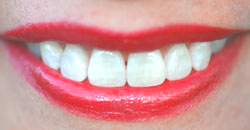
Your teeth The visible part of a tooth, otherwise known as the crown, is only a small portion of the living system. The crown is made up of enamel, the hardest substance found within the body. It is bone that has been enriched with large percentages of calcium. That's why people who drink lots of milk or take calcium supplements have strong bones and teeth. The enamel is thickest at the crown, and thinnest near the roots of the teeth. Excellent crowns and bridges were made by the Etruscans in the 7th cent. B.C. At about that time, teeth were being extracted in Asia Minor as a cure for bodily ills and diseases. Skills achieved by the Etruscans, Phoenicians, Egyptians, Greeks, and Romans were largely lost during the Middle Ages, when barbers and roving bands of charlatans practiced unskilled dentistry at marketplaces and fairs. Abulcasis, a Spanish Moor, was one of the few in his time who studied dental surgery. The permanent teeth are the second set of teeth that will last the rest of your life. They tend to be more yellow (and not just because of coffee) and are extremely hard. The final set of teeth is made up of 32 teeth, or 16 on each jaw. There are two central incisors for biting, two lateral incisors for biting, two canines for tearing and cutting, four premolars for chewing, and six molars for chewing.
Teeth reshaping You maybe candidate for tooth contouring and reshaping, if you want your teeth to appear less crowded, lack chips and fractures, have decreased overlaps or to be without pits or grooves in the enamel, this procedure should be discussed with your cosmetic dentist. With a little dental contouring, you can make a huge difference in the way you feel about your smile. Good cosmetic dentistry can give you a smile that is the envy of others. Tooth contouring by a cosmetic dentist does require that you have normal, healthy teeth. Tooth reshaping, or tooth sculpting, is a safe and conservative way to improve your smile. Teeth may become weaker if large amounts of enamel are removed, tooth reshaping should be limited to minor changes or combined with veneers or bonding for the best smile. Dental reshaping and contouring is a procedure to correct crooked teeth, chipped teeth, cracked teeth or even overlapping teeth in just one session. This procedure is even a substitute for braces under certain circumstances. This is also a procedure of subtle changes. A few millimeters of reduction and a few millimeters of tooth-colored can create a beautiful smile when performed by a cosmetic dentist, with no discomfort to you. Tooth reshaping, or dental contouring, is commonly used to alter the length, shape or position of your teeth.
Learning more about dental implants If you're missing one tooth or all of your teeth, implants may well be for you. So long as you have enough bone in the area of the missing tooth to facilitate the anchorage of the implants, this procedure can yield terrific results. If you don't have enough bone for this purpose, a bone graft may be necessary. If you have a small dental bridge or partial dentures (removable type), implants will be a welcome alternative. Implants are an alternative to a fixed bridge. The implant will last a lifetime, but the crown on top of it will last ten to fifteen years. If you're missing one tooth or all of your teeth, implants may well be for you. So long as you have enough bone in the area of the missing tooth to facilitate the anchorage of the implants, this procedure can yield terrific results. If you don't have enough bone for this purpose, a bone graft may be necessary. A procedure of building up the bone is known as Bone Grafting. Bone grafting is common with dental implants. The bone that is used is one of three types. The preferred bone to use is taken from other areas of your mouth or collected in a suction device as the drilling of the sites for dental implants occurs. Sometimes bone is taken from areas such as a hip (this requires an orthopedic surgeon and an operating room). The third source for needed bone is a synthetic type. This is the least preferred type of bone to be used for this procedure.
Dental dentures Dentures, also known as false teeth, are the primary topic in this section of our site. Here, you can learn how the procedure is performed, what dentures cost and the advantages and disadvantages of having them. There are two main types of dentures. Both Complete Dentures and Partial Dentures are finely crafted, custom-fitted. If you properly maintain your dentures they will appear natural and provide a perfect smile. Additionally, dentures help strengthen muscles controlling your expressions that require the support of your teeth, rid you of pronunciation problems caused by missing teeth and aid with chewing. This procedure should be thoroughly discussed with your dentist as there are several personal and medical factors to take into consideration. You may instead be a candidate for dental bridges and dental implants as optional procedures.
The need for teeth whitening While there is no medical need to whiten teeth, it is a procedure that can have a big impact on a person's self-esteem. Severely yellowed or discolored teeth can make a person self-conscious and reluctant to smile. There are many different causes that lead to stained or discolored teeth. Some of the most common causes are everyday foods and drinks--coffee, tea, soda, and red wine all have a staining effect on tooth enamel. Smoking will also darken teeth. Some medications, if taken during early childhood, can result in teeth that are discolored. For individuals who are looking for a fast way to achieve dramatic teeth whitening results, in-office whitening is the way to go. Protective gel is applied to the gums, lips and other tissue around the teeth, and then a bleaching solution is applied to the tooth enamel. A high intensity laser or other type of light catalyzes the bleach, and the teeth are treated for one to two hours. Some types of tooth discoloration are difficult to whiten and treat. Teeth that have been subjected to trauma may darken significantly, and resist any bleaching procedure. Some medications affect young children when their teeth are first forming and may also be nearly impossible to treat. Dentists will be able to tell what situations may result in bleach-resistant discoloration, and provide advice on how effective various treatments may be. In cases of extreme discoloration that cannot be subjected to common teeth whitening procedures, porcelain veneers applied to the teeth may be an alternative solution.
Dental fillings If you have a cavity in a tooth, broken fillings, mercury fillings, or amalgam fillings, this type of dental filling is well worth discussing with your dentist. Mercury fillings or amalgam fillings can easily be removed and replaced with far more attractive colored fillings. These fillings actually strengthen your tooth beyond the level it had with the amalgam fillings. A special dental material is then used to open up the pores of your tooth's dentin and roughens up the surface of the exposed enamel. This achieves better and stronger bond. The bond resin is applied to stick the composite to your tooth. This material is made of the same dental resin as the composite however it is much more fluid. This layer is then hardened and cured with a very bright light. If over half of your molar tooth's biting surface is decayed an inlay or onlay may be a better option than a filling. These options are basically for when more than a filling is needed but less than a crown will do. An inlay is placed in between the cusps of the tooth, whereas an only will cover one or more of the cusps. They can be made of a gold alloy, porcelain or tooth-colored resin and are cemented into place.
Teeth bonding Basically, bonding will cover any natural flaws applying a thin coating of a plastic material on the front surface of your teeth. After this, your cosmetic dentist will apply a bonding material and sculpt, color and shape it to provide a pleasing result. A high-intensity light then hardens the plastic, and the surface is finely polished. The resin comes in many shades so that we can match it to your natural teeth. Due to the layers involved, this procedure will take slightly longer than traditional silver fillings because multiple layers of the bonding material are applied. Typically bonding takes an hour to two hours depending on your particular case. You are good candidate for tooth bonding, if you have close, small gaps between your front teeth, or if you have chipped or cracked teeth, you may be a candidate for bonding. Bonding is also used for patients who have discolored teeth, uneven teeth, gum recession or tooth decay. Bonding material is porous, so smokers will find that their bonding will yellow. If you think you are a candidate for bonding, discuss it with your dentist.

Definitions and termsDental fillings
- Dental fillings are inserted as restorations in the treatment of dental cavities, after drilling out the cavities.
Dental implants
- Dental implants are surgically fixed substitutes for roots of missing teeth. Embedded in the jawbone, they act as anchors for a replacement tooth, also known as a crown, or a full set of replacement teeth.
Dentures
- Removable complete dentures are full-mouth false teeth, which are used when a patient has no teeth left on either the mandibular arch, the maxillary arch, or both.
Veneer
- A layer of tooth-colored material, usually porcelain or acrylic resin, attached to and covering the surface of a metal crown or natural tooth structure.
Anesthesia
- Total or partial loss of sensation, especially tactile sensibility, induced by disease, injury, acupuncture, or an anesthetic, such as chloroform or nitrous oxide.
- Local or general insensibility to pain with or without the loss of consciousness, induced by an anesthetic.
- A drug, administered for medical or surgical purposes, that induces partial or total loss of sensation and may be topical, local, regional, or general, depending on the method of administration and area of the body affected.
Bridge
- A dental bridge is a prosthesis used in place of missing teeth and may be removable or permanently attached.
Dental cavities
- The formation of cavities in the teeth by the action of bacteria; tooth decay.
- Also known colloquially as tooth decay.
Dental crown
- Full-coverage restoration (sometimes incorrectly called a cap) is a prosthetic tooth designed by a dentist and usually created by a lab technician.
Porcelain
- A hard, white, translucent ceramic made by firing a pure clay and then glazing it with variously colored fusible materials.
Stomatology
- The medical study of the mouth and its diseases.
Tooth bleaching
- Also known as tooth whitening.
|