THIRD REPUBLIC - PORTUGAL AFTER 1974
The Revolution of the Carnations
-
-
Two developments galvanized the movement that was shortly to topple the dictatorship. The first occurred in mid-1973, when career army officers became alienated by a government measure commissioning militia officers for service in the colonial wars.
The second incitement was the publication in February 1974 of the book Portugal e o futuro (“Portugal and the Future”) by the colonial war hero General António de Spínola, who argued that the wars in Africa could not be settled by force of arms and advocated negotiated autonomy for the colonies and an alternative to Caetano's leadership. Some 200 to 300 officers calling themselves the Armed Forces Movement (Movimento das Forças Armadas; MFA), led by Francisco da Costa Gomes and other officers, planned and implemented the coup of April 25, 1974, which came to be known as the Revolution of the Carnations.
The revolution encountered little resistance from the dictatorship's remaining loyalists and won initial support from an urban middle class vexed by economic and political uncertainty. The transition to a functioning, consolidating, pluralist Portuguese democracy mirrored, though in a nonviolent way, the political course of the French Revolution: an early moderate-conservative phase (May 1974–March 1975) followed by a middle radical-leftist phase (March–late November 1975) and a final moderate reaction (late November 1975–June 1976).
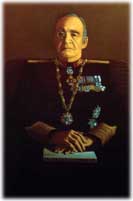
Gen. Spínola
-
-
The Revolution of the Carnations
After exiling Caetano and Tomás, a subgroup of the MFA calling itself the Junta of National Salvation filled the political vacuum, installing Spínola as president and commencing negotiation with the African nationalist movements. Independence was granted to Portuguese Guinea (as Guinea-Bissau) almost immediately after the revolution.
The new regime abolished such instruments of repression as censorship, the paramilitary forces, and the secret police. Spínola, who opposed rapid independence for the colonies without free referendums, resigned in September 1974, launched a countercoup attempt that failed (March 1975), and fled into exile.
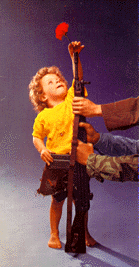
By this time, radical MFA elements and their leftist civilian allies in the Portuguese Communist Party and other Marxist-Leninist groups had won virtual control over the government in Lisbon, sections of the armed forces, and the media. The MFA itself was restructured and a Council of the Revolution installed with the support of six political parties.
-
-
An election for a national assembly in April 1975 drew 92 percent of eligible voters, a record in western European history. The decolonization of the Cape Verde Islands and Mozambique was effected in July 1975.
Portugal's remaining African territories achieved independence later the same year, thus ending a colonial involvement in Africa that had begun in 1415. However, in Angola full-scale, internationalized civil war followed Portugal's departure, and Indonesia forcibly annexed briefly independent East Timor, controlling the territory until 1999.
Political and social instability prevailed through most of 1975. More than half a million people fled to Portugal from the former African colonies, adding a refugee problem to the already volatile domestic situation; some 30 persons died in incidents of public violence, new political parties proliferated, and strikes were widespread.
In 1975 the government also decided to nationalize banking, transport, heavy industries, and the media. In the Alentejo in southern Portugal, farmworkers expropriated latifundia and established communal farming. On November 25, 1975, moderate military elements crushed a radical leftist coup in the army and restored order.
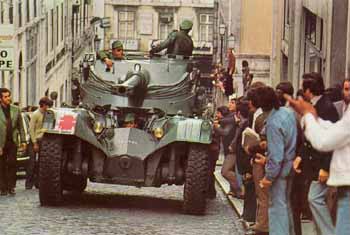
"Chaimites" in Lisbon - 1974
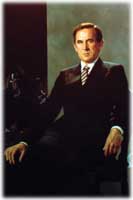
Gen. Ramalho Eanes
-
-
The 1976 constitution and subsequent reforms
In April 1976 the Constituent Assembly approved a new constitution, which committed Portugal to socialism. Parliamentary elections held on April 25 produced no single majority party; the Socialists, the Popular Democrats (centre-right), the Social Democratic Centre Party (conservative), and the Communist Party (founded 1921) made the strongest showings, and the Socialist leader, Mário Soares, formed a minority government. In June, General António Ramalho Eanes, who had been instrumental in preventing a radical leftist military coup in November 1975, won more than three-fifths of the valid votes cast in the presidential election.
Soares's minority government resigned in December 1977, primarily because it was unable to enact an effective austerity program. A number of volatile coalition governments followed, until in 1980, in the general election scheduled by the constitution, a centre-right coalition, the Democratic Alliance (Alianca Democrática), swept into power. The new government swiftly moved to revise the character of the 1976 constitution.
The Assembly of the Republic approved a series of reforms that included reducing the powers of the president and abolishing the Council of the Revolution, which had been given the power to determine the constitutionality of laws and gave the military effective veto power over legislation. These constitutional reforms completed Portugal's transition to full civilian rule.
Both government policy and public sentiment, as reflected in numerous elections and polls, favoured reprivatization of the largely nationalized economy, a de-emphasis on communal agriculture, and entry into the European Economic Community (EEC; renamed the European Community and now embedded in the European Union [EU]) as soon as possible.
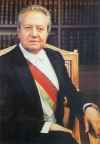
Dr. Mário Soares
-
-
The alliance faltered in 1982, propelling the country into yet another crisis. President Eanes called an early general election for April 1983, and the Socialists, led by Soares, scored an inconclusive victory. Because Portugal urgently needed a stable, broadly based government to tackle its severe economic problems, Soares formed a coalition government with the Social Democrats (formerly the Popular Democrats). It successfully implemented an 18-month emergency program and a four-year modernization plan in its quest for admission to the EEC.
The coalition, though precarious, lasted until June 13, 1985. It survived several internal crises caused predominantly by a division within the Social Democrats between a left wing favouring the coalition and a right wing that opposed the coalition's economic policies. In May 1985 Aníbal Cavaco Silva, leader of the right wing, became head of the party. Almost immediately, Cavaco Silva questioned the viability of the coalition, voicing doubts especially on the subjects of labour and agrarian reform.
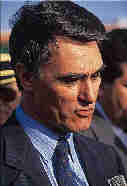
Cavaco Silva
-
-
This crisis, which ended the coalition in June, had been intensified by nationwide strikes in the industrial and transport sectors led by communist unions and by demonstrations by parties on both the left and the right of the political spectrum calling for an end to the coalition government.
Soares resigned, and in October 1985 the Social Democrats, campaigning on a platform advocating a free-market economy, became the largest single party in the Assembly of the Republic and were able to form a minority government with Cavaco Silva as prime minister.
Portugal was admitted to the EEC on January 1, 1986, and on February 16 Soares became the country's first civilian president in 60 years. The parliamentary elections of 1987 marked another milestone as Cavaco Silva's Social Democrats won the first clear majority in the Assembly since the 1974 revolution. A renewal of this mandate four years later provided the continuity necessary for carrying out reforms
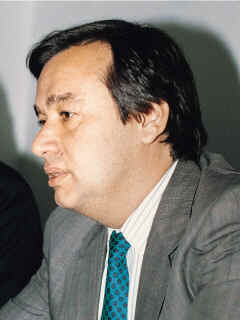
António Guterres
-
-
Stabilization and the European future
By the end of the 20th century, Portugal's democracy had become solidified. With the military's withdrawal from politics and several revisions of the constitution, Portugal adopted what could be called a semipresidential system, which limited the president's powers by investing significant authority in the prime minister. Portugal developed a multiparty system in which two major parties (the Socialists and the Social Democrats) and several minor parties emerged.
In 1995 Cavaco Silva left office, replaced by Socialist António Guterres; the following year, Soares was succeeded as president by Socialist Jorge Sampaio, the former mayor of Lisbon. In 1999 the government adopted the euro, the EU's single currency—which fully replaced the escudo as Portugal's sole currency in 2002—and also returned Macau, its last overseas territory, to Chinese rule.
Sampaio was reelected in 2001, but in 2002 Guterres's government was ousted by the Social Democrats, whose leader, José Manuel Durão Barroso, formed a centre-right coalition government and promised to reduce taxes and spending and privatize some public services. Economic problems beset the new government, which in 2005 lost power to the Socialists.
Perhaps a reflection of the tremendous progress made by Portugal in establishing a successful democracy and in fully integrating itself into Europe, a Portuguese, Durão Barroso, was named president of the European Commission in 2004. Nevertheless, Portugal continued to experience several troubling problems.
Despite economic growth during the 1990s, high unemployment persisted. Also of concern to political leaders were continued poverty in rural and urban areas, a growing gap between rich and poor, and administrative and labour inefficiency. Moreover, too large a share of Portugal's population over age 40 had little formal education, and Portugal remained among western Europe's poorest countries.
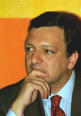
Durão Barroso,
-
The protection of Portugal's historic heritage became a serious issue; Portugal's economy was partly dependent on tourism, but its fragile environment was endangered by the impact of tourism, urban sprawl, and a failure to limit and control air, water, and soil pollution brought on by growth and development. The increasing depopulation of interior rural areas, the result in part of urbanization and rural-urban migration, was an issue of major concern.
Rural and provincial areas of Portugal experienced the steady loss of population to urban areas such as Greater Porto, Coimbra, and Lisbon. This movement further hampered agriculture, which faced stiff competition from other EU countries, and limited the availability of educational, health, and social services in rural areas. As Portugal increasingly evolved into an urban society, political leaders attempted to achieve a balance between growth and development (modernization) and the need to protect consumers, the public interest, and the rare but vulnerable environment.
By the beginning of the 21st century, Portugal had benefited from substantial improvements in health, communications, transportation, welfare, and education. The new pluralist democracy provided citizens with historically unprecedented civil liberties. Nevertheless, the country's empire had vanished, and Portugal was highly dependent on imports of energy, capital, and food. During the 1990s, as a partner in further European integration, Portugal was under great pressure to conform to rigorous EU standards, procedures, and rules. New layers of administration were established, and trade, travel, employment, and other barriers started to fall in 1993, when Portugal began preparing for full economic and monetary union with other EU members.
From 1988 through 2000, Portugal celebrated many historical feats. Notably, the government sponsored commemorations of Portuguese exploration, including the 500th anniversaries of Bartolomeu Dias's 1488 voyage that rounded the Cape of Good Hope and the founding of Brazil by Pedro Álvares Cabral in 1500. In 1998 Lisbon hosted the World's Fair (Expo '98), which also marked the 500th anniversary of the arrival of Vasco da Gama in Asia following his discovery of an all-water route from Europe. As the celebrations ended and the 21st century began, many wondered how the new Portugal would conceive of its national tradition and what effect European integration would have on the country's self-image and national identity.
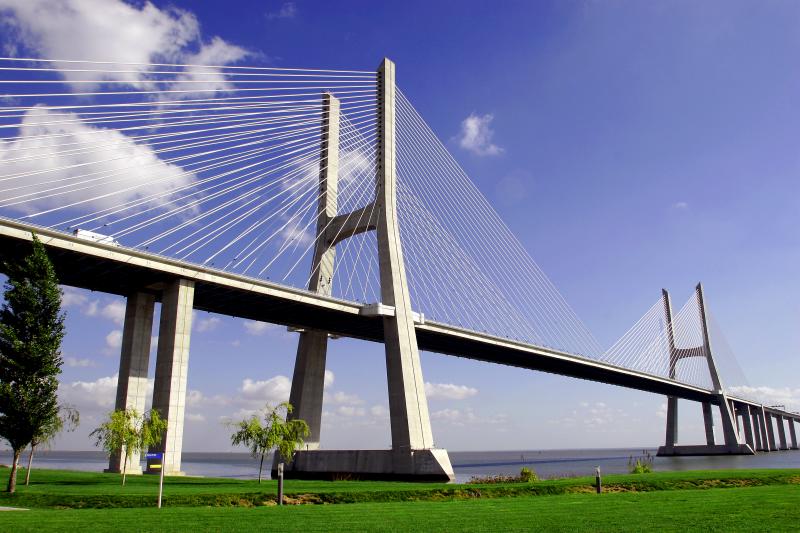
World's Fair (Expo '98) - Vasco da Gama bridge over the Tejo
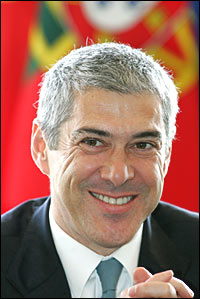
José Sócrates
In the election for a National Assembly in February 2005, the Socialist Party won majority, and José Sócrates is the new prime minister.
PS - 45,05 % - 120 Deputados
PSD - 28,7 % - 72 Deputados
CDU ( PCP e PEV ) - 7,56 % - 14 Deputados
CDS-PP - 7,26 % - 12 Deputados
BE - 6,38 % - 8 Deputados
