|
Classic Review: Silver
Bullet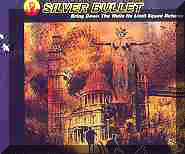
Album:
Bring Down The Walls�No Limit Squad Returns
Label:
Parlophone 1991
Rewind to 1991. Hip hop is well on the way to being accepted as
part of the mainstream, credible acts such as De La Soul having broken into the
charts, Public Enemy have released their masterpiece �Fear Of A Black Planet�,
and magazines such as Hip Hop Connection are on the rise, championing UK artists
like Hijack, Blade and the Ruthless Rap Assassins. Both the American and
home-grown scenes are vibrant, energised and dedicated to the cause of advancing
the sound. The time is right for the bomb to drop.
After two
1989 singles on the little known Tam Tam label (�Bring Forth the Guillotine� and
�20 Seconds To Comply�, receiving both underground respect and chart success)
�Silver Bullet� split with his label, signed to Parlophone and redefined his
objectives: this time the sound was for the underground. There would be no
sell-out, no record company marketing ploys, and no cheesy Norman Cook remixes.
The third single, �Undercover Anarchist� went Top 40 in �91 and the long awaited
LP was unleashed onto an ill-prepared British public.
�Bring Down The Walls�No Limit Squad Returns�, the title says it
all. This is hip hop without boundaries, without limits. Two angry young men
with a mission, a message that has to be heard by the world.
The opener is the track that everyone has heard, �20 Seconds To
Comply�. Rerecorded for the new label, this version is ruffer, harder, angrier.
Silver�s lyrics tell of a society on the brink of collapse, Thatcher�s legacy:
nuclear fallout, the criminal underground and inner cities destroyed by narcotic
indulgence. The backing is impeccable�the beats roll, snares rattle, the
samples, if a little predictable (�So you think you outsmart a bullet?�) fit
perfectly.
Every track on the album shares this vibe: apocalyptic,
determined, dark and ethereal but also brutal. The standout, for me, is the
third single, �Undercover Anarchist�. A lonesome bleep introduces it, searching
through the darkness for some kind of compatriotism. �Yo�can anybody hear me?�
Silver asks. Is anyone listening? But when the tune drops, no one can ignore it.
The beats, well I could listen to Silver�s breaks all day, you don�t even need
the rest of the track. They roll and drive at the same time, the kick beating
you into submission before the rest of the track kicks in. The bass! Hip hop is
the king of bass�whereas other musicians use bass to aid the rhythm or melody,
to constantly underpin the track, hip hop artists, in taking their musical
styling largely from old funk and soul records understand the value of holding
back. Releasing one apocalyptic note at a crucial point in the beat, stopping
the rhythm dead just when you least expect it, then cutting it back again. It�s
precisely the sparsity that makes it so effective, something that other
musicians would do well to learn from.
The scratching, in contrast, is constant. Abstract noises chopped
to fuck under Silver�s flow, and DJ Mo�s scratching is always impeccable. On any
track, whether cutting up familiar vocal snippets from Silver�s contemporaries
or transforming sirens, they always play perfectly in the track. Never standing
above the music, unlike nowadays hip hop, where scratching is no longer an
element of the whole track but a solo brought in over the mundane, undeveloped
backing loop. This is the decks as an integral part of the sound; they sit
perfectly between the backing and the vocal. No one scratches like this anymore.
Of course, in grand hip hop tradition Mo is given his chance to shine: �He Spins
Around�, the penultimate track is solely Mo�s creation, and this is the DJ track
taken to another level. Bizarre, twisted. Beginning as a mass of discordant,
unresolvable loops, suddenly the beat kicks in and it all makes sense�in a
way�the rhythms are locked together, but fluid, lurching and twisting beneath
the break, with further layers of scratching on top. A world away from what
turntablists are doing now, or have ever done since.
Of the other tracks, all are amazing, there is very little to
criticise. Although they all share the same feel, there is variation in the
styling. �Guns Of Mind Alone� is almost moochy in comparison, (relatively)
downtempo and bearing a great funk bassline with Mo�s scratching standing out as
always. �Legions Of The Damned� is the most contemplative track of the ten,
alternating between sinister, twisting verses complete with an atypical 2-bar
break loop, twinkling horror film sample (the title of which shall go
unmentioned�for fear of putting people off! That said, it does fit perfectly),
and the ethereal flute sample of the chorus. And the return of the apocalypse
bass!
I�m hard pushed to think of many other records produced with this
much passion. Two that spring to mind are the already mentioned �Fear Of A Black
Planet� and Manic Street Preachers� �The Holy Bible�. �Bring Down The Walls�
shares several qualities with the latter: the precision, the tightness of the
different elements working in unison; the drive, the music pulls you with it,
keeping you always focussed on what�s happening now�there�s no chance to stop
and consider what you�ve just heard as Silver jumps from one issue to the next
with almost schizophrenic speed. And the backing too flows, overflows, with
funk, attitude, aggression. I am constantly dismayed by today�s hip hop scene,
the weak fare, lacking in any kind of drive, blunted on its own success in the
mainstream, with no desire to challenge either the listener or themselves. What
this album displays is what was defining of the hip hop of this era, but taken
to another level. The complex breakbeats, the plethora of conflicting elements,
bass, samples, scratches, all there not merely to give the MC a groove to work
over, but as essential to the track as the vocal. Finally, the aggression, the
sense of imminent apocalypse that prevents any kind of prevarication. These
words cannot wait, the message has to be heard NOW. As Silver says, �Say what
you got to say then get the hell out�.
Having already mentioned the Manic Street Preachers�, Silver�s
lyrical tendencies often bear an uncanny resemblance to Richey Edwards� own. The
sense of style, the power of pure words alone, phrases and slogans devoid of
syntax, stripped of any grammatical customs not essential to the message�a
message never explicitly stated but implied within swathes of imagery. Check
�Imminently influence drops ill/Full moon ordeal/The attitude concealed/For
carnival revenge of course claimed� or �Don�t view stereotypes/No insight
through psyche�. But always Silver�s flow is in motion, touching on one topic
with barely a chance to breathe before he jumps to the next attack. The lyrical
rhythms flow around the beat, stopping/starting/jumping, unpredictable. There
are few MCs who share Silver�s skills. Chuck D is one who springs to mind. The
tired, repetitive rhythms of modern million selling hip hop are nowhere to be
found. This is rap as the new jazz, ad-libbing rhythms instead of melodies
around the complex backing. In some sense the meaning is almost irrelevant,
second to the hypnotic, unpredictable flow. Words strike you at random, shooting
from the chaotic mass of disjointed phrases, beats, samples, bass and cuts.
One can draw comparisons to Silver Bullet�s contemporaries,
Hijack, Hardnoise and 80�s Public Enemy but it doesn�t do justice. The feel is
more like No U-Turn techstep, but more organic, more thoughtful and precise. I
can�t think of any other album that even comes close to this. And even if
Bullet�s new work has descended into current hip hop clich�s, even if in ten
years, hip hop has produced no one to touch on this one, barely acknowledged
album (Rubberoom come close at points, but they�re not there yet) at least I
gain some kind of satisfaction from the fact that the twelve�s I bought from my
local store for four quid ten years ago are now changing hands on eBay for
fifteen quid.
�So what�s the score/What do we do?/Authorise apocalypse, bomb
I�m droppin� it��
Michael Miller
|
 |
|