The Orange Rogue-- Trinity ReviewI wrote this review for my "philosophy and criticism of dance" class. It is exceedingly basic, but could be a resource for some...
Back to the Orange Rogue
Trinity Irish Dance Company
February 4 & 5, 2000
Phoenix, Arizona
Elizabeth Venable
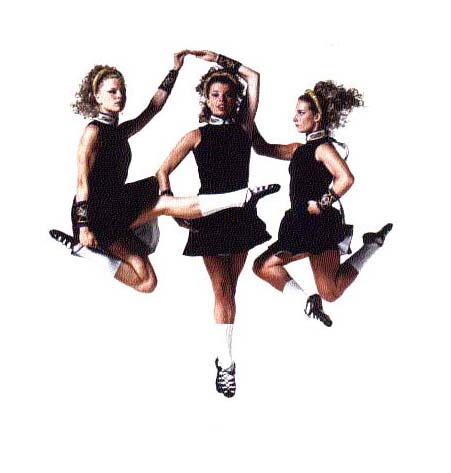
Trinity Company is the foremost Irish dance repertory company, successful in the fusion of �traditional� Irish dance with other techniques in novel fashions. Trinity is also revered among American An Coimisuin Le Rinci Gaelecha (the world Irish dancing commission) members for the technical purity of its dancers and the skill of their director, Mark Howard, who lead the school and the company to the first ever North American win for figure (group) dancing, in the late 1990s. Trinity has won 17 different world championship titles. Perhaps the only touring company which is not based upon a central plot line, it�s foundation in the late 1980s marked a drastic divergence from common Irish dance performing groups, which are usually entirely theme less and entirely choreographed and dictated by the teacher of the particular school whose dancers are featured, and which is almost always not for profit. Trinity breaks several conventions in terms of choreography, sometimes even inviting artists who are not always even familiar with the classic forms of the style, who then set about to temporary alter it dramatically (Ashley Roland and Brian Jeffery being classic examples). Interspersed between these more experimental works are moments of sheer joy and undiluted technique, in the form of more historic and competition influenced abstract numbers.
The pieces in Trinity�s usual program of dances progress from lightweight to more dramatic and emotionally captivative works. In the beginning of the concert, one is greeted with the sylphlike purity if Irish figure dancing, as displayed in Howard�s �The Mist�. The dancers float in and out of complex geometries, shrouded by the whir of foam and gas which surrounds them. Attired in decidedly non-traditional garb (silver-blue unitards), they leap and skip in unison, flying far above the ground as if they were truly unconstrained by such matters of the earth as gravity. �Blackthorn� and �Step About� are constructed in a more usual format, the first a focusing upon hardshoe and traditional patterns, and the second, a rousing work, in true �step about� style, a display of virtuosity of a breath-taking magnitude (I sitting in the front row for one of the shows, was so fixated by the lift and the perfection, as well of the fleetness of foot, that I barely think i moved during the entire segment). There is a musical interlude, which is followed by �Johnny�, another piece of Howard�s, which was the first number the company displayed in on the Tonight Show, in 1990. Following that is the first view one gets of the company�s ventures into the world of fusion, Ashley Roland�s �O�Reely� (1999), a farce of half-malice and ribald gestures which is characterized by trios and duets, and which eschews the more swift usual style for a rougher, more unfinished form of the dance which (although I now doubt intentional, and perhaps a result of conflicting techniques) happens to complement the subject matter. �Just Shannon�, which includes elements of competitive sets, which are dances performed by only champion dancers, is a solo which then morphs into a group dance, focusing mainly upon hardshoe, rounds of the lighter first half.
�The Mollies�, a very harsh and poignant work to be discussed below, opened the second, more weighted half. It is followed by another musical interlude, and then another section of magnificent hardshoe, �Treble Jig�, which features the amazing (and 1997 World-Champion) Darren Smith, who is wonderful, but is almost amusing in his stiffness when compared to the more experimental style of the girls, Dierdre Mahoney and Patricia Mahon, which surround him. �The Dawn, which follows, shows, again, the purity of line that the company is so famous for. This piece (with certain alterations, I assume, as An Coimisuin would hardly allow some of the floor work shown here) was the piece which won the company the gold medal for choreography at Worlds. Following this, there is a fabulous drum solo, by Jackie Moran, and then the show is finished with the oft copied (there is a Riverdance piece, �Distant Thunder�, which is almost a verbatim copy of the work by Howard�s old classmate, M. Flatley, for which Howard should have received credit.....) but never truly matched �Celtic Thunder�, a 1988 piece which helped to push Trinity to the forefront of the Irish dance world. It features very syncopated group work, and is an excellent example of the power and strength which is another of the group�s best traits.
�The Mollies�(1997), a collaboration between Howard and XSIGHT choreographer Brian Jeffery, really shows Trinity at its best, and is of a type of work which is most rare in concerts of the form, and which is perhaps the type very necessary for the furtherment of Irish dance as an art form. The most experimental work by far in the entirety of the concert , it examines the struggles of a group of Pennsylvanian Irish miners who revolted in search of base levels of respect and better working conditions. Although the dance does not focus very heavily upon the actual levels of the violent acts and atrocities committed by the group, perhaps because this would skew the general nature of the piece and leave the �Mollies� unrecognizable as sympathetic figures. However, the piece does depict violence of a more general nature and, specifically, does portray the angst and dissent within the new Irish-American community. The work begins in darkness, punctuated by the aggressive trebles of the workers. Headlights, as it were, are turned on and off, and the patterns of struggle and work begin to become apparent. There is a good deal of repetition and angular paths traced by the workers, who move as several almost unconscious drone units. This first segment of the dance serves to illustrate the isolation of the group from the �common� world, and the heft of their work. Several images of carts, dank caves, and laborers flash upon the back screen to illustrate the theme and help provide ambiance. Somewhere throughout this sequence, there is a divergent event, and one particularly rebellious worker is singled out for torture by his companions. In a wonderfully macabre juxtaposition, this worker is beaten and kicked repeatedly while �When Irish Eyes are Smiling� begins to play in the background, and a poached looking, blinking eye shows up on the back screen. Dissonant hardshoe �tapping� sequences accompany this section, and there is a good deal of play-acting (betrayal and cruelty being the focus). These images are continued almost to the point of the audience�s personal nauseation, until there is another breaking point, and the revolting worker begins to garner some support and alliance. The group, now unified, proceeds to take over their surroundings their movements almost as a collective, strong and passionate. This unison continues and each movement is amplified until all join, leaving us to witness the pure power they represent, as represented by the clear and resonant thuds which add tremendous weight to the transference of the theme to the audience.
This work, certainly one of Trinity�s best, really serves to show the expressiveness of Irish dance as an art form, a medium which, although heavily dominated by abstract choreography and Rockette-style lines, but which has the capacity to transmit so much more.