Het Spel


Enige informatie over het spel, de regels

maar ook enkele links...

Het Spel 10 Squash Tips Useful Info Links

Het Spel


squash
(Eng., lett. = pletten, nl. van de zachte rubberbal), is een aan tennis verwant spel, dat rond 1880 ontstaan is in Engeland (Harrow). Het wordt gespeeld in een besloten ruimte (6,40 x 9,75 m). De hoofdspeelmuur is de voormuur (4,57 m hoog), waarop een servicelijn is getrokken. De onderste lijn is een outline. Op de vloer staan vakken aangegeven die alleen bij de service betekenis hebben. Er wordt gespeeld met een holle rubberbal van 23,3/24,6 gram en met een diameter van 39,5/41,5 mm. Bij het serveren staan de spelers naast elkaar: de serverende speler met minimaal één voet in het servicevak, de ontvangende speler in het tegenover liggende grote vak. Bij de service wordt de bal rechtstreeks via de voormuur (boven de servicelijn) naar het vak van de ontvanger gespeeld. Na de voormuur mag de bal de zijmuur en achterwand raken. Terugkaatsend van de voormuur mag de bal slechts eenmaal op de grond stuiten. Na de service mag de bal via alle muren teruggespeeld worden naar de voormuur, met dien verstande dat hij nooit tweemaal dezelfde muur mag raken. Het spel vraagt een groot reactievermogen door de snelheid waarmee de bal gespeeld wordt. Men kent veel van de tennisslagen: volley, lob, daarnaast de boast (via de zijmuur), enz. Men speelt best of five games (soms best of three). De telling gaat tot 9. Bij een stand van 8-8 kan de ontvanger vragen om 9 of 10 punten (set two). Alleen de speler die serveert, krijgt punten. Verliest hij een ralley, dan gaat de service naar zijn tegenstander.

Bron : Microsoft Encarta 98 Encyclopedie


10 Squash Tips


1.Keep it straight. A mainly straight game gives a good basic pattern and is open to variation.

2.Return the service straight. Make it an automatic response so your opponent is in the back and you're winning the T.

3.Look for opportunities to cross-court. Be careful, as the cross- court is the loosest shot played in the game. Pick opportunities carefully.

4.Lob to create time. If you're out of position and under pressure, create time to recover the T. Don't be tempted to attack.

5.Volley away from the opponent. Volley chances give you little time so position yourself well to volley away from an opponent.

6.Volley drop the loose cross-court. Always try to work your opponent by moving him through the diagonal.

7.Volley boast the loose straight ball. Be early on the T to have this opportunity to move your opponent through the diagonal.

8.Straight drop the loose cross court ball. Before you play the drop, you must ask yourself: Do you have an easy ball and is your opponent out of position?

9.Boast the short ball. When your opponent is behind you and his drive is too short, play a working boast.

10.Drop off the boast. Force a boast and counter with a straight drop.


Useful Info

Which ball should I use ?

It depends on your standard, and the court conditions. The double yellow dot is for professional and team play. Club players may find the single yellow dot ball (which is a little bouncier) more suitable. On a cold court a faster ball should be used. Some manufacturers produce blue and red dot, or larger balls for beginners/improvers which are bouncier still

What happens if my opponent hits me with the ball that would otherwise have hit the wall and been in? Is it a let?
If your opponent hits you with the ball and it is going directly to the front wall, a stroke is awarded to your opponent (unless he had turned or it was a further attempt). If he had turned a new rule in 2001 rules awards the stroke to the player hit - yourself in this case. If it is a further attempt a let is allowed. If the shot was going to a another wall on its way to the front wall then a let is allowed provided the shot was going to be good as you indicated it was.

What happens if my opponent hits me with the racket after he struk the ball ? Is it a let?
If the opponent hits you with the followthrough after hitting the ball it is regarded as interference by the non striker - in this case yourself. This means that rule 12 applies and the referee can allow a LET if you were making an effort to get out of the way of the swing, a STROKE to your opponent if you were making no effort to get out of the way or your position prevented your opponents reasonable swing, or a LET if youir opponents swing is regarded as excessive. Of course interference is the major complication in the game of squash and I suggest you read rule 12 in full.

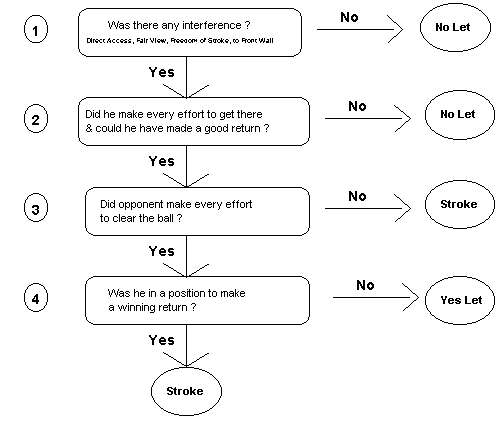
How to determine a stroke/let?


Links

Laatste keer deze pagina is gewijzigd: januari 23, 2000


setstats 1
Hosted by www.Geocities.ws

1