Star Clusters are groups of stars or galaxies that are clumped together. The Pleiades is one example of a star cluster that we can see at night (found in the constellation "Taurus"). They are an "open cluster". An Open Clusters and Globular clusters are the two main types of Clusters.
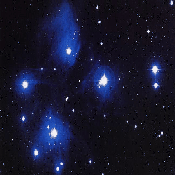
The Pleiades
Open Clusters are named that way because the stars are relatively
young and so it is easy to tell the different stars apart. There are few stars
in the cluster, only a few thousand total. Open clusters are usually found in
the spiral arms of the galaxy. They are also usually pretty irregular in shape.
All the stars in an Open Cluster are relatively the same age
and are made of the same chemical composition. Another famous Open Cluster that
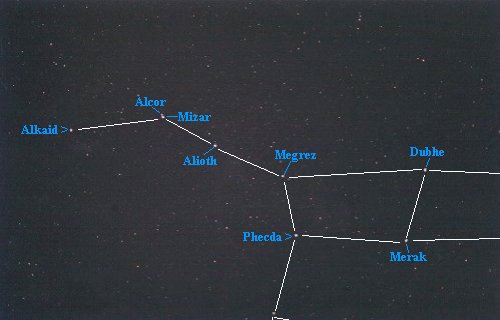
can be found easily is Ursa Major, or more commonly known as the Big Dipper. The
Big dipper can be found usually by looking straight up in the sky. It is one of
the few constellations that can be seen all year long. (see below)
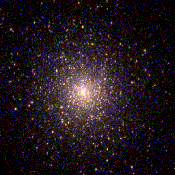
Globular Clusters are much older than open clusters and it is much harder to tell the different stars apart. There are typically more stars in a globular cluster, approximately 100,000 to 1,000,000 total. They get their name because of the appearance of a "glob" of light. (see picture below)
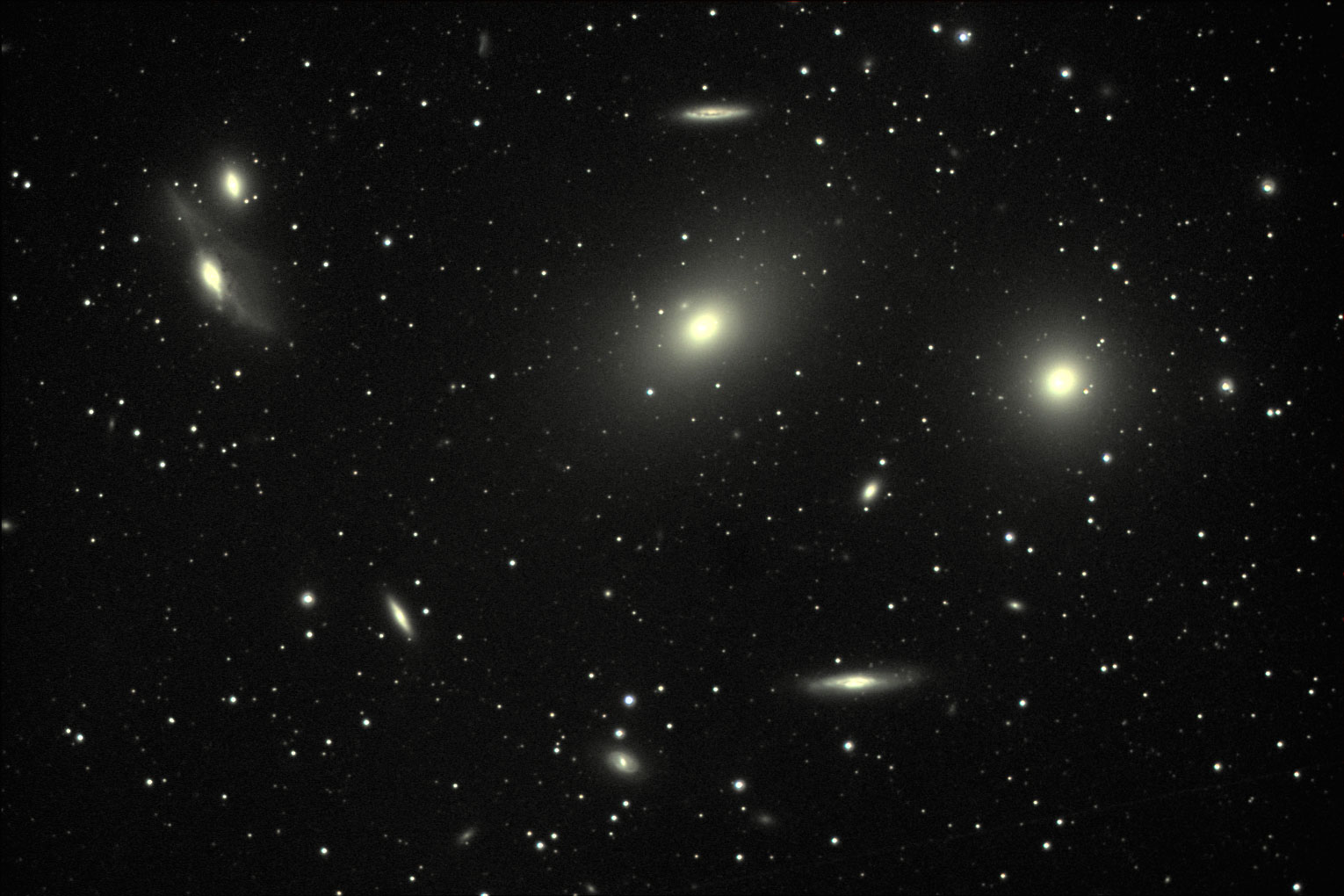
A common cluster of galaxies is the Virgo Cluster of Galaxies. There are between 1,500 and 2,000 galaxies, both large and small, in the virgo cluster. It was first spotted by Charles Messier (remember that guy who started writing down everything he saw that wasn't a comet?) in 1781 and it is found in the constellation Virgo. Galaxies that are in the Virgo Cluster are M49, M58, M59, M60, M61, M84, M85, M86, M87, M89, M90, M91, M98, M99 and M100. (see the picture below)