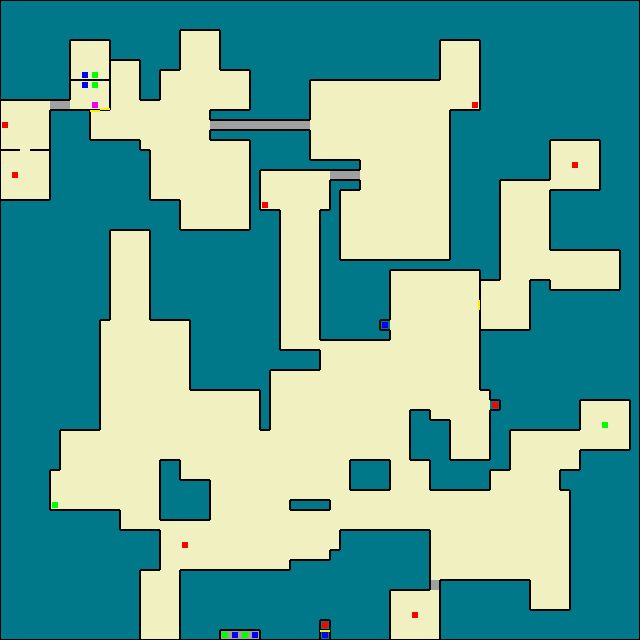
There is a little ruby dust or emerald dust to be found on level 5, if the characters take time to gather it.
This is the third and final orc level.
The entire level (except for the pair of rooms on the west side) is the home of a tribe of orcs. Unlike the wandering monsters (see below), the orcs know their way around the level and act intelligently.
The first time the player characters enter this level, there will be 270 orcs and 100 orogs in the tribe (plus additional orcs as described in whichever version of the monster manual you use). The maximum number of orcs in the tribe is 270. If any day ends with the current number of orcs being less than the maximum number, overnight, 2d6 additional orcs will sneak into the level and join the tribe. Slain orogs are not replaced.
The orcs train tigerdogs. Initially the orcs have 100 trained tigerdogs. Slain tigerdogs are not replaced.
Unless and until the player characters kill all of the orcs on this level, additional orcs will continue to settle here as described above. Even after the player characters have killed all the resident orcs, wandering monsters will continue to turn up as described below.
The orcs know all about the one-way wall in the north-east part of the level. If they see player characters go in, they will make sure that they do not accidentally trigger it and allow the player characters back out.
All of the lairs marked on the map are additional resident monsters (i.e. not orcs). The residents of these lairs are entirely up to you. Note, though, that some of them at the ends of passageways blocked by rubble, so the residents must either be sneaky (e.g. snakes, spiders) or intangible (e.g. undead), and that others are in areas where the orcs go regularly, so they must be monsters which are not entirely incompatible with orcs.
The suite of rooms in the north-west corner should be the home of something lethal. Choose a sensible combination of (for example) brigand chieftains, evil high priests, demons, stone giants and medusae. Whatever the trap behind the one-way wall is, the residents know about it and make use of it.
For example:
The trap might be a magical statue which casts a delayed-action hold person
spell on everyone who enters. As far as the player characters can tell, although the
statue looks creepy and magical, nothing has happened, so they press on.
Ten minutes later, they are in melee with a group of demons,
and suddenly half the party cannot move. Won't that be fun :-)
This is the moment the evil high priest, who lives in the second room, has been waiting for :-)
(N.B. the evil high priest wears a ring of free action, so is unaffected by the statue.
The demons, not being people, are also unaffected by it.)
In the unlikely event that the player characters emerge successfully from this encounter, there should be plenty of treasure. Imaginative players will realise that the most valuable treasure is the suite of rooms itself. This suite of rooms makes a very good base for exploring deeper levels of the maze, particularly if the player characters can make use of the trap themselves.
Whenever you feel the time is right, roll 2d6.
| 2d6 | Monster |
| 2 | Gargoyles (+ Supergargoyle) |
| 3 | Gargoyles |
| 4 | Ghouls |
| 5 | Hobgoblins |
| 6 | Orcs |
| 7 | Wild Tigerdogs |
| 8 | Ogres |
| 9 | Trolls |
| 10 | Hill Giant |
| 11 | Stone Giant |
| 12 | Medusa |
Wandering monsters are there to annoy, not to kill the entire party (that's what the orcs and resident monsters are for). Choose the numbers accordingly.
Remember also to include as many oozes, slimes, gelatinous cubes and other gooey things as you like, as well as enough carrion crawlers and other clean-up monsters to make sure that anything left lying around is not left lying around for too long. Keep your dungeon tidy!