Tips for Starting a Community Based ASCA Support
Group
Copyright 2005, The Morris Center
Contentsby
Introduction. 3
Getting Started: The Three P’s. 3
Participants. 3
Number of Participants. 3
Advertising. 3
Craig’s List 4
Posting Flyers. 6
Mailings. 6
Open Drop-in or Closed Meetings. 6
Internet 6
Email Address. 6
Creating a Web Page On Yahoo. 6
Meeting Place. 6
Administration. 6
Administrative Goals. 6
Roles. 6
Decision Making. 6
Types of Decisions. 6
Voting. 6
Other Tips. 6
Additional Help and Resources. 6
Stories by Starters. 6
Scott’s Story. 6
Congratulations on taking the initiative to form a support
group for Adult
Survivors of Child Abuse (ASCA). Mostly
likely, you have not been able to locate an existing group with a convenient
meeting time and/or location. Perhaps, you know of a group other than ASCA but
find its energy and style a mismatch for yours. Whatever the case, starting an ASCA group is an attainable goal
and a rewarding experience.
The ASCA program has been employed for over a decade by a
number of groups in cities throughout the world. ASCA is based on hugely
successfula
twenty-one-step program for survivors of child abuse. You can find more
material on the program itself in the Survivor to Thriver manual and the ASCA
Co-Secretary / Co-Facilitator Training Manual. You can download or order these
materials on the Morris Center website (www.ascasupport.org). If you have any questions, need more
information, or just want some moral support, please don’t hesitate to call The
Morris Center Outreach office at 415-830-2191.
They would love to hear from you.
There are currently two different group models:
community-based groups and provider based groups. The tips contained in this
brochure are geared for community-based groups. Community based groups are
formed by survivors of child abuse who, are also the group’s participants and
co-facilitators. Provider based groups,
on the other hand, are usually formed by mental
health providers or organizations and may or may not be co-facilitated by
survivors of child abuse.
Starting a group may seem daunting at first, but, as with
most tasks in life, you can achieve the goal by proceeding step by step, and
celebrating each accomplishment along the way. There certainly are numerous
approaches to starting an ASCA group. In this pamphlet, I we will try to present
an assortment of tips. These tips may or may not be helpful to you. Feel free
to apply those that seem to apply to your situation.
There are three primary ingredients to a support group. They
are 1) Participants
(survivors), 2) Place (meeting place), and 3) Procedure (format). It’s a
simple recipe. The Morris Center has prepared the procedures (format) and
supporting materials for you, so you can focus your efforts on locating other
survivors and the meeting place. WeI’ll discuss which materials you’ll
need - as well as offer tips - for the first meetings later in this pamphlet.
Support groups are all about people, and so, in the end,
people are the most important ingredient to the group. For that reason, try to
find a few people to serve as a core to the group’s formation. This group can
assist with finding other interested parties, selecting a meeting place, and
choosing an appropriate meeting time. If you act on your own, you may choose a
place and time that does not work for others. It is hard to know these details without
getting input from other people.
Of course, you may not be able to find others to help you
form a group. Many people only want to commit to existing entities. However, I we know of at least one
group that started purely from the efforts of one person who, not finding
others to help establish the group, chose a meeting place and time and then
advertised to attract members. So, don’t be discouraged!
You may know some people who are interested in joining a
support group for survivors of child abuse. Opinions differ on the minimum
number of people you need for a meeting. There’s no iron-clad rule on the
matter. The Morris Center believes that the ASCA meeting format works best with
seven or more people. Some people are satisfied with even just two people in
the room, but this is not the norm. Consider aiming to have at least five
people at each meeting.
Smaller groups, five to nine people, allow for greater
intimacy, enough time for each person to share, and the possibility of
extending shares beyond five minutes. Many participants appreciate the
opportunity for longer shares. However, smaller groups carry the additional
risk of having too few people when everyone is not able to attend each meeting.
Larger groups may be more comfortable for people who prefer not to speak at a
meeting. Even though no person is ever required to speak at a meeting, people
sometimes feel a subtle pressure to do so if there are not enough participants
to fill the allotted time.
Your own unique circumstances will determine how big your
meeting will be. You will just have to wait and see how many people are
interested in the meeting and then navigate from there.
If you do not know enough interested people to form a group,
then you will want to find people. One good approach is to ask individuals you
know. Naturally, you should ask people you trust. Some people do not understand
these things and you might be better off not telling them. Please do not
pressure yourself to ask people you do not trust, because there are plenty of
other ways of finding participants.
Advertising is an effective way of finding participants. A
good place to start is Craig’s List, a popular classified ads web site. Craig’s
List receives a huge amount of traffic, particularly from the kinds of people
who join support groups. Here’s how you do it:
Get on the Internet, open your web browser, and type in the
address <www.craigslist.org>
(without the <> brackets). See Figure
1 below.
Figure
1
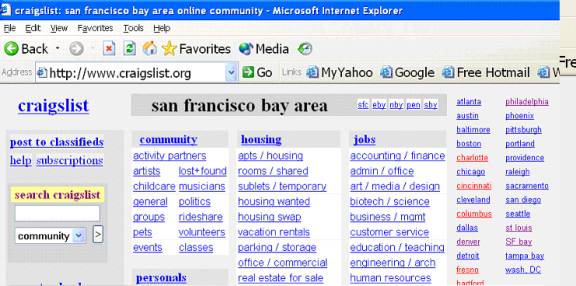
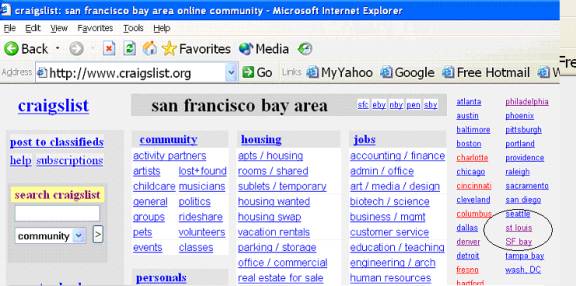
The default city is San Francisco. If you live in a
different city, find it on the right side of the page and click it. For this
example, we’ll try St. Louis. See Figure 2.
Figure
2
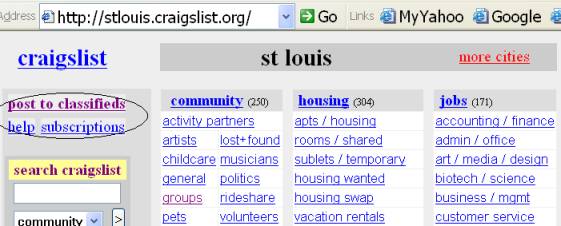
On the top left of the page, click on the link called “post
to classifieds.” See Figure 3.
Figure
3
Click on “community.” See Figure
4.
Figure
4
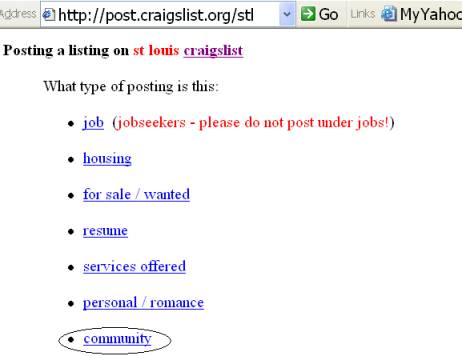
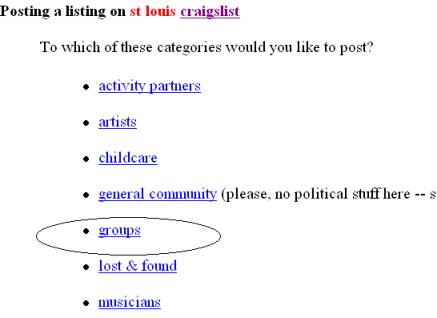
Click on groups. See Figure
5.
Figure
5
You will see an entry screen. See Figure 6:
Figure
6
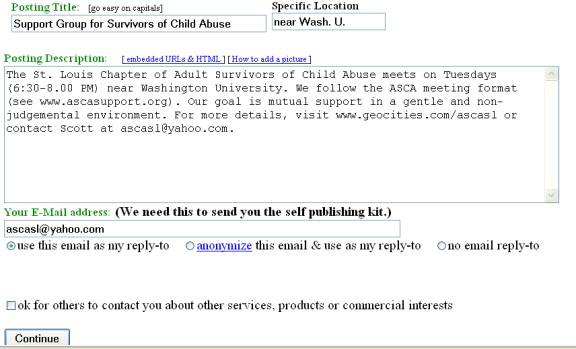
Fill in a title, description, and location. You can copy my
description from the example above or compose a different one. You can leave
the check box at the bottom (ok for others to contact) unchecked. It’s not a problem
if you place a checkmark there – but you might receive email solicitations from
businesses.
You can choose to list your actual meeting address or just
give a general description. This depends a bit on your group format. If the
group screens new participants, then you first would communicate with the
applicant. Even if you do not screen applicants, you still might not want to
list the address publicly. Some participants worry that a child abuse
perpetrator or some other unwelcome person might try to attend a meeting and
cause a disturbance. Some people do not worry about this at all and just go
ahead and list the address. I have never seen a visitor cause a problem. The
former approache requires a bit more work and may
even deter some legitimate participants who would otherwise attend. As with
everything in life, there are trade-offs.
In the above example, I we listed a group web site that I we established at
geocities, which is Yahoo’s hosting service. I’ll We’ll show you how to
set up an email address and web site on that service too. If you do not have a
group email address, you can enter a different address. Alternatively, you can
select “anonymize” at the bottom of the screen. Craig’s List will invent an
address for you and post it in the ad. This way, your email address will not be
viewable from the web. Any mail sent to the temporary address will be forwarded
to you at the address you will specify after receiving your confirmation
request from Craig’s.
If you have not yet selected a location or meeting time,
then you might just write about your idea to form and group and ask for
interested people to respond. You could write the following:
We are in the process of forming a
support group for adult survivors of child abuse. Our goal is mutual support in
a gentle and non-judgmental environment. We welcome survivors of any type of
child abuse. If you are interested in helping to form the group or would just
like to attend, please contact Scott at [email protected].
Note: I we realize that I we misspelled the word
“non-judgemental” in my our Craig’s entry form in Figure 6. It should
be non-judgmental. But I we aream allowing myself ourselves to make
mistakes, even those in public forums like the web. You do not have to be
perfect in your effort to start a support group. You will make lots of mistakes
along the way. That’s fine.
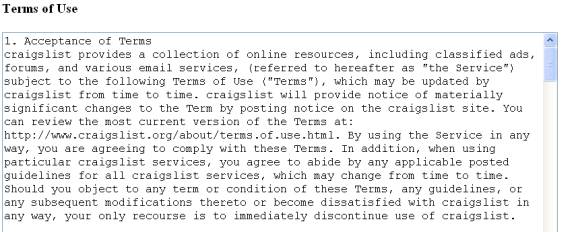
After clicking “continue”, you will get a screen asking you
to confirm your entries. Click “continue” if you are satisfied or “edit” if you
want to change something. After clicking “continue” you will see a screen
asking you to affirm the “Terms of Use.” Read the terms and click “Accept.” See
Figure
7.
Figure
7
The final screen doesn’t require you to take any action now,
but informs you that you will be receiving an email to which you must respond
before your ad is posted.
An hour or so after your submission, you will receive an
email from Craig’s. See Figure
8.
Figure
8
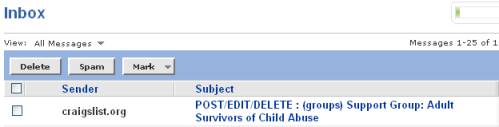
The email will contain a link. Click on the link. See Figure 9:
Figure
9
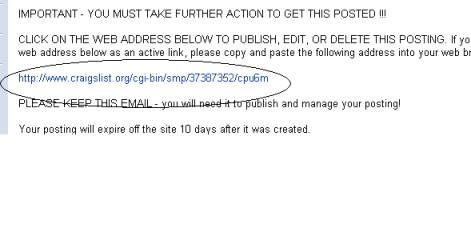
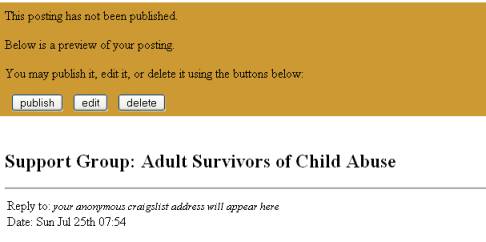
Click “publish” and you are in business. See Figure 10:
Figure
10
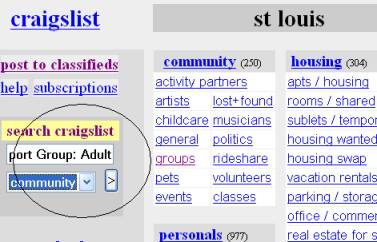
To view your ad, go to Craig’s List, and pick your city. In
the search box on the top left, type in the subject of your ad (as you entered
it) and click the arrow to the right of the search box. See Figure 11. Your ad
should appear.
Figure 11
The ad will run for ten days. You can renew it every ten
days if you like.
Another good means of advertising is posting flyers at
universities, health clinics, community-center bulletin boards, and even coffee
shops. Most places take down the flyers after a few weeks. So, you’ll have to
get in the habit of making the postings as long as you are looking for new
members. You might find this effort tedious, but you might also find it
therapeutic. Each step towards establishing your support group is an
affirmation of your initiative, independence, strength, and yearning to survive
and thrive.
I We have created a sample flyer. You can
download your own copy of the flyer from the Morris Center web site (www.ascasupport.org) or at the ASCA NYC
website at <www.geocities.com/ascanyc>. You can also copy and paste from
this document if you are reading via computer. The document is in Microsoft
Word format. Obviously, you’ll have to customize it a bit for your group.
Here’s the flyer:
Figure 12
ASCA:
New York City
Support Group for Adult Survivors of Child Abuse

Join us for our weekly meetings. We give one another
emotional support and an opportunity for expression of feelings, thoughts,
memories, hopes, insights, and education on the subject of child abuse.
|
Held currently on Tuesday evenings from 6:30 PM to 8:00 PM in Greenwich
Village, Manhattan.
|
See www.geocities.com/ascanyc
for more information or Email Scott at [email protected]
Once your meetings get started, you can leave a few copies
of the flyer on your literature table. Participants can assist in the
advertising efforts by posting flyers at their schools and coffee shops. I We don’twouldn’t
suggest pressuring anyone to help (most survivors had enough of that as
children), but you can mention it during business meetings or the announcements
portion of the meeting.
You can also run a mail campaign by email or snail mail
(snail mail is old fashioned mail with paper and envelopes). Who should you
email? You can email anyone who might know of people who could use a support
group. This can include the United Way, religious institutions, community
centers, or even psychotherapy groups or individual counselors. The public
library and web are great places to find addresses.
Here’s sample text for the letter:
Figure 13
Dear Community Services Director,
I am writing to tell you about the Adult Survivors of Child
Abuse Program (ASCA), which was designed by the Morris Center (www.ascasupport.org) in San Francisco.
ASCA is a support group for adult survivors of child abuse. This group may
interest some of your staff and clients. You may have received inquiries from
the public on the availability of such a group in our metropolitan area.
Our ASCA group meets once a week, currently Tuesday evenings
in _________, for emotional and intellectual expression in a gentle and
supportive environment. All participants are survivors of child abuse. There is
no fee for attendance, only a suggested $10 contribution, which is applied
towards rent for the meeting room, recovery literature, and contributions to
The Morris Center — the non-profit organization that maintains our World
Service Office.
I would be most appreciative if you could include our group
with any listings of services used by your staff or in literature and web
sites. While our city has no shortage of support groups in general, it suffers
from a dearth of groups specifically for this purpose.
Please find attached a flyer (in the form of an MS Word
document) that you can place on a public bulletin board.
Suggested blurb for your literature:
ASCA-NYC
Support group for adult survivors of child abuse. Meets
Tuesday evenings 6:30 - 8:00 PM at the Children's Aid Society, Greenwich
Village Center at 219 Sullivan Street (a block and a half south of Washington
Square Park) in Manhattan. Suggested contribution $10. See www.geocities.com/ascanyc or Email
[email protected] for more details.
Thank you for your kind assistance here and for your
important work in general.
Sincerely,
Your Name
Of course, you need to adapt this sample with references to
your particular group name, location, meeting time, and contact information.
For the snail mail campaign, replace the word “attached” with “enclosed.” It’s
also better to have a specific name in the salutation instead of the generic
“Community Services Director.”
Please keep in mind, people may not welcome solicitations
from mail order catalogs or credit card companies, but they often appreciate
hearing about helpful resources. You might even receive phone calls (if you
list your number) from people who ask for more information.
You might also find yourself speaking with someone who is
checking you out for credibility. Do not be concerned or intimidated by that.
The caller may represent a community organization that wants to exercise diligence on behalf
of their clients. You do not have to impress them with a big show. Just talk a
bit about your group, its format, and its goals. I Some group starters have
found that mentioning my their association with the Morris Center is
helpful. You can mention
howI talk about how the group
closely follows the Morris Center’s meeting format. You canI emphasize that your group does notwe are not a
group where people receive give psychoanalysis or counseling but provides. We provide
a safe place to express one’s feelings and thoughts in a supportive environment
- without encountering analysis or cross-ttalk (please see the Welcome to ASCA
Guide for more information on cross-talk).
As we mentioned earlier, you will need to decide whether to
classify your meetings as “open drop-in” or “closed”. Closed meetings provide a
more stable environment. This is both a strength and a weakness. Sometimes,
people who are new to the meeting can add a different perspective and fresh
ideas. Sometimes, new people can inhibit free expression by those who do not
want to share before complete strangers. The founding members make many of
these types of decisions. You can change the genre of your meeting as
necessary. You may need to change whether a group is open or closed in order to
attract members. However, excessive change can be harmful because most support
group participants tend to want a fairly stable environment. Even positive
changes can sometimes unsettle a group. I We will discuss group
decision-making processes in the section titled Administration.
There are numerous advantages to establishing an
email address for your group including the following:
1.
You
can insure that inquiries from the public do not get mixed in with your other
email.
2.
You
can better guarantee privacy in your correspondence in case some other person
at home shares your regular email address.
3.
You
can more easily maintain your anonymity if you so desire.
4.
You
can pass on responsibility for the email account to another person in the
group.
We all know by now a number of
ways to establish an email address. You might find it helpful to establish an
address at yahoo.com because you Yahoo will also allow you to form an online
web page and group. Here’s how to set up an email account on Yahoo. In your web
browser, type yahoo.com and when the page loads, click on Mail. See Figure 14
Figure 14

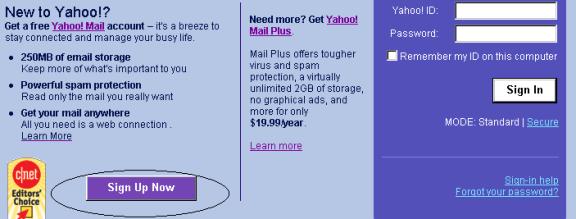
On the new web page, click Sign Up Now. See Figure 15.
Figure 15
On the new web page, click Sign Up For Yahoo Mail.
See Figure 16.
Figure 16

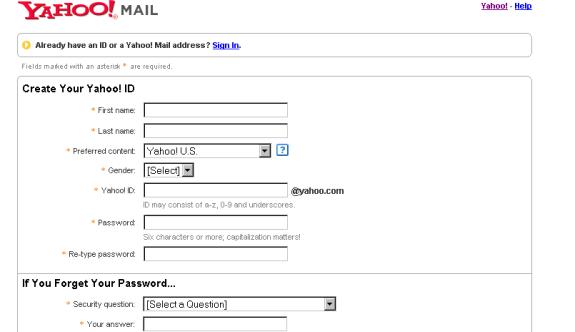
Now fill out the information on the sign up page.
See Figure 17.
Figure 17
From this point onward, just follow the
instructions that Yahoo provides until you complete the creation of your
account.
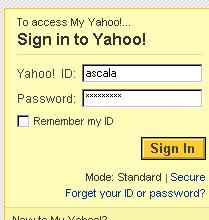
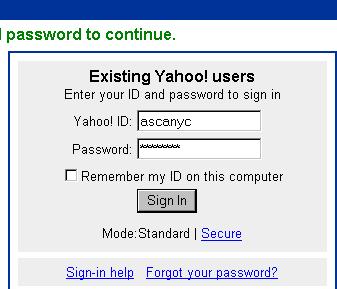
Once you set up your account, you can send and
retrieve mail by going to my.yahoo.com and entering your id and password. See Figure 18 and Figure 19.
Figure 18

Figure 19
Yahoo allows anyone to create a small web site on its servers. They use
geocities.com, one of their subsidiaries for this purpose. To create a web site
on geocities, do the following:
Go to geocities.com using your web browser and
click on Sign Up. See Figure 20.
Figure 20

Enter the yahoo email address and password that you
created earlier. See Figure 21.
Figure 21
Choose Health as your topic and click Continue. See
Figure 22.
Figure 22

On the next web page, note your web address (should
be geocities.com/your email address, eg geocities.com/ascanyc) and click Build
Web Page. On the Build My Web Site page, click Yahoo Page Wizards. See Figure 23. From this point onwards,
follow the instructions yahoo gives you.
Figure 23

To create a meeting place, you really just need a room and
chairs. However, there are some other considerations. It is best to find a
meeting room with a safe environment – well lit, fairly public – so that
participants do not fear for their physical safety. People who have been
physically or sexually abused as children have a greater sensitivity to safety
issues. One group tried
to arrange meetings in a basement of a synagogue and realized that the
windowless room, deep in the bowels of an old building, might appear unsafe to
some people. For safety considerations,
try to find a room with windows. The light from windows also cheers up the
atmosphere. A room in good condition is optimal, although this is not always
possible.
Another consideration in room selection is environmental
control. By that I we mean that the place
needs to be heated in the winter and cool in the summer
(air-conditioning). However,
air-conditioners can sometimes make a lot of noise! I Watch out for
this.
Stability is another consideration. You want find a room
where you can stay for the long haul. Switching meeting locations can be
difficult for the group. The new location might not be convenient for some
people. And if you have a drop-in meeting, communicating the change to all
attendees can be cumbersome. So, try to find a stable situation with a
reasonable landlord.
You might be puzzled by the choice of the word “landlord”
for renting a room. You can try to locate a free room in the library, a
hospital, or community center. For example, one of the San Francisco groups and
both of the Chicago groups found free meeting spaces in their local hospitals.
However, most organizations charge rent. Rental costs will vary. The lowest I rate you might findfound
in New York City is $15 an hour. Some places want $100. A group organizer has
to be a bit of a businessperson. Negotiate the best deal you can.
You can search the classified ads for rooms to rent, including
those on Craig’s List, the yellow pages, or the web. You can also just ask
around.
One important consideration in selecting a room is whether
the lobby to the building has security, which requires people to show
identification. Many meeting participants
want to retain their anonymity throughout their association with the group.
Having to show ID, may compromise that desire.
Community based ASCA support groups work democratically.
Regular business meetings provide the space and opportunity for group
participants to decide on issues such as how to develop new co-secretaries, how
to raise funds, what types of reading materials to approve for Rotation C
meetings, etc.
Before we discuss the administrative and decision-making
process,
I we
should detail the purpose of administration. There are numerous tasks involved
in running a group. Some of the salient tasks including the following:
People
Continuous advertising for new members if necessary
Responding to inquiries
Resolving interpersonal conflict
Communicating meeting place, time, and procedure changes
Place
Paying rent
Tidying the room
Ensuring climate control: heating/AC
Making sure there are a sufficient number of chairs for the
meeting
Meeting
Communicating rotation schedule issues and topics
Collecting contributions
Providing Welcome to ASCA guides and other materials
Bringing materials to each meeting
Other
Record keeping/treasury
If you are just starting an ASCA group in your area, you
(and your co-secretary) might need to handle all of these tasks. Like anything, such an approach has its
advantages and disadvantages. The primary advantage is simplicity. However,
relying on a single administrator depends on one person to commit to the work,
which may require two hours a week, not including meeting time. A disadvantage
of this approach is that other people may want to contribute to the group
administration. You won’t find out if you don’t ask for volunteers.
Here is a matrix of some of the tasks according to roles.
Note that in many meetings, the co-facilitators handle all of these tasks. We
are just suggesting that this doesn’t have to be the case.
|
Roles
|
Tasks
|
Notes
|
|
Co-secretary or Co-facilitator
|
Reads script and intervenes when rules are
broken.
|
Usually a “veteran”
of ASCA meetings, who knows the program and understands the importance of
safety in a support group.
|
|
Initiator/
Literature Person
|
Brings materials to each meeting.
Starts meeting by asking for volunteers for
co-secretary duties.Sets up meeting materials on a table. Posts
signs.
|
Can change at every meeting with one person committing to
be Initiator/Literature Person at the next meeting.
|
|
Treasurer
|
Collects contributions.
Keeps records on collection
Pays rent
Buys support group materials
|
Co-secretary
usually handles this. But if someone attends regularly and is reliable, he or
she might want to take on this role.
|
|
Door Monitor
|
Checks for late arrivals
|
|
|
Timekeeper
|
Times the shares during the meeting
|
|
|
Newcomer Greeter
|
Greets newcomers, explains the handout, and helps person
feel welcome
|
|
Survivors of child abuse tend to be especially averse to any
hint of tyrannical control in a meeting. So, I especially in
community-based meetings, voting is usually a good way to make decisions. That
way, each person has equal say in the decision-making process, You can vote on
almost anything including topics for Rotation “C” meetings, whether to open
windows on hot days, and length of shares.
Some decisions, such as whether or not to turn on a fan, are
relevant only to individual meetings. Other types of decisions might impact
more than just your own group. People in recovery might attend more than one
ASCA support group – if they are available in their area. You might consider
designating special times for policy decisions at business meetings. Most
people cannot commit to attending every meeting. A participant might become
disconcerted if she or he finds out thatthat the group made a major
decision during the one meeting they missed. One solution to this dilemma is to
vote on policy matters only during the first meeting of each month. This way,
people know they should attend those meetings if policy decisions are important
to them.
Another
recommendation is to ask group members tos bring all
issues directly to the co-facilitator after the meeting. The co-facilitators then announce those
items that the group needs to discuss at the business meeting. Presenting issues calmly and rationally is
an important role of the co-secretary and co-facilitator.
The co-secretaries facilitate the voting process. For
example, in the New York ASCA business meetings, any participant may raise an
issue for discussion or suggest a vote. If another person seconds the motion,
the co-secretary asks if anybody wants to discuss the issue before voting.
Length of discussion depends on the availability of time and the productivity
of the discussion. The co-secretary then asks for a show of hands from those
who are “in favor”, “who oppose,” and “who abstain.” The majority wins.
Please note that these are all just administrative
suggestions. Your group can adapt these suggestions or discard them altogether
in favor of a different approach.
If possible, leave the phone list out after the meeting as
you clean up. This will give people more time to copy down names and numbers.
Approach newcomers and make sure they have a copy of the
Welcome to ASCA guide. Ask them if they have been to a support group before
and, if not, explain to them the meeting flow (opening remarks, readings, main
share, positive feedback, regular shares). Explain the concept of cross-talk.
Help them to feel welcome. Tell them they do not have to give a share or read
aloud. They can just say, “pass”.
Try to strike a balance between enforcement of rules and
tolerance and patience. People need a little time to learn the group
guidelines. For example, wI e think it is better to enforce the
punctuality rule (by allowing late comers to enter the meeting at designated
times only). However, a brand new participant might not see the sign on the door
and just barge in the room. Such things happen now and then. Just try to
recognize that participants usually break group rules because they do not
understand or know about them yet. Please remember that support group
administration is an art - not a science. Don’t expect things to run perfectly.
You’ll learn many other tips over time.
Once you establish your local ASCA group, you will find out
that there is a whole community to which you belong! Not only will you meet
other survivors who support you in your recovery journey. You can get to know
other ASCA group facilitators around the country – and world!
The Morris Center provides several resources to help you
continue to learn how to run effective meetings. You can:
1.
Attend one of The Morris Center’s ASCA Co-Secretary Training
workshops in San Francisco
2.
Order or download a copy of the ASCA Co-Facilitator Training
Manual from the website www.ascasupport.org.
3.
Join the ASCA Meeting Facilitators e-group hosted on the Yahoo
website. This is a private e-group that only
invited members (ASCA meeting co-secretaries around the world) can access. You
can post questions and discuss ideas online with other co-secretaries. To find
out more about how to subscribe to the group, e-mail [email protected] or [email protected].
4. Call
The Morris Center Outreach Office in San Francisco at 415-830-2191
Following is one person’s account of his efforts to start a
group. Maybe you will soon have a story that we can add to this section.
For all of my adult life I have had a notion that I would
benefit from group therapy, but somehow, despite searching for a group and
requesting the help of my therapists, I did not come across any for many years.
When the 12-step movement became wildly popular some years ago, I found my way
to 12-step support groups for people suffering from codependency and eating
disorders. However, I felt somewhat out of place in these groups, as much as I
enjoyed the group experience, since the subject matter and life experiences of
the participants did not address the core of my struggle.
One night, an idea occurred to me that perhaps I needed a
group that specialized in child abuse. Living in New York City, a center for psychotherapy,
I thought that finding a support group for survivors of child abuse would be a
breeze. But it wasn't. I searched the papers and the web. I called clinics and
hospitals and all sorts of social service organizations. Eventually, I found a
group for female survivors of sexual abuse and later on a group for male
survivors. However, I sought to discuss a broader range of child abuse issues
and simply could not find in Metropolitan New York City, home to nearly 20
million people, a support group for survivors of child abuse in general.
I was exasperated and frustrated. As I started to dwell in feelings of
bitterness that the world was once again letting me down, another idea occurred
to me: start your own group. How hard could it be, I wondered.
I figured I could use the 12-step format, the only one with which I was
familiar. Other than that, I needed some people and a room. I really didn't
know where to start for either task so I just took shots in the dark. I asked
around. I tried the phone book and the Web, specifically Craig's List, in
search of rooms for rent. I phoned Churches, Synagogues, and community centers.
I was surprised at first that these public service organizations required rent, sometimes
sizeable sums for an hour of room space. In thinking it over, however, I
realized that maintaining a room for the public carries an expense. So I set
about finding one in the thirty dollar range for an hour or so of time.
I went to Craig's List looking for people too. My advertisement asked for people
who would be interested in helping to organize a group. In the end, I didn't
find anybody interested in forming the group, but there were a few who said
they would come to the first meeting once it was all organized. I could live
with that. All of my life, I have had to take care of myself, and I could do it
here too. What I needed from other people was for them to show up at the
meetings and share.
Several people inquired as to the group format. I told them
it would be run like a 12-step group, but I experienced trepidation that I was
working with only adumbrations as to the actual workings of the meetings.
At some point in all of this organizing work, somebody
(might have been two people actually, my wife and one of my correspondents)
referred me to the Morris Center website. I could see instantly that I had
stumbled on a storehouse of great material for my goal of starting a support
group for survivors of child abuse for such is their specialty. The meeting
format document was the best find of all since it scripted the entire meeting
and helped allay my fears regarding the
running of meetings.
I also took instantly to the 21-step program in its design specifically for
survivors of child abuse. As I mentioned earlier, the 12-step programs, as much
as I appreciated them, never seemed ideally designed for my issues. For one
thing, forgiveness, a staple of the 12-steps, is a much more complicated issue
with trauma survivors. Also, while I believe in God, religious belief is a more
complicated issue with many survivors of child abuse since religious abuse is a
common form of child abuse. The 21 steps do not demand forgiveness or reliance
on a higher power (not that they discourage them) and address instead matters
more relevant to recovery from child abuse, such as recall of memories,
reclaiming of one's life from dominant personalities, and building of personal
strength.
With the ASCA material in my possession, I felt more
confident in my organizing efforts. While still looking for a room, my wife
came to the rescue again by finding something in Tribeca, a neighborhood in
downtown Manhattan. It was a fairly well maintained basement room in a
synagogue and the price, whatever we could afford at first and $25 per meeting
after we established ourselves, seemed reasonable. With the room, the format,
and a few interested parties in place, I settled on a meeting time that was
agreeable to everyone and announced the first meeting a few weeks hence.
Naturally, I was excited and nervous on the day of the first
meeting. But I felt enormous pride that I had taken an idea from germ to event.
For much of my life, I had lived in a state of helplessness and hurt, and here
I was taking charge of my emotional destiny. As I set up the room for the first
meeting, I wondered who would show and what we would talk about. I was anxious
to meet people with childhood experiences similar to mine. I sat down and
waited. But nobody came! I waited an hour. I went upstairs to see if anybody
was lost or locked out, but didn't find anybody. I couldn't believe it. All
this work and nobody came. But I didn't despair. I believe that my proactivity
boosted my faith in my self and the world.
I advertised some more and went to the second meeting. Again, nobody came. I
waited an hour.
It occurred to me that my choice for a meeting place might be hurting my recruitment efforts. The building was not centrally located within
Manhattan. Also, a basement room might be off-putting to some people for a
variety of reasons. So, I researched some more and found a place at the
Children's Aid Society in Greenwich Village. I visited the room and loved it.
The neighborhood was much more popular and maintained. I notified my mailing
list of the location change and tried again. This time, five people showed up, and
I had my first support group meeting. It went surprisingly well, thanks in
large part to the ASCA format document, which I followed closely.
Well, ASCA NYC has been holding meetings now for over eleven
months We have some regulars, some people who came but once, and others who
come periodically. If I had a dollar for each time I have been thanked
profusely for starting the group the sum would more than cover my share of the
rent. But equal to my joy in having given something to the community and to survivors
of child abuse is the psychological benefit to me of having a forum for sharing
my story and hearing those of others like me. Group support is a powerful
device, in some ways a perfect antidote to a lonely childhood. Starting a group
took a bit of work and patience (although not excessively so), but it has been
undoubtedly worth it.
I We hope you found this
pamphlet of tips useful! Again, congratulations on taking the initiative to
start a group of your own! You are on a journey in which you do not have to
travel alone any more. Welcome to ASCA!