BOQUIREN’S MATHEMATICAL MODELS
ON EXCHANGE RATE CHANGE 1997
I.
IMMEDIATE EFFECT OF
A DEVALUATION ON EXPORTS
Assuming for a single commodity i that:
 =
=  ()
()  (
( ())
())
then it can be shown mathematically that for n
commodities:
 > 0
iff
> 0
iff 
 d > 1
d > 1
 < 0
iff
< 0
iff 
 d < 1
d < 1
 = 0
iff
= 0
iff 
 d = 1
d = 1
II. ROLE OF LIQUIDITY ON EXPORTS IN A DEVALUATION
Assuming that:
TR =
p
=
p (, L) q
 (p
(p (, L), W
 (, L),
  ())
())
Solving for the total differential of the equation, we obtain:
dTR = [
= [
 +
+  (
(
 +
+ 
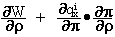 )] d
)] d
+ [ ] dL
] dL
The effect of a
devaluation is determined by the first component of the righthand side of the
equation above. We focus on the second
component of the righthand side of the equation to analyze the effect of
liquidity on exports in a devaluation.
Whether the net effect of liquidity on exports would be positive or
negative would be determined by the quantity
[ ]. We assume
  < 0 or that an increase in liquidity leads
to a higher foreign currency price of exports and eventually to a decrease in
the volume of exports. Thus, provided
that
< 0 or that an increase in liquidity leads
to a higher foreign currency price of exports and eventually to a decrease in
the volume of exports. Thus, provided
that  >
0 or that the increase in liquidity translates into an increase in
working capital leading to an increase in the volume of exports, the net effect
of an increase in liquidity on exports would be positive if
>
0 or that the increase in liquidity translates into an increase in
working capital leading to an increase in the volume of exports, the net effect
of an increase in liquidity on exports would be positive if 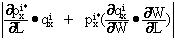 >
>
 . Ignoring
  for simplicity, this implies that the net effect of liquidity would be
positive on exports if
for simplicity, this implies that the net effect of liquidity would be
positive on exports if  or the
positive effect of liquidity on working capital is large enough or if
or the
positive effect of liquidity on working capital is large enough or if
 or the negative effect of liquidity on export
competitiveness is low enough. It is reasonable to assume that at some low
range of money growth the positive effect of liquidity on working capital is relatively large compared
to its effect on the foreign currency price of exports. Thus, given the tendency
for our economic managers to impose a tight monetary policy during a
devaluation (as imparted to them by a conventional point of view) then it is
reasonable to believe that within some low range of money growth, money growth
positively correlates with export growth during a devaluation.
or the negative effect of liquidity on export
competitiveness is low enough. It is reasonable to assume that at some low
range of money growth the positive effect of liquidity on working capital is relatively large compared
to its effect on the foreign currency price of exports. Thus, given the tendency
for our economic managers to impose a tight monetary policy during a
devaluation (as imparted to them by a conventional point of view) then it is
reasonable to believe that within some low range of money growth, money growth
positively correlates with export growth during a devaluation.