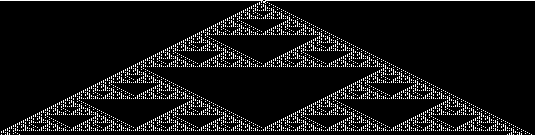
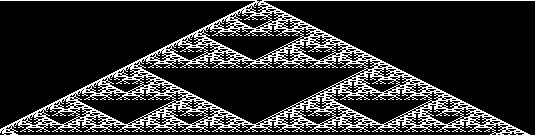
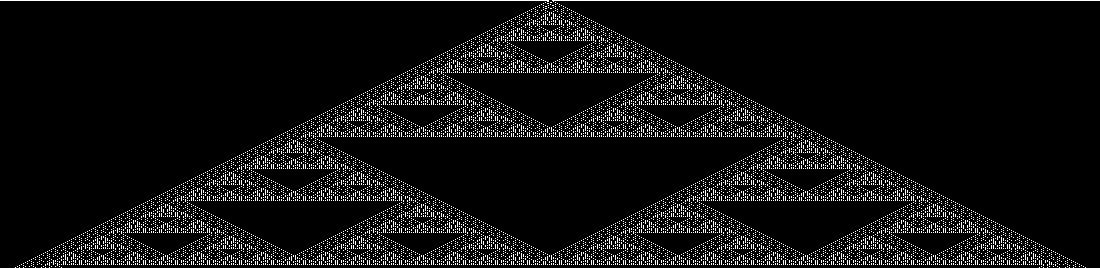
These self-similar fractal-like structures were not uncommon and the GA
found many different ways of drawing Sierpinsky-like triangles.
Note that 2792888933, 3099420589 and 3148502933 (CA rules) are prime numbers. I
still don't know if this is just a coincidence.
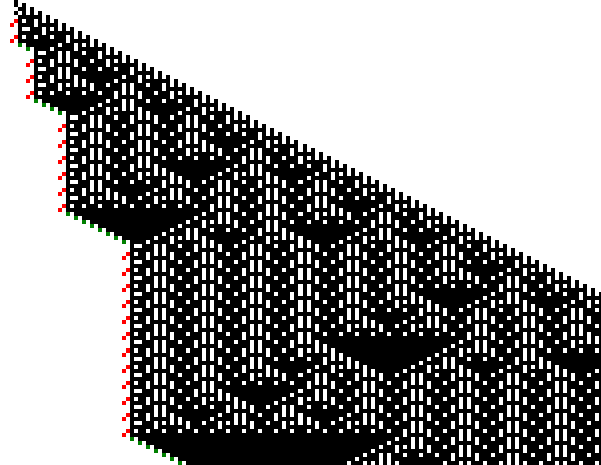
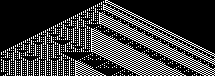
Click on the image to enlarge. Rule 2868868760.
There are two progressions in this rule, one
(2,3,6,12...) is shown in red and the other is shown in green
(2,4,8...). I wonder whether one can demonstrate if that these
progressions continue ad infinitum or not. There's something
remarkable about this rule: it's one-dimensional but when its
two-dimensional space-time diagram is drawn, an illusion of a third
dimension appears (as vertical pipes).
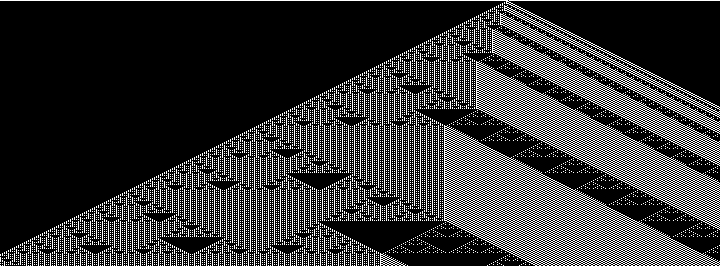
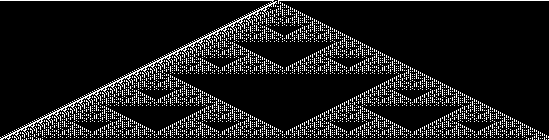
Click on the image to enlarge. Rule 3133097257.
This is the most complex rule that the program has been able to
evolve. I like to call it "fractal breeder". This rule generates lines
of fractals (Sierpinsky triangles) in rows of increasing height.
The hypotenuse of the fractals grows according to the progression
1,2,4,8... I wonder if it ever loses this structure. I've drawn big
images with this rule and this behavior continues.
To Do : Maybe...
- Test whether is more probable to obtain prime rules when
maximizing entropy. I think one could run N GAs, count the number
of obtained prime rules and then compare it against the
theoretical prime number probability (density) of obtaining one
between 1 and 2^32 at random.
- It would be interesting if one could classify CA rules
automatically. I had trouble because I had to analyze many images
(7 per GA run). If the rules could be analyzed automatically one
could be able to test more initial configurations and more rules
per GA run. Although, there's a problem I think: How do we come to
the conclusion that the "fractal breeder" is an interesting rule?
For instance. Is this a computable task? Can this algorithm be
written? Before going philosophical I think there's something that
could be tried: use Genetic Programming in order to build a
program that can rank CA images according to how interesting they
look like. A program could be trained by giving it examples. Each
example could be made of an image and a score assigned by a human.
The evolved program would have access to a number of statistics
extracted from the image. Would it work? I don't know =) I'd like
to give it a try.
- Is it possible to find fractal-like structures in three dimensions
by drawing the space-time diagram of a two-dimensional CA once
it's entropy has been maximized using a GA? There is a problem,
too. We would not be able to look inside such a figure because we
are three-dimensional creatures. Well, computer graphics are
advances enough for this task : breaking apart three-dimensional
CA.
- If entropy is correlated with interesting CA one could rank
all the 2^32 d=1,k=2,r=2 CA rules by entropy value. Nowadays this
task is feasible and symmetry exists. Then one could analyze the
CA starting from more initial configurations and with the rules
that attained higher entropy values first. It's easy to use parallelism
for this task.
- Write a Java Applet for exploring these rules. This will provide
interactivity for the user and quality to the image.
Conclusions
- It's paradoxical that CA with complex structures can be obtained
by maximizing entropy. I'm I wrong?
- I'm still confused and I will have to study a lot.
References
- [1] Gutowitz H., Langton C. "Methods for Designing 'Interesting'
Cellular automata", CNLS News Letter ,1988.
[online]
- [2] Tomassini M., Sipper M., Zolla M., Perrenoud M, "Generating
high-quality random numbers in parallel by cellular automata", Future
Generation Computer Systems 16, pp. 291-205, 1999.
[online]
|