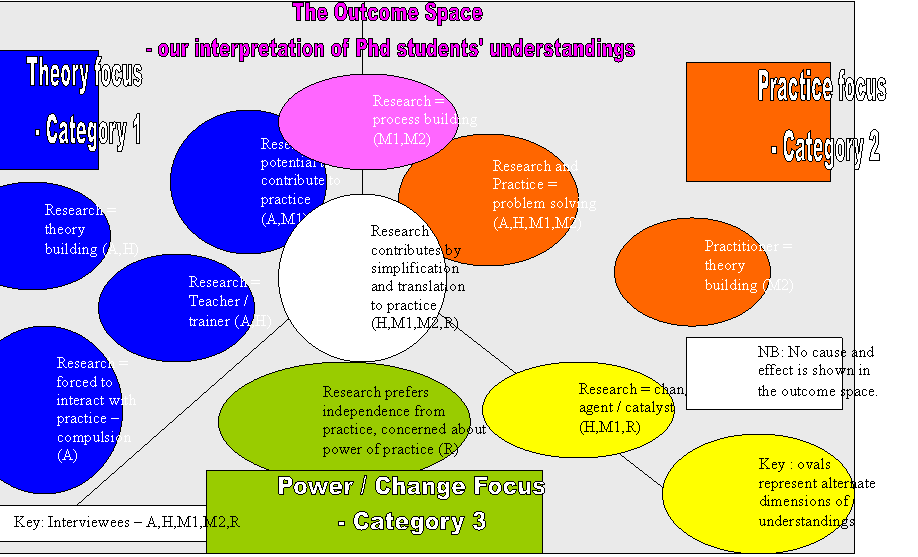
The results of the analysis - Dimensions, Categories and Interviewees
Connecting dimensions
categories and interviewees
Interviewees
were linked to dimensions.
Categories
were linked to interviewees.
Categories
were linked to dimensions
Connection
of Interviewees to categories
Connection
of dimensions to categories of understanding - overview
Connection
of dimensions to categories of understanding – detailed analysis
Detailed explanation of
dimensions
Dimension
1: Researchers as Theory Builders
Dimension
3: Research and practice as problem Solving
Dimension
4: Researcher as Teacher / Trainer
Dimension
5: Research as change / catalyst
Dimension
6: Simplification - Research contributes
by simplification and translation to practice
Dimension
7: Compulsion – Researchers forced to interact with practice
Dimension
8: Potential to contribute to Management Practices
Dimension
9: Practitioners as Theory Builders
In the below discussion, the process of the analysis is described, and the results are presented. Several categories of understanding were developed, and dimensions of the outcome space found that led to a re-evaluation of the research question. The connection between research and practice was found to be much richer and complex than the literature suggested, that is that the connection was beyond the idea that research should contribute to practice. Below we explore the complex interaction between the dimensions, categories, and interviewees, from their understanding of the contribution and connection between not only research and practice, but also theory.
The analysis has derived from the interviewees 10 dimensions of experience, which have been related to three categories of the outcome space, the possible variation in understandings.
The categories have been difficult to name, due to their inherent complexity, and increasing remoteness from the empirical material. The dimensions were much easier to connect to the themes because of their closeness with the transcripts.
Process
Three people comprised the analysis team, and two people the literature team. Five interviews were conducted, and transcribed. Separately, the analysis team read the transcripts, and extracted significant comments that related to the research question. Coming together, the comments were discussed, negotiated and integrated by interviewee. Upon reflection, suggested dimensions were derived for each respondent to characterise overall their understanding of research’s contribution to management.
The next day, the significant comments were applied to the suggested dimensions, and new dimensions were created to account for the remaining significant comments. This led to a much more rich and complex understanding of the research problem, and pointed to some naivety or preconceptions in the question itself.
Where we had expected to understand the qualities of research’s connection to practice (R -> P), we found the respondents had several views of the interrelation (richer and more complex, than the single view which the research question implied), which we called dimensions of the outcome space. This view was negotiated when a member of the literature team, dropped in during an analysis session and was able to provide a fresh perspective. Copies of preliminary analysis were provided to the literature team on an ongoing basis for comment.
This explanation was presented to our peers for explanation and comment. The most significant comment was from the phenomenography expert, who suggested the presentation implied our research was “going along nicely”. The peer review was favourable, lending some communicative validity to our efforts.
Further analysis was made to connect the dimensions, categories and interviewees.
Connecting dimensions categories and interviewees
The relations between these three proved more complex than initially anticipated.
Theoretical justification for linking these in the analysis comes from Akerlind 2002 (Akerlind, 2002; Orgill, nd) suggesting a relating of dimensions. The dimensions help see the relations between the categories and visa versa.
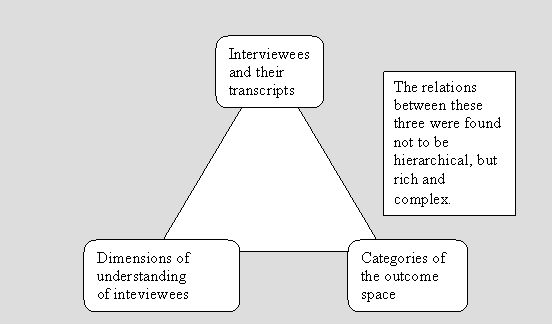
Figure xx. The analysis found rich links between the data source (interviewees), and analysis outcomes (categories and dimensions).
A graphical view of the results of the interconnection analysis is found in Appendix 1. Note this graphical view is complex, and rich, like the connections between the dimensions, categories, and interviewees. Simpler versions are portrayed in tabular form below.
Interviewees were linked to dimensions.
This analysis shows that in seven of the ten dimensions, there was agreement between at least two respondents, but in only two cases were there three or more agreeing, based on the significant comments extracted from the transcripts. Incidental comments were not included in this analysis. It was interesting to note that none of the ten dimensions were agreed by all respondents.
Categories were linked to interviewees.
This seemed reasonably straightforward, and we were comfortable that three interviewees belonged within one dimension, and the other two interviewees had a dimension to themselves. Again, with more analysis this initial understanding proved naïve and simplistic, and reality was more complex and interrelated.
Categories were linked to dimensions
While this was firstly proposed as hierarchical, that is each dimension belongs within one category, this was found to cause inconsistencies with our link between interviewee and dimensions. Upon further reflection, we decided that a more grounded explanation was that some categories were related to multiple people, and thus multiple dimensions. Three categories crossed boundaries between the categories, and one of these crossed over all three categories. One border was uncrossed.
The Categories
The dimensions relate to the type and direction of connection between research and practice. A third construct at this level was needed, and found in the data – namely theory.
Category 1 – This relates to those researchers focussed more on theory, and theory drives what they are researching. There is only a weak link to practice, which they talk about as a ‘possible link’ or potential future link.
Category 2 – This relates to a complex interaction between research, theory and practice, where theory relates to both research and practice, and research is driven by both theory and practice. The links are all strong.
Category 3 – This relates to a strong separation between research and practice, concerned about the power of practice to set a research ‘agenda’, whether their should be a link at all or whether a focus on academic independence is preferable. Theory takes a significantly lesser role here.
Some difficulty was faced in naming the categories.
|
|
Category 1 |
Category 2 |
Category 3 |
|
Proposed name |
Theory focus |
Practice focus |
Power / change focus |
|
Alternate names |
|
Systemic or, research practice dynamic interaction |
|
|
Focus |
Theory |
Practice |
Separation of research and practice |
|
View of
contribution |
Potential rather than actual |
Optimistic |
Pessimistic |
|
Connection of
research and practice |
Weak separation |
Integration |
Strong separation |
Add discussion here….
Derived from the dimensions we assigned the dimensions to three prominent categories which we call:
- theory focus category (C1),
- practice focus category (C2), and
- power / change focus category (C3).
The theory focus category consists of four main categories which is theory building, compulsion, teacher / trainer and potential contribute to practice. Category two (the practice focus) consists of two major dimensions which are problem solving and practitioners as theory builders. The third category which was labelled as power / change focus consists of the parallel / independence category, simplification and change category. Our interpretation also lead us to find that some of the categories overlap in each dimensions, for example the simplification category appears to be in all three categories. The change / catalyst categories appear to be overlap in category two and three while the process building seems to overlap in category one and two. (hassan)
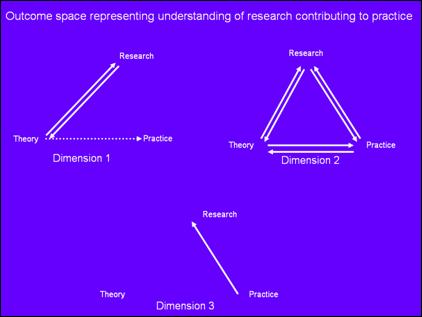
Need to change this diagram use of Dimension to Category!!!
Tim, Can you add some discussion to link to this diagram
Connection of Interviewees to categories
|
|
Interviewee |
Revised assessment |
|
Category 1 |
A, H, M1 |
A, H, M1, M2 |
|
Category 2 |
M2 |
H, M1, M2 |
|
Category 3 |
R |
R |
Initially it was thought that interviewees could be characterised as connected to one category. But once the categories were analysed by dimension, then some dimensions were found to overlap category boundaries, and thus three interviewees also were found to overlap, while two remained fixed close to one category. (rf)
We also assigned the students to a category. Our interpretation leads to us to believe that respondent 1, 2 and 3 (transcripts 1, 2, and 3) easily can fit in category 1 (the theory focus) with respondent 2 having some overlap in category under process building category. Respondent four (transcript 4) can be easily fitted in the category 2 (practice focus), we also found that there is one category overlap between respondent 4 and 5 which is the change and catalyst category. Finally the respondent 5 (transcript 5) can be fitted in the third category (change focus). Our interpretation also shows that the all respondents seem research contribution to management practice should be made simple. Therefore, we believe all the students believe that research is a deeper process and in order to be useful to management practice it should be made simple for a practitioner to understand and use it in their daily activities. (hassan)
In a further study, to publication level, more interviews would be needed until further interviews provide no more categories, or conceptions. (Orgill, nd)
Connection of dimensions to categories of understanding - overview
|
Concept / Dimension |
C1 |
C2 |
C3 |
C4 |
C5 |
C6 |
C7 |
C8 |
C9 |
C10 |
|
D1 |
|
|
|
|
|
|
|
|
|
|
|
D2 |
|
|
|
|
|
|
|
|
|
|
|
D3 |
|
|
|
|
|
|
|
|
|
|
Key: The dots indicate a connection between the category and dimension.
While we are conscious that there are a lot of dimensions, and the interest in parsimony, these dimensions were attempted to be reduced, but we were unable to subordinate one wholly within others, or find other methods to reduce the number of dimensions (add ref here re parsimony)
Connection of dimensions to categories of understanding – detailed analysis
Interestingly the spread between categories is unexpectedly even. Each of the dimensions has categories that belong to no other and each dimension shares categories with other dimensions. (I don’t think this table adds much rf)
|
Dimension |
Category |
Attributes |
|
Dimension 1 – theory focus |
|
C1 Understanding phenomenon C1 Research for the sake of research C2 R=P C2 Value to practices C2 Tangible C2 Valuable C2 Measurable C2 Intervention programme C4 Staff training (T1) C4 Training (T2) C4 Student training C6 Eg AMJ to HBR C6 Toolmakers / toolbuilders C6 Simpler, efficient, effective C6 Communicate / connect P = R C6 Simplicity C7 Forced to interact with practice C7 Compulsion (T3) C7 Potential to practice C7 Can be applied to recruitment and managerial outcomes C8 Potential to impact practice C8 Can be applied to recruitment and managerial outcomes |
|
Dimension 2 – practice focus |
|
C2 R=P C2 Value to practices C2 Tangible C2 Valuable C2 Measurable C2 Intervention programme C3 Practice as measurable C3 Research as deeper (T@) C3 Tool makers C3 R -> P C3 Research deeper than practices C5 Change management perceptions C5 “Bridge the gap” C5 Application of research is a contribution to management = actually change C5 Change by challenging assumptions C6 Eg AMJ to HBR C6 Toolmakers / toolbuilders C6 Simpler, efficient, effective C6 Communicate / connect P = R C6 Simplicity C6 Complexity (separation by language) C9 P = R C9 Implied that certain things not taken account of in research eg risk, gut / experience |
|
Dimension 3 – power / change focus |
|
C5 Change management perceptions C5 “Bridge the gap” C5 Application of research is a contribution to management = actually change C5 Change by challenging assumptions C6 Eg AMJ to HBR C6 Toolmakers / toolbuilders C6 Simpler, efficient, effective C6 Communicate / connect P = R C6 Simplicity C6 Complexity (separation by language) C10 Connect (P/R) or separation is contextual C10 Research = personally incompatible with practice C10 Frustration by practice’s resistance to change (futility) C10 Shift in attitude from R = P to R <> P |
Detailed explanation of dimensions
As mentioned above the doctoral students are ‘researchers-in-training’. Since these researchers are still ‘in training’, it seems they should be the most susceptible to changing their research approaches to accommodate the management practice turn. Given these conditions, how can research students understand their research according to the management practices? In our interpretation, ten qualitatively different dimensions of research student understanding and experience of research to management practices. These were research students as 1. theory builders, 2. process builders 3. problem solvers 4. teacher/trainer 5. change/catalyst 6. simplification 7. compulsion 8. potential to practices 9. practitioners as theory builders and 10. independent/parallel.
Within each dimensions, it is possible to distinguish several essential attributes of research contribution to management practices. More specifically, each dimension is characterised by a specific structure of attributes that appears as the research students understanding of how research contributes to management practices. Therefore, a particular way of conceiving of the research organises them into a distinctive structure of understanding research to management practices. For this reason, the research student’s dimensions of their own research contribution to management practices. The way each dimension and its key attributes from a distinctive structure of research contribution to management practices is summarized in Table 1 and elaborated below.
Table 1
The Dimensions of Ten Distinctive Structures of Research Student Understanding of Research’s Contribution to Management Practices
|
Dimensions 1.
Research as
theory building a.
Understanding
phenomenon b.
Research for the
sake of research 2.
Process building a.
R->P:
research should impact practice b.
Value to
practices c.
Tangible d.
Valuable e.
Measurable f.
Intervention
programme 3.
Problem solving a.
Practice as measurable b.
Research as
deeper c.
Tool makers d.
R -> P:
research should impact practice e.
Research deeper
than practices 4.
Teaching /
training a.
Staff training b.
Student training c.
Other training 5.
Change /
catalyst a.
Change
management perceptions b.
“Bridge the gap” c.
Application (only)
of research is a contribution to management = actually change d.
Change by
challenging assumptions Key: R – research, P -
practice |
Dimensions 6.
Simplification a.
Eg AMJ to HBR b.
Toolmakers /
toolbuilders c.
Simple,
efficient, effective d.
Communicate /
connect P to R e.
Simplicity f.
Complexity
(separation by language) 7.
Compulsion a.
Forced to
interact with practice b.
Compulsion 8.
Potential to
impact practice a.
Potential to
practice b.
Can be applied
to recruitment and managerial outcomes 9.
Practitioners /
practice as theory building a.
P = R
(practitioner is a researcher) b.
Implied that
certain things not taken account of in research eg risk, gut / experience 10. Independent /
parallel a.
Connect or
separation between research and practice is contextual b.
Research =
personally incompatible with practice c.
Frustration by
practices resistance to change (futility) d.
Shift in
attitude from R should contribute P to R disconnected from P |
Dimension 1: Researchers as Theory Builders
The characteristic feature of this category is that the students believe that their research contribution to management practices is understanding a phenomenon and research for the sake of research. The following discussion demonstrates this - between the interviewer (I) and student (S), which developed out of the key, question “What is your understanding of the relationship between research and practice? For example:
I: What do you think of your research heading towards
that goal (to management practices)?
S : I am looking at the behaviour of the customers rather than any
managerial input but the outcome of that is that we can create an environment
where customers enjoy themselves, they come back they will tell other people
how good the place was, they will come back (Transcript 1, page 1 line 14-17).
Dimension 2: Process Builders
The characteristic of this dimension is that the students believe that their research contribution management practice as value to practice, tangible, valuable, measurable and some intervention program and more of application of research to management practice. This category was capture base on both our two principle questions, “What is your understanding of the relationship between research and practice? and “What is your experience of research contribution to management practices?, for example:
I:
I guess what I am trying to ask is what you are saying practical outcome but
you seem I’m not quite to have this idea of what practical outcome means (mmm)
in your head and can I (I guess ) I’m trying to pin you down into what you
actually mean there
S: …..to me a practical outcome for my research
and that perhaps is an expectation of myself rather than of or is a definition
of what a practical outcome would mean that it actually changes something in
the way that the organisation operates the way the managers operated that
something actually changes and with any luck is made for the better (transcript
3, page 6, line 23 – 27)
Dimension 3: Research and practice as problem Solving
The characteristic of this category is that the students believe that research contribution to management practice as something that can be measurable because research is deeper than practices and research outcomes should translate as toolmaker for practitioner in problem solving and decision making. This dimension was captured out of our second principle question. “What is your experience of research contribution to management practices? For example:
I: Well, that’s a real issue, in that particular
field, isn’t it? (yes) Because the, all the dynamic capabilities literature,
even at a theoretical level, people can’t agree what they’re talking
about. (right) So how can we make that
practical for managers if, if the academics are still having real problems in
saying, well, this is what we’re talking about?
S: heh, when I was a manager, what I would always do,
when I went to a conference, I always tried to push the presenters to put those
theories or findings into tools. (yeah)
So, I think, ok, I agree with your findings, but can you give me the tools that
derive form your theory? (Transcript 4, page 4 line 30 – 33)
I: Do you think that’s the way to do it? To translate
that theory into tools? Is that the way
you think about it in your research?
S: Well, in my research, first I have to find the
answer of this… yes. And then, I hope,
this research result can be easily transferred into tools. And then managers can use that to solve their
problems, their daily problems. Maybe.
(Transcript 4, page 4 line 38 – 40)
Dimension 4: Researcher as Teacher / Trainer
The characteristic of this dimension is that the students believe that research contribution to management practice as something that can be use in staff and student training. This training therefore, they believe, will bridge the gap between academic research and management practice. This was captured from our two principle questions “What is your understanding of the relationship between research and practice? and “What is your experience of research contribution to management practices? For example:
I: What is difficulty in maintaining the relationship
between theory and practice?
S: Ahh I think the major problem is because I perceive
myself as academician teacher and researcher. As researcher I need to discover
and push the limits and built up the understanding and I will use this finding
in my teaching (Transcript 2 page 1 line 41 – 43).
I: What is your experience linking management research
and management practices?
S: Like right now I am working with
Dimension 5: Research as change / catalyst
The characteristic of this dimension is that the students believe that research contribution to management practice as changing perceptions of management with regards to academic research. In addition, the students also believe that only application of research is contribution to management practice. This category was capture base on our first principle question “What is your experience of research contribution to management practices? for example:
I: And if that’s what your understanding and
aspiration is, to adopt a critical approach which does result in change, what’s
been your experience to-date of that happening?
And in terms of change, I mean very broadly, in the broader sense of
change…
S: My experience is that in order to facilitate this
change you really have to challenge people’s underlying assumptions and that is
just incredibly difficult and I’m not too sure how to do that (transcript 5
page 5 line 45 – 48).
Dimension 6: Simplification - Research contributes by simplification and translation to practice
The characteristic of this dimension is that the students believe that research can contribute to management practice if the research can be translated into an simple, efficient and effective way that the practitioner can use for their daily work. This dimension was captured by asking “What is your experience of research contribution to management practices? For example:
I: What practitioners think of your research?
S: Ahhh I think we can’t use academic languages to
covey the messages to them but we have to make the knowledge I mean the way of
dissemination ahh what I will use is Bar and pie chart and use more simple
language I mean day to day language and explain why is this so important what
is the indications that use for the organization ahhh what we can do something
that we can explain the future problem base on the current indicators to their
organization and they aware with the problem (transcript 2 page 4, line 2 – 7).
Dimension 7: Compulsion – Researchers forced to interact with practice
The characteristic of this dimension is that the students do not think about their research contributing to management practice. They are forced to interact with practice and mainly they put in their research contribution as part of a requirement from their advisor and thesis. This dimension was captured, based on the first principle question, “What is your understanding of the relationship between research and practice?, for example:
I: So what is your general idea of how it should
be-academic research contributing to management practice?
S: What my research is -- providing a theoretical basis or theoretical
grounding of why those things (aspects) happen. If you knew how they happen
then you knew how manipulate them so that they happen again and again and
again. But to go one step deeper and to find a justification for… things that
happen—that’s the aim (Transcript 1, page 4 line 4 – 7).
Dimension 8: Potential to contribute to Management Practices
The characteristic of this dimension is that the students believe that their research has potential to contribute to management practice. They believe if their research model can be confirmed through certain tests it can be applied to organisational and managerial outcomes. This dimension was captured based on the first principle question, “What is your understanding of the relationship between research and practice?, the following interaction between interviewee and students shows the category:
I:
And what about your what you are researching ah in terms of how its going to um
we are going to look at how it might affect practice (mmm) and ah the way
people do things (mmm) you want to (mmm) have a think about that
S: I think mmm in some ways that from the outset I
would not say that my research not trying to shoot myself in the foot does not
have much to do with the practice of management I see that the usefulness the
validity of my type of research in practice is more at in terms of actually
understanding people in the workplace…… (transcript 3, page 1, line 19 – 22)
Dimension 9: Practitioners as Theory Builders
The characteristic of this dimension is that the students believe a manager is a theorist. They develop their own research model and add something that cannot be captured in research such as experience (gut feel) and risk. This category was captured based on our second principle question, “What is your experience of research contribution to management practices?, for example:
I: Do you think that… that practitioners pay attention
to research when they’re out managing? When they’re trying to win, or trying to
use the resources efficiently, or all the things they’re doing on a day to day
basis?
S: I think that managers, or directors, are more theorists than the theorists themselves, the academics. Because, they’re trying to guess, or to predict the situation, or to describe the situation, to describe, to explain about relationships between two factors, or cause and effect, and they try to modify, to, introducing new regulations, new procedures, routines, new strategy. They are actually making theories! Building theories first (yep) and then put it in a, what should I say, put it in their decisions. For that reason I think – there are two levels now, normatively, managers, or directors, should base their actions, or their managerial decisions, on research. I think they have to have these capabilities (transcript 4, page 1, line 29 – 37).
Dimension 10: Independent / Parallel – Researchers prefer independence from practice, concerned about the power of practice
The characteristic of this dimension is that at first students believe that research should contribute to management practice. Later they believe that research and practice should be separate because of practitioner use of academic research for their own gain. They believe that academic research sometimes is used by the practitioner as part of their commercialisation program. This category was also captured based on our first principle question “What is your understanding of the relationship between research and practice?, for example:
I: When you think about the relationship between
theory and practice, or the contribution of theory to managerial practice,
what’s your understanding or experience of that?
S: I would say that in my experience the two tend to
be very separate and more separate than I think they should be. That the research community, if I can call it
that, and the professional community, sorry the practitioner community, tend to
keep each other apart and happily and purposively so. With some exceptions but in general I would
say that the two are rather separate and indeed that that hinders a lot of
progress (transcript 5, page 1, line 4 – 9).
Validity
Pretty quick and dirty here – we have 1500 words on the web page that will add next
Interpretative awareness - assumptions were bracketed, by disclosure on the individual analysis sheets, and discussed when the individual analysis was collated, negotiated and integrated. The separation of the literature (who were naïve in the theoretical literature) and analysis team (who were immersed in the theoretical literature) was also felt to assist in removing theoretical preconceptions from the analysis. The literature team provided suggestion and comments to the analysis team for their follow up comparison with the interviews.
Independent coding of transcripts – there is some debate as to whether this quality process is inconsistent with the underlying assumptions of phenomenography, and interpretative awareness was used as a substitute (Sandberg, 1997)
Communicative validity – discussion of the results and analysis with the interviewees, and peers helped keep us on the right track.
Pragmatic validity – in this initial study there was not scope to undertake presentation of the analysis and results to the Business school for them to assess, and operationalise. A full study would require such connection to pursue pragmatic validity.
Observation would be included in the full study, but not in the pilot, to confirm the observations are consistent with the results of the analysis (Sandberg 2000)
Appendix 1 – Graphical representation of the results