ARCHICLIMATE:Fundamentals
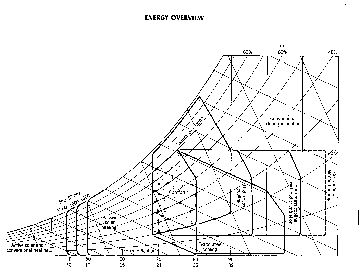
Psychrometric-Bioclimatic Chart (Givoni-Milne)
Relation between: Heat Flow-Strategy-Comfort
Temperature is the most important variable
in determining comfort. Heat exchanges through a building are determined
by several variables, of which air temperature is the most important. The
amount of heat exchanged through a building envelope plus the internal
gains determines interior temperature. Thus, if we know the outside air
temperature and the comfort zone, we can determine strategies to control
heat flows in a building and achieve indoor comfort.
Definition of Action Zones
The borders of the zones in ARCHICLIMATE
are adapted from bioclimatic charts such as those developed by Olgyay and
Givoni and Milne. But in ARCHICLIMATE the strategies to achieve comfortable
indoor temperatures are defined in terms of heat flow actions. These actions
are either to increase or decrease the heat flow (depending on outside
air temperature) and comprise several strategies for each action.
Conduction Strategies.
Conduction actions are defined as “block
heat flows” or “indifferent if heat is blocked”.
The “block heat flows from conduction”
zone, should be defined symmetrically around the comfort point of 24 C;
upwards of 32 C and downwards of 15 C. But, due to the influence of solar
radiation which affects surface temperature and thus, the heat flow by
conduction, it begins at 29 C (85 F) instead of 32 C. The farther from
the comfort zone we go in either direction, the more we need to block heat
flows by radiation. When we go downwards we need to block heat losses from
the building and when we go upwards we need to block heat gains to the
building.
Radiation Strategies.
Radiation actions are defined as “increase
radiation” or “block radiation”.
The “increase radiation” zone is defined
between 10 C (50F) up to 21 C (70F). The lower limit is defined as the
point at which heat gains during the day, through the windows, will be
lower than heat losses, at night, through these windows.
The “block heat flows by radiation” zone
is defined from 21 C (70F) upwards. The lower portion of this zone is the
lower portion of the comfort zone and indicates the point at which we should
start blocking heat gains by radiation to avoid overheating of the building.
Convection Strategies.
Convection actions are defined as “increase
convection” or “block convection”.
The “increase convection exchange zone”
is between 21 C (70F) and 32 C (90 F). This is the zone during which it
is beneficial to exchange air with the outdoor environment, so as to cool
the building. The lower limit of the zone is the lower limit of the comfort
zone, because from this point (or even below it) cooling by convection
would be helpful to achieve comfort. The upper limit is also the upper
limit of thermal comfort with air movement and thus the highest point at
which comfort can be achieved with air movement. Outside of this zone the
building should be sealed to block convection flows.
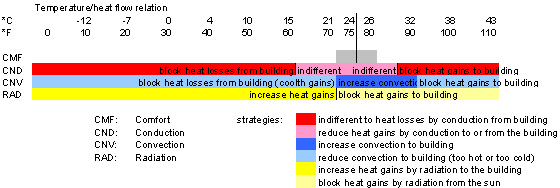
Delimitation of Action Zones
For conduction (CD):
If Ot < 15 C (60 F) the envelope should
block heat losses from the building.
If Ot > 29 C (85 F), the envelope should
block heat gains to the building.
For Ot > 15 C (60 F) and Ot < 29 C
(85 F) blocking heat flows by conductions is indifferent.
If values of RH are known then we can refine
on conduction:
If Max RH > 70% use insulation with low
mass (also if mechanical cooling.
If Max RH<=70% use mass with insulation
(if no mechanical cooling)
For convection (CV):
For Ot=>21 C (70 F) or Ot<= 32 C (90
F), the building should be permeable to the wind
If Ot<21 C (70 F) or Ot > 32 C (90
F) the building must block heat flows by convection
For radiation (RD):
If Ot > 10 C (50 F) and Ot< 21 C (70
F) and if daylight, the building should increase heat gains by radiation
If Ot >= 21 C (70 F) the building should
block heat gains by radiation.
Color coding is used to so that the architect
can relate concepts to colors. Red is used for conduction, blue for convection
and yellow for radiation. If it is necessary to increase the flow, a dark
version of the color is used and if it is necessary to decrease the flow
a light version is used. For each of these three cases, a set of design
guidelines, to achieve solar control of the building, is proposed. These
would appear in a separate window and are organized inside their zones.