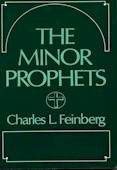
Review of
Charles L. Feinberg's
The Minor Prophets
(Moody Press Paperback Edition)
by Joseph Short
In 1948 Charles Feinberg began the work that would evolve into a rare gem of a
book when he published the first part of his extensive studies in the Minor
Prophets. Originally, a collection of expository essays, Feinberg took great
care in transferring them into a scholarly collection of much quality. Feinberg
proves himself a first rate scholar with his careful exposition of the text.
Before his rather recent death, he was known as one of the nation’s foremost
authorities in issues stemming from Jewish history, both Old Testament and
intertestamental. And his expertise in Biblical prophecy was among the top of
his field. After all, of how many Biblical scholars can it be said that they
trained for the rabbinate before their conversion?
The Minor Prophets is primarily a
compilation of five volume previously published in the book series The Major
Messages of the Minor Prophets. These divisions are seen in the book’s five
sections reproduced in the exact order of their publication. Feinberg’s ultimate
purpose seems to be to produce an introductory work on these oft-neglected
books. He goes into minimal detail. This is after all not so much a commentary
as a guidebook. But those details he does reveal prove to be well chosen and
work effectively in giving the reader a more than adequate acquaintance with the
Twelve.
Feinberg does not attempt at a
general introduction to the Minor Prophets. Nor does he a conclusion. Rather, he
allows the individual books to speak for themselves. Any unity that exists among
the Twelve must come from the Biblical text itself, rather than from some forced
sense of cohesiveness pushed onto the text by the writer. The grouping together
of chapters within the five parts follow the order of the English text (save
Zechariah which is in a category all its own) instead of a historical or
thematic type of unity. This is advantageous as a point of reference. However,
thematic unity would have been more helpful in this writer’s opinion if for no
other reason than to make interpretation easier and more convenient.
The setup of individual chapters is
convenient for purposes of a general overview. The splitting of the text into
major and minor sections without outline numbers gave it a more informal tone.
However, for the one studying a minor prophet or a part of a chapter or book in
depth, this is no way to go. It is difficult to find information on a specific
verse without time wasted in searching that could have been spent in study.
As an example of how Feinberg handles the text we shall examine his examination
of one of the prophets in depth. Let us look at his handling of, let’s say Joel.
He begin the chapter by dedicating it to his children, and then offering his
purpose for writing the chapter. He then begins the main text of the chapter,
dividing it into three sections: The Locust Plague and Day of Jehovah, The
Outpoured Spirit and The Judgment of All Nations. He divides the first major
section into five more, the second major section into ten and the third major
section into six. Each of these sections range in size from one sentence to four
or five paragraphs.
He begins the first section by
discussing the background of the prophet, the meaning of his name and other
pertinent background information. He moves quickly into exegesis, making
frequent reference to various verses of Scripture that parallel various concepts
in Joel’s prophecy. In one section, he discusses Peter’s quotation of Joel
2:28-32 in his Pentecost sermon and its possible interpretations and
implications.
This approach proves to be a success. Of course, it must be admitted that the
fact that the previous example took a cursory examination of a Biblical book to
test the book’s usefulness. And for this type of study, it works. However, few
serious Bible students engage in this type of study.
It would have been helpful if the
author or an editor had made more of an effort to fashion the text into a
cohesive unity. Some attempt was made in the form of those paragraphs at the
beginning of each chapter, but this was far too little to be as effective as was
necessary. For example, the use of charts and tables concerning the historical
placement of the prophets would have been helpful. This almost makes the book
seem to be more of an afterthought.
If the reader is shows at least a
cursory interest in the Minor Prophets, Feinberg’s book is a must-read. It
provides the basic background necessary for further studies to be undertaken. It
provided this writer with information that he will value for a lifetime. One
major advantage of this text is its emphasis on finding the Messiah in the Minor
Prophets. Feinberg stays true to the principles of only identifying a Scripture
as a Messianic prophecy when the New Testament identifies it as such. While this
information is helpful, it is far too scattered. Perhaps an appendix essay
wherein instances of Messianic prophecy in the Twelve are discussed and
identified would have been helpful. At the very least, I would have like this in
chart form.
Feinberg’s text is perfect for one
seeking a casual introduction to the Minor Prophets. But for one who wants to
sit at the knees of one of them, so to speak, soaking up his knowledge, learning
from the mistakes of the land and praising God for its triumphs, this text falls
miserably short. But that is not necessarily a bad thing. What has been said
before will be echoed again. This book was never intended to be an in-depth
study. One must appreciate it for what it is—a guidebook.
"Review
of Christ in the Old Testament" Copyright © 2000 Joseph Short. All rights reserved.
Revised: July 30, 2001
Placed on site August 1, 2001
Search barnesandnoble.com
for these and other relevant books.