|
The early history of Ujjain is lost in the midst of
antiquity. As early as the time of the Aryan settlers, Ujjain seems to
have acquired importance. By the 6th century B.C. Avanti with its
capital at Ujjaini, is mentioned in Buddhist literature as one of the
four great powers along with Vatsa, Kosala and Magadha.
Ujjain lay on the ma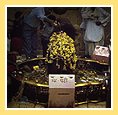 in
trade route between North India and Deccan going from Mathura via
Ujjain to Mahismati (Maheshwar) on the Narmada, and on to Paithan on
the Godavari, western Asia and the West. The Northern black polished
ware - the NBP as it is often called which is technically the finest
pottery of the time, with a brilliantly burnished dressing almost of
the quality of a glaze in colour from jet black to a deep grey or
metallic blue and iron, found their way to the northern Deccan from
the Gangetic plains through Ujjain. The articles of export to the
western Asia such as precious stones and pearls, scents and spices,
perfumes, silks and muslin, reached the port of Brighukachcha from the
remote north through Ujjain. All this finds a detailed and interesting
description in the Periplus of the Erythrean Sea, an account of an
unknown Greek merchant who made a voyage to India in the second half
of the first century AD. The Periplus talks of a city called Ozene to
the east of Barygaza (Broach) which fed all commodities to trade like
onyx, porcelain, fine muslin and quantities of ordinary cottons,
spikenard , costus bodellium to this important port and to other parts
of India. in
trade route between North India and Deccan going from Mathura via
Ujjain to Mahismati (Maheshwar) on the Narmada, and on to Paithan on
the Godavari, western Asia and the West. The Northern black polished
ware - the NBP as it is often called which is technically the finest
pottery of the time, with a brilliantly burnished dressing almost of
the quality of a glaze in colour from jet black to a deep grey or
metallic blue and iron, found their way to the northern Deccan from
the Gangetic plains through Ujjain. The articles of export to the
western Asia such as precious stones and pearls, scents and spices,
perfumes, silks and muslin, reached the port of Brighukachcha from the
remote north through Ujjain. All this finds a detailed and interesting
description in the Periplus of the Erythrean Sea, an account of an
unknown Greek merchant who made a voyage to India in the second half
of the first century AD. The Periplus talks of a city called Ozene to
the east of Barygaza (Broach) which fed all commodities to trade like
onyx, porcelain, fine muslin and quantities of ordinary cottons,
spikenard , costus bodellium to this important port and to other parts
of India.
The earliest known epigraphic record of the Paramaras,
the Harsola Granth, issued at the beginning of the 10th century AD,
maintains that the kings of the Paramara dynasty were born in the
family of the Rastrakutas in the Deccan The early Paramara chiefs of
Malwa were probably vassals of the Rastrakutas. The Udaypur Prasati,
mentions Vakpati Vakpati I as the king of Avanti and it was probably
in his region that the Rastrakuta Indra III halted at Ujjain while
advancing with his army against the Pratihara Mahipala I. Malwa was
lost in the time of Vakpati's successor, Vairisimha II, to the
invading forces of Mahipala I who avenged his defeat at the hands of
Indra III by invading the empire of Rastrakuta. Mahipala and his
Kalachuri confederate Bhamanadeva are said to have conquered the
territory up to the banks of the Narmada including Ujjain and Dhar.
The Paramara sovereignty in the Malwa ceased until AD 946 when
Vairsimha II became dominant in the area. It is in his son Siyaka II's
reign that the independent Paramara rule in Malwa began. It is
believed that it was this time that the capital was shifted to the
area of the Mahakala Vana in Ujjain.
From the 9th to the 12th centuries, the Paramaras
became so identified with Ujjain that subsequent tradition has
converted Vikramaditya into a Paramara. The last Paramara ruler,
Siladitya, was captured alive by the Sultans of Mandu, and Ujjain
passed into the hands of the Muslims.
Thus began a long era of misfortune and decay and the
ancient glory of Ujjayini was lost in a morass of repeated inroads of
attacking hordes. The invasion of Ujjain by Iltutmish in 1234
triggered off a systematic desecration and despoiling of temples. This
tide of destruction was stemmed only in the time of Baz Bahadur of
Mandu. The Mughal rule heralded a new era in reconstruction.
Emperor Akbar put an end to Baz Bahadur's hegemony over
Malwa and had a city wall constructed for the defense of Ujjain. The
Nadi Darwaza, Kaliadeh Darwaza, Sati Darwaza, Dewas Darwaza and Indore
Darwaza were the various entrances to the city.
In 1658 took place a battle near Ujjain in which
Aurangzeb and Murad defeated Maharaj Jaswant Singh of Jodhpur, who was
fighting on behalf of Prince Dara. The actual scene of the battle is
Dharmatpura, renamed Fatehbad by Aurangzeb, after the victory. The
cenotaph of Raja Rattan Singh of Ratlam, who fell in the battle, still
stands at the site.
In the reign of Mahmud Shah, Maharaja Sawai Jai Singh
was made the Governor of Malwa, a great scholar of astronomy, he had
the observatory at Ujjain reconstructed and built several temples.
At the beginning of the 17th century, Ujjain and Malwa
went through another period of seize and invasion at the hands of the
Marathas, who gradually captured the entire region. The Maratha
domination of Malwa gave impetus to a cultural renaissance in the
region and modern Ujjain came into being. Most of the temples of
Ujjain were constructed during this period.
It was during this time that Ujjain became the meeting
ground of painters of the Poona and Kangra styles. The impact of the
two different styles of painting is distinctive. The examples of
Maratha style are found in the temples of Ram Janardan, Kal Bhairava,
Kalpeshwar and Tilakeshwar while the traditional Malwa style can be
seen in the Sandipani Ashram and in many large houses of the local
seths.
In the Maratha period, the art of wood work also
developed. Wood carvings were done on the galleries and balconies. But
many excellent examples have either been sold as junk or destroyed.
Ujjain finally passed into the hands of the Scindias in
1750 and until 1810, when Daulat Rao Scindia founded his new capital
at Gwalior, it was the chief town of his dominions.
The shifting of the capital to Gwalior led to a decline
in the commercial importance of Ujjain. But the opening of
Ujjain-Ratlam-Godhra branch of the Bombay-Baroda line corrected the
balance. A considerable volume of trade mainly with Bombay, existed in
cotton, grain and opium during the British Indian period.
There is much to demonstrate that in the perspective of
India's long history, Ujjain enjoyed great importance in the battle
for the empire and the constant struggle for supremacy. Political
importance was compounded by the economic factor of Ujjain being
situated on the main artery of trade between the North, the South and
the West. This in turn contributed to Ujjain acquiring a cultural
splendour of its own which is equaled by very few other cities in
India.
Today, Ujjain abounds in temples, hoary old tradition
attached to each of them. But though most of them have been built upon
sites of antiquity, none of them has survived in the original
splendour. Desecrated and despoiled time and time again, the
structures that stand today are of more recent date, renovated or
rebuilt over the years. And yet, the temples form an integral part of
the city and contribute to the continuity of Ujjain's tradition of
greatness.
Bade Ganeshji Ka Mandir
This temple situated above the tank near the Mahakaleshwar temple,
enshrines a huge artistic sculpture of Ganesh, the son of Shiva. An
idol of this size and beauty is rarely to be found. The middle of the
temple is adorned by an idol of the pancha-mukhi (five faced) Hanuman.
There is provision for learning of Sanskrit and Astrology in the
temple.
Chintaman Ganesh
The temple is built across the Shipra on the Fatehabad railway line.
The Ganesh idol enshrined here is supposed to be swayambhu - born of
itself. The temple itself is believed to be of considerable antiquity.
Riddhi and Siddhi, the consorts of Ganesha, are seated on either side
of Ganesha. The artistically carved pillars in the assembly hall date
back to the Paramara period. Worshippers throng to this temple because
the deity here is traditionally known as Chintaharan Ganesh meaning
"the assurer of freedom from worldly anxieties".
Pir Matsyendranath
This is an extremely attractive spot on the banks of the Shipra quite
close to the Bhartihari Caves and the Gadkalika Temple. It is
dedicated to the memory of one of the great leaders of the Natha sect
of Saivism-Matsyendranath. Since muslims as well as the followers of
the Natha sect call their saints 'pir', the ancient site of Pir
Matsyendranath is venerated by both. Excavations at this site have
yielded some antiquities which date back to the 6th and 7th century
BC.
Bhartrihari Caves
These caves are situated just above the bank of the Shipra near the
temple of Gadkalika. According to popular tradition, this is the spot
where Bhartrihari, who is said to have been the step brother of
Vikramaditya, lived and meditated after renouncing worldly life. He is
believed to have been a great scholar and poet. His famous works,
Shringarshatak, Vairagyashatak, and Nitishatak, are known for the
exquisite use of the Sanskrit meter.
Kaliadeh Palace
Situated on the banks of the Shipra, the island-like site immediately
conjures up the natural beauty of ancient Ujjain which poets down the
ages have waxed lyrical. The glorious landscape of the flowing river
on both sides of the palace and the man-made tanks and channels, with
water gurgling through them, provide a spectacular backdrop to the
imposing building.
The central dome of the palace is a beautiful example
of Persian architecture. Two Persian inscriptions found in one of the
long corridors of the palace record the visits of Emperor Akbar and
Jehangir to this palace.
The palace was broken down in the time of the Pindaris
and was restored by Madhav Rao Scindia in 1920 to its present glory.
The Sun Temple was also restored by the family.
Durgadas Ki Chhatri
This distinctive monument glows like a small jewel in the surrounding
lush landscape. Vir Durgadas earned a secure niche for himself in the
history of Marwad by his undaunting, selfless service to the State. He
fought for the independence of Jodhpur after the death of Maharaj
Jaswant Singh and helped Ajit Singh to ascend the throne against the
wishes of Aurangzeb.
Durgadas died at Rampura in 1718, and his funeral rites
were performed according to his wishes on the banks of the Shipra. The
rulers of Jodhpur had built the chhatri to consecrate his memory. This
beautiful structure, built in the Rajpur style of architecture, houses
a statue of Durgadas which crumbled down.
Harsiddhi Temple
This temple occupies a special place in the galaxy of ancient sacred
spots of Ujjain. Seated between the idols of Mahalaxmi and
Mahasaraswati, the idol of Annapurna is painted in dark vermilion
colour. The Sri Yantra, the symbol of power or shakti, is also
enshrined in the temple.
According to the Shiva Purana, when Shiva carried away
the burning body of Sati from the sacrificial fire, her elbow dropped
at this place. There is an interesting legend in the Skanda Purana
about the manner in which the Goddess Chandi acquired the epithet of
Harsiddhi. Once when Shiva and Parvati were alone on Mount Kailash,
two demons called Chand and Prachand tried to force their way in.
Shiva called upon Chandi to destroy them which she did. Pleased, Shiva
bestowed upon her the epithet of 'one who vanquishes all'.
The temple was reconstructed during the Maratha period
and the two pillars adorned with lamps are special features of Maratha
art. These lamps, lit during Navaratri, present a glorious spectacle.
There is an ancient well on the premises, and an artistic pillar
adorns the top of it.
Siddhavat
This enormous banyan tree on the banks of the Shipra, has been vested
with religious sanctity as the Akashyavat in Prayag and Gaya,
Vanshivat of Vrindavan and the Panchavata of Nasik. Thousands of
pilgrims take a dip in the Shipra from the bathing ghat built here.
According to one tradition, Parvati is believed to have performed her
penance here. It used to be a place of worship for the followers of
Natha sect. One legend has it that some Mughal rulers had cut off the
Banyan tree and covered the site with iron sheets to prevent its roots
from growing. But the tree pierced the iron sheets and grew and
flourished. The little village of Bhairogarh near Siddhavat is famous
for its tie and dye painting for centuries. In ancient times when
trade with other countries flourished, exquisitely printed cloth from
Bhairogarh used to find its way to Rome andChina.
Kal Bhairava
The worship of the eight Bhairavas is a part of Saivite tradition and
the chief among them is Kal Bhairava, believed to have been built by
King Bhadresen, on the banks of the Shipra. There is mention of a Kal
Bhairva temple in the Avanti Khanda of the Skanda Purana. Worship of
Kal Bhairava is believed to have been a part of the Kapalika and
Aghora sects. Ujjain was a prominent centre of these two sects. Even
today, liquor is offered as a part of the ritual to Kal Bhairava
Beautiful paintings in the Malwa style once decorated the temple
walls, only traces of which are visible.
Sandipani Ashram
The fact that ancient Ujjain apart from its political and religious
importance, enjoyed the reputation of being a great seat of learning
as early as the Mahabharata period is borne out by the fact that, Lord
Krishna and Sudama received regular instruction in the ashram of Guru
Sandipani. The area near the ashram is known as Ankapata, popularly
believed to have been the place used by Lord Krishna for washing his
writing tablet. The numerals 1 to 100 found on a stone are believed to
have been engraved by Guru Sandipani.
The Gomti Kunda referred to in the Puranas was the
source of water supply to the ashram in the olden days. An image of
Nandi, belonging to the Shunga period, is to be found near the tank.
The followers of Vallabha sect regard this place as the 73rd seat of
the 84 seats of Vallabhacharya where he delivered his discourses
throughout India.
Gadkalika
Situated about 2 miles from the city of Ujjain, the deity in this
temple is believed to have been worshipped by Kalidasa. The legend
goes that he was an idiot and it is by his devotion to the goddess
Kalika that he acquired great literary skills.
Emperor Harshavardhan had this temple renovated in the
7th century AD. There is further evidence of renovation during the
Paramara period. The temple has been rebuilt in the modern times by
the erstwhile Gwalior State.
Mangalnath
This temple is situated away from the bustle of the city and can be
reached through a winding road. The temple looks upon a vast expanse
of the Shipra waters and fills the onlooker with an indescribable
sense of peace.
Mangalnath is regarded as the birth place of Mars,
according to the Matsya Purana. In ancient times, it was famous for a
clear view of the planet and hence suitable for astronomical studies.
Mahadev or Shiva is the deity which is worshipped in the temple of
Mangalnath.
Gopal Mandir
This huge temple is situated in the middle of the big market square.
It was constructed by Bayajibai Shinde, the queen of Maharajah Daulat
Rao Shinde in the 19th century. It is a beautiful example of Maratha
architecture. The sanctum sanctorum is inlaid with marble and doors
are silver plated. The door in the inner sanctum is said to have been
carried to Ghazni from the Somnath temple and from thence by Mahmud
Shah Abdali to Lahore. Mahadji Scindia recovered it and now it has
been installed in this temple.
Navagraha Mandir (Triveni)
Situated on the Triveni Ghat of the Shipra, the temple is located away
from the old site of Ujjaini town. It is dedicated to the nine
planets, attracts large crowds on new moon days falling on Saturdays.
Its religious importance has increased in recent years though there is
no known reference to it in the ancient texts.
Mahakaleshwar
 The presiding deity of
time, Shiva, in all his splendour reigns eternal in Ujjain.The temple
of Mahakaleshwar, its shikhara soaring into the skies, evokes
primordial awe and reverence with its majesty. The Mahakal dominates
the life of the city and its people, even in the midst of the busy
routine of modern preoccupations, and provides an unbreakable link
with past traditions. The presiding deity of
time, Shiva, in all his splendour reigns eternal in Ujjain.The temple
of Mahakaleshwar, its shikhara soaring into the skies, evokes
primordial awe and reverence with its majesty. The Mahakal dominates
the life of the city and its people, even in the midst of the busy
routine of modern preoccupations, and provides an unbreakable link
with past traditions.
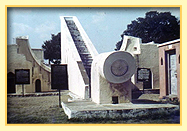
The Vedha Shala (Observatory)
Ujjain enjoyed a position of considerable importance in the field of
astronomy. Great works on astronomy such as the Surya Siddhanta and
the Panch Siddhanta were written in Ujjain. According to Indian
astronomers, the Tropic of Cancer is supposed to pass through Ujjain.
It is also the fist meridian of longitude of the Hindu geographers.
From about the 4th century BC, Ujjain enjoyed the reputation of being
India's Greenwich. The observatory extant today was built by Raja Jai
Singh (1686-1743), who was a great scholar. He translated the works of
Ptolemy and Euclid into Sanskrit from Arabic. Of the many
observatories built by him at Jaipur, Delhi, Varanasi, Mathura, and
Ujjain, the one at Ujjain is still in use actively. Astronomical
studies are conducted through the Department of Education and the
ephemeris is published every year. There is a small planetarium and a
telescope to observe the moon, Mars, Jupiter and their satellites. The
observatory is also used for weather forecasts.
Vikram Kirti Mandir
Established on the occasion of the second millennium of the Vikram
era, as the cultural centre to perpetuate the memory of Vikramaditya,
the Vikram Kirti Mandir houses the Scindia Oriental Research
Institute, an archaeological museum, an art gallery and an auditorium.
The Scindia Oriental Research Institute has an invaluable collection
of 18,000 manuscripts on various subjects and runs a reference library
of important oriental publications. Rare manuscripts in Prakrit,
Arabic, Persian and other Indian languages cover a wide range of
subjects from Vedic literature and philosophy to dance and music. Palm
leaf and bark leaf (Bhurja Patra) manuscripts are also preserved in
this institute. Apart from an illustrated manuscript of Shrimad
Bhagavata in which actual gold and silver have been employed for the
paintings, the Institute has a rich collection of old paintings in the
Rajput and Mughal style. The museum also exhibits a rich array of
images, inscriptions, copper plates and fossils discovered in the
Narmada valley. A huge skull of a primitive elephant is of special
interest.
Vikram University
A famous centre of learning in the past, Ujjain continues to uphold
that tradition. The establishment of the Vikram University in 1957 was
an important landmark. Situated on the Dewas Road, this university
plays a significant role in the literary and cultural activities of
the city.
Kalidasa Academy
This academy was set up in Ujjain by the Government of Madhya Pradesh
to immortalize the memory of the great poet dramatist-Kalidasa, and to
create a multi-disciplinary institution to project the genius of the
entire classical tradition, with Kalidasa as the apex, enable research
and study in Sanskrit classical and traditional performing arts, and
facilitate its adaptation for contemporary stage in different cultural
settings and language groups. The Academy complex consists of a
theatre, museum, library, lecture and seminary halls, mini stage for
rehearsals, research facilities for scholars, and a large open air
theater.
Ram Janardhan Temple, Ram Ghat, Harihara Teertha, Mallikarjuna
Teertha, Ganga Ghat, Bohron Ka Roja, Begum Ka Maqbara, Bina Neev Ki
Masjid, Maulana Rumi Ka Maqbara, and Digambara Jain Museum are some of
the other prominent places of interest in Ujjain.
BACK |