 |
|
Believe it or not |
|
Bada Ganpati
The idol has a most interesting configuration of ingredients;
bricks, limestone, masala made of gud (jaggery), methi dana, soil
collected from the seven mokshapuri: Ayodhya, Mathura, Maya, Kashi,
Kanchi, Avantike and Dwarka; mud from the stables of elephant,
cow, horse; the powder of 'Panch Ratna': heera, panna, moti, manek
and pukhraj (diamond, emerald, pearls, rubies and topaz) and holy
waters from places of pilgrimage. The metallic frame is made of
Panchdhatu or five metals i.e. gold, silver, copper, iron and
brass. |
|
|
|
Facts |
 |
|
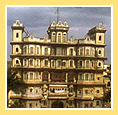
Rajawada
Synonymous with the heart of Indore city, it stands today as a
mute witness to the bygone splendour of the Holkar rulers. This
200 year old seven-storey historic palace of the Holkars is built
in a mixture of Muslim, Maratha and French styles.
The lower three floors are made of stone and the upper floors are
made of wood, which made it very vulnerable to destruction by
fire. Rajwada was burnt three times in its history; the last fire
in 1984 took the greatest toll. Today only the front facade
remains. Recent renovations have recreated some of the old glory
of this beautiful palace. |
|
|
|
|
|
|
INDORE |
| |
|
 Lal
Baag Palace Lal
Baag Palace
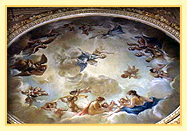
Lal Baag Palace is one of the grandest monuments the Holkar dynasty
left Indore. A reflection of their taste, grandeur and lifestyle, its
construction began in 1886 under Tukoji Rao Holkar II, and was carried
out in three phases. The final phase was completed in 1921 under
Tukoji Rao Holkar III. Many royal receptions were held here. It has a
total area of 28 hectares, and at one time it had the reputation of
having one of the best rose gardens in the country.
Bada Ganpati
Better known for its size than antiquity, this temple houses perhaps
the largest Ganesh idol in the world measuring 25 feet from crown to
foot. Created as a result of the dream of an Avantika (Ujjain)
resident, Shri Dadhich, it was built in 1875.
Kanch Mandir
This Jain temple is an architectural marvel in glass. The walls,
ceilings, floors, pillars and door knobs are entirely inlaid with
glass. Even paintings are done in glass. Atop is a special glass
chamber which multiplies the three statues of Lord Mahavira installed
there into an indefinite number (said to be visible upto 21 times,
corresponding to the 21 tirthankaras).
Town Hall
Made in 1904 and originally named King Edwards Hall, it was renamed
Mahatma Gandhi Hall in 1948. Its architectural style is Indo-Gothic.
Made in Seoni stone, its domes and staples are a landmark of Indore
today. It has a four-faced clock tower in front, because of which it
is locally known as Ghanta Ghar.
It is frequently the venue for the various book and
painting exhibitions, fairs and festivals held throughout the year.
The building also has a library, a children's park and a temple.
Central Museum
The Indore Museum houses the finest collection of Parmar sculptures
from Hinglajgarh. The Parmar style originated here, and is
characterized by proportioned figures, carefully and ornately depicted
in stone. The museum is also known for its collection of coins, arms
and armour.
Gita Bhavan
Adorned with many statues of gods of various religions, its
construction is inspired by the religious motto "many names to a God
is after all of one God."
Chhatris
 Chhatris
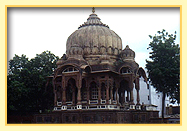
are the tombs or cenotaphs erected in memory of dead Holkar rulers and
their family members. The Chhatris picturesquely poised on the Khan
river banks near Rajawada are incomparable in terms of Maratha
architecture and sculpture of their period. At Chhatri Baag is the
main collection of tombs housed in two compounds. Close by is the
beautiful Bolia Sarkar's Chhatri constructed in 1858 AD in memory of
Sardar Chimnaji Appa Sahib Bolia. Chhatris
are the tombs or cenotaphs erected in memory of dead Holkar rulers and
their family members. The Chhatris picturesquely poised on the Khan
river banks near Rajawada are incomparable in terms of Maratha
architecture and sculpture of their period. At Chhatri Baag is the
main collection of tombs housed in two compounds. Close by is the
beautiful Bolia Sarkar's Chhatri constructed in 1858 AD in memory of
Sardar Chimnaji Appa Sahib Bolia. |
|
Annapurna
This temple was inspired by the Meenakshi temple of Madurai. Four
life-sized elephants hold an ornately decorated gate in plaster.
Inside the temple of Annapurna Devi are also temples of Shiva, Kal
Bhairava, Hanuman and a Pravachan Hall. The outer wall of the main
temple is decorated with colourful motifs from mythological stories.
Khajrana
The citizens of Indore have great faith in this Ganesh temple, built
during the reign of Ahilyabai Holkar. It is believed that all wishes
are fulfilled by praying here. Nearby is the dargah of Nahar Sayed.
This is an important pilgrimage place for Maita Muslims.
Kasturbagram
8 km from Indore, the Kasturba Gandhi National Memorial Trust was
founded by Mahatma Gandhi. Its headquarter were shifted from Wardha to
Indore in 1915. The main objective of this trust is showing ways of
improvement in the quality of village life and the welfare of rural
women and children. Some of its many commendable activities are :
agricultural production, research, training, experiments in fruit
orchards, social forestry, new renewable sources of energy, gobar gas,
better water management, rural institute for girls, village sanitation
programmes etc.
Bijasen Tekri
A 2 minutes drive from the airport leads you to a hillock on which was
perched a guest house of the Holkars, now converted into Border
Security Arms Museum, as well as a small temple of Bijasen Mata, built
in 1920, which has a magnificent view of the sunset. A mela (fair) is
held during the Navratri. A good picnic spot, with a breathtaking view
of Indore city by night.
Gomatgiri
The Jain Samaj has constructed a 21 feet statue of Lord Gomateshwar, a
replica of the Bahubali statue of Shravanbelagola. Also built here are
24 marble temples with shilars for each tirthankar. |
| |
|
|
|
|
BACK |
|