PHYSICS NOTES
 Mandatory Experiments
To Find the Focal Length of a Concave Mirror
1/f
= 1/u + 1/v
The object should not be placed at the Principle Focus. If it is the image will be at infinity and will not be visible.
The experiment should be carried out in a dark room
(if using a light box)
The screen must be placed to one side.
An object with a sharp outline should be used.
To Verify Snell’s Law and hence Determine the
Refractive index of Glass
Sin
i ÷ sin r = a constant
The ray box should give a narrow, parallel ray of light to allow it to be traced more accurately and ensure accuracy of angles.
Place a book or a hand over the glass block when lining up the pins to avoid confusion.
To Determine the Focal Length of a Converging Lens
1/f
= 1/u + 1/v
The object should not be placed at the Principle Focus. If it is the image will be at infinity and will not be visible.
The experiment should be carried out in a dark room
(if using a light box)
An object with a sharp outline should be used.
To Measure Velocity and Acceleration
v
= s/t
a
= (v-u)/t
Make sure the body moves with a constant speed when measuring velocity.
Find an average distance to ensure accuracy of
calculations.
To Verify the Principle of Conservation of Momentum
m₁v₁
= m₂v₂
Make sure the second body does not
move before the collision or its velocity will not be 0.
Make sure that the two bodies connect and stay
together.
To Verify that a∝F/m
a
= a constant.F
a
= a constant.1/m
Slope the track.
To Measure the Acceleration due to gravity, g.
(Free Fall Method)
S
= ½gt²
Use the smallest value of t.
Burn the thread instead of cutting it so as not to
affect the path of the ball as it falls.
Repeat to get an average.
To Measure the Coefficient of Dynamic Friction
F
= μR
Place the block on a horizontal surface so that there will be no component of the block’s weight affecting the applied force, F.
The block must move at a constant force as the
applied force, F is equal to the frictional force only if the block moves at
constant speed.
To Verify the Principle of Moments
F₁d₁
= F₂d₂
The metre stick should be kept horizontal when
measuring the moments.
The stick must be hanging exactly at its centre of
gravity.
To Verify the Parallelogram Law
The apparatus must be allowed to hang
freely to ensure that no forces other than those of the weights act upon the
thread.
Friction at the pulleys should be kept to a minimum
so that the full force exerted by the weights is transferred to the thread.
The weights should not be brushing against the board.
To Measure the Wavelength of Light
Nλ
= s sinθ
The experiment should be carried out in a dark
room.
Repeat and get an average.
To Investigate the Factors which Determine the
Natural Frequencies of a Stretched String
f
∝ 1/l
f
∝ √T
f
∝ 1/√μ
Place a small piece of paper on the string to indicate when the string is resonating.
To Measure the Speed of Sound in Air
λ
= 4(l+0.3d)
Hold the end of the fork close to the end of the tube and ensure that it is vibrating strongly.
To Calibrate and use a Thermocouple Thermometer
θ
= Eθ-E0
----------- x 100
E100-E0
Ensure that the reading E0 is 0.
Measure the temperature with a mercury thermometer to check the accuracy of the results obtained.
To Verify Boyle’s Law
P / kPa
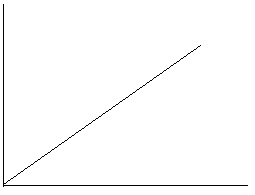 1/V
/ cmˉ³
1/V
/ cmˉ³
Allow the
apparatus to settle after changing the pressure.
To Measure the s.h.c of Water
E = mwcwΔθ + mcccΔθ
Make sure that the calorimeter is well lagged and stirred gently during heating.
To Compare the s.h.c s of Copper and Water
m₁c₁Δθ₁
= mwcwΔθ
+ mcccΔθ
Transfer the copper from the test tube
to the calorimeter quickly to avoid losing heat to the room.
Measure the temperature of the boiling water.
Place enough water in the calorimeter to cover the
copper.
To Measure the s.l.h of Fusion of Ice
m₁l
+ m₁cwΔθ₁
= m₂cwΔθ₂
+ m₃cwΔθ₂
Ensure that there is sufficient ice to give a significant temperature change in the calorimeter.
Ensure that the ice is dry before adding it to the
water so as not to increase the mass of the water after it has been calculated.
Measure the temperature of the ice instead of
assuming it to be 0º.
Use warm water to melt the ice more quickly and to
reduce the error due to heat transfer.
To Measure the s.l.h of Vaporisation of Water
m₁l
+ m₁cwΔθ₁
= m₂cwΔθ₂
+ m₃cwΔθ₂
Ensure that no water emerges from the
delivery tube before placing it in the calorimeter.
Pass the steam through a steam trap to ensure that
any water formed by condensation cannot enter the calorimeter.
Allow the steam to issue freely for a few minutes.
To Determine the Resistivity of Nichrome
P = Rπd²/4l
Ensure that the wire is straight.
Measure the diameter of the wire several times and
get an average.
Do not measure the parts of the length of wire that
were in contact with the terminals of the metre bridge.
Connect a resistor in series with the galvanometer.
To Investigate the Variation of Resistance of a
Copper Wire with Temperature
R / Ω
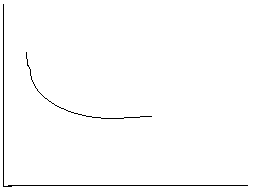 θ
/ ºC
θ
/ ºC
Use a large amount of water so that the temperature rises slowly.
To Verify Joule’s Law
Δθ / ºC
I²
/ A
Maintain a steady current.
Use the same mass of water when repeating.
Keep the temperature constant.
To Measure the E.C.E of copper
m
= zIt
Dry the cathode before weighing.
Allow the current to flow for 15-20 seconds.
Ensure that the current flow is constant.
To Measure the Internal Resistance of a Cell
R + r = │AC│
R │AD│
Do not slide the jockey along the potentiometer wire.
To Plot the Characteristic Curve of a Diode
I / mA Forward Bias
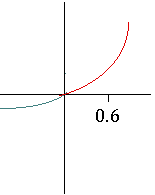 V
/ V
V
/ V
Reverse Bias I
/ μA
Do not exceed the upper limits of the current
meters.
Change the position of the voltmeter when changing
the bias of the diode so that it measures the p.d. across both the diode and
the micro ammeter.
To Establish Truth Tables for AND and OR Gates
Make sure that the switches are always high or low.
To Establish the Truth Table for a NOT Gate
Make sure that the switches are always high or low.
To Determine the Half-Life of Radon
Activity
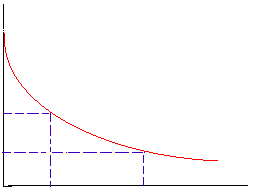 Time
Time
Three people are needed to carry out this experiment. One calls out the time, the second watches and reads the scalar display, and the third records the accumulated count.
Physics Notes
Index


