ART NOTES
 Impressionism
1991 Higher
Level
Impressionism
is regarded as the most important artistic phenomenon of the 19th
century and as the first of the modern movements. Discuss this statement with reference to the work of two artists
associated with the movement.
The 19th century in France was a time of
considerable change in France. New
inventions of the time created more leisure time for the people while the
Industrial Revolution coupled with the French Revolution of the previous
century created a new social order and a wealthy middle-class, which tended to
be conservative. They became the new
patrons of art. However they looked to
the Ecole des Beaux-Arts for direction – particularly following the Franco-Prussian
war of 1870 when a general feeling of insecurity pervaded Paris.
Up to the late 19th century the
classical style of painting was prevalent in Europe. This was based on those ideals of art (such as perspective and
classical themes) that had been formulated during the Renaissance. The Impressionist painters believed that by
the end of the 19th century the potential of heroic painting had
been exhausted. The new possibility of
landscape painting had already been explored by Carot, Turner and Constable.
This was brought to new depths by the ‘plein air’ Impressionist painters. The most famous of these, Monet, claimed
that his ‘plein air’ paintings were executed completely out of doors (however
some of them were touched up in a studio).
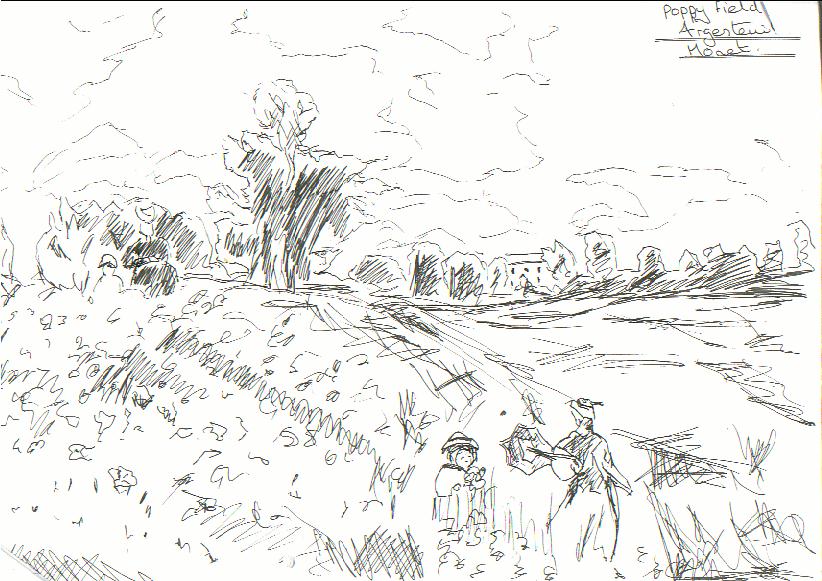
‘Poppy Field at Argenteuil’ is an example of this. This is a landscape of a field with poppies
on the left of the painting and four figures – two women and two children –
walking through the poppies. The bright
reds and greens as well as the effect of light and shade are indicative of the
freshness and spontaneity that was now possible with landscape painting.
Monet is seen as the artist who remained truest to
the creed of Impressionism. His main interest was light and the effect it had
on colour. To achieve this he used only
spectrum colours and made series of studies of objects such as buildings and
haystacks in changing light conditions.
He once commented that he wished that he had been born blind and had
regained his sight so that he could paint objects as they truly were without
any preconceptions. Another feature of
his work was his use of rough brushstrokes to apply paint thickly and
spontaneously. This was a new departure
from classical painting, which had blended brushstrokes to give paintings a
finished appearance. Monet’s use of
brush strokes is best seen in ‘The Regatta at Argenteuil’ where the effect of
water is given by broken horizontal stripes and ‘Boulevard des Capucines’, a
busy street scene where the buildings, crowds and trees are painted using
small, quick strokes.
Degas, while also an Impressionist painter, differed
in many ways from Monet. He
concentrated on draughtsmanship and drama rather than dissolving the shapes in
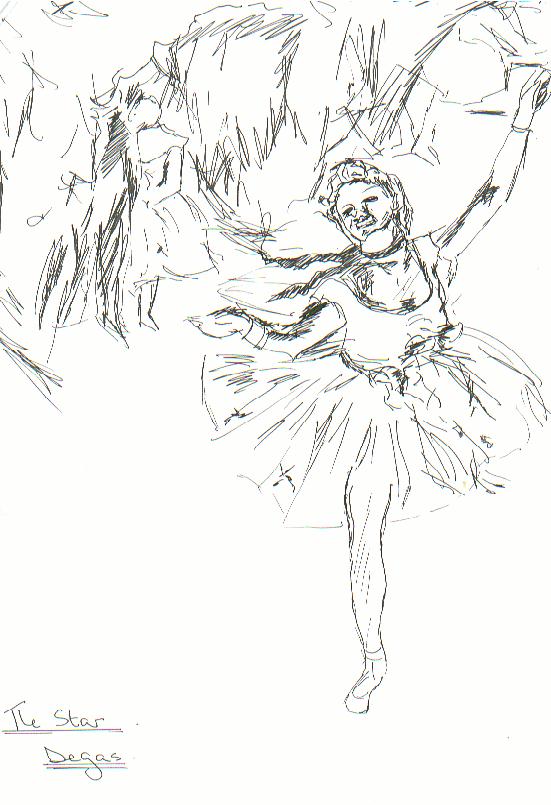
the painting. In ‘The Star’ he explored
the effect of light on the face of the ballet dancer on the stage. However strong lines are still evident in
her facial features and the bodice of her dress. This contrasts with Monet’s studies of Rouen cathedral where the
line of the building takes secondary importance to the effect of light and
colour. Degas also concerned himself
with the human figure, and gestures and actions. ‘Dance Foyer at the Opera’, a painting of ballet dancers
practising watched over by their teacher, is an exercise in movement and
space. Ballet was one of Degas’
favourite themes as well as horses and people working. He was also a colourist; in this he was
influenced by Delacroix. ‘Women drying
herself’ is rich in bright colours such as the blues and yellows of the cloths,
the reds of the curtains and the browns of the figure. He worked in many different media, including
sculpture. His ‘Portrait of Edmond
Duranty’ combines watercolour, pastels and gouache. Like Monet his subjects were taken from everyday contemporary
life. This was a marked difference from
classical painting, which avoided the commonplace.
Impressionism was the first art movement to break
away from the ideals of Renaissance painting and to discover a new method of
painting. It was also the most
important modern art movement in that it made the other possible. It was also the most important modern art
movement in that it made the others possible.
In breaking the mould of classical painting they paved they paved the
way for more artistic diversions and provided the inspiration for future
innovations. The pointillists took the
Impressionist idea of colour mixing and added to it more scientific discoveries
in colour, as can be seen in the work of Seurat. The Fauves were inspired by the Impressionist use of pure
colour. The Impressionists, through
their contact with the post-Impressionists imparted their ideas on them. Cézanne, originally an exhibitor in the
Impressionist exhibitions, became absorbed with Monet’s idea of dissolving
objects but decided to reintroduce definite lines reminiscent of Degas. Van Gogh also used strong lines and thickly
applied paint in small brushstrokes. He
in turn influenced Expressionists such as Munch, while Cézanne influenced
Braque and the Cubists. As the
beginners of this process of development the Impressionists played an
invaluable role.
|
|
|