ART NOTES
 Giotto
Giotto was one of the most famous of the pre-Renaissance artists. He was a pupil of Cimabue, and is referred to in Dante’s ‘The Divine Comedy’ as the pupil who excelled the master. His innovations in painting were to be so revolutionary that he was to influence such future greats as Michelangelo and Donatello.
Up
to the 14th century the most popular type of painting was the
Byzantine style. This was a rigid
style, which hadn’t developed much in the previous 400 years. The figures weren’t proportional to each other
but were sized according to importance with the most important being the
biggest. They had no emotional
expressions, as it was believed that only solemnity was suitable for holy
figures. The pictures had no sense of
depth.
But
Giotto was to change this. His most
significant innovations were depth, which he created by using the folds and
drapes in fabric, much in the same way as the Gothic sculptors. He also brought a new intensity of emotion
to his characters. Giotto created a new
sense of realism by setting his figures in a background and through the
previously unseen technique of foreshortening.
The most famous example of his work is in the chapel at Padua, where he
painted a series of frescoes, including the ‘Lamentation’ and the ‘Taking of Christ’.
The
series of frescoes in the chapel at Padua were commissioned in atonement for
the patron’s dead father’s sins. They
tell the story of Mary, her parents, Joaquim and Anna, her husband Joseph, and
her son Jesus Christ.
The
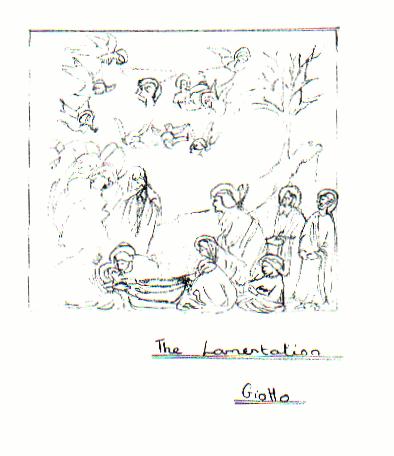
‘Lamentation’ was painted by Giotto between 1304 and 1309. It is pre-Renaissance in style and is a
fresco. The colours used are subdued –
pale pinks, yellows, and blues. The
painting is three dimensional in form.
This is created using foreshortening in the angels and in St. John’s
arms, which are flung backwards. This
difficult foreshortening is almost perfectly executed. Form is also created in the shading of the
clothes on the figures – particularly the two figures with their backs to the
viewer. The clothes disguise the lack
of knowledge of anatomy.
Like
all of Giotto’s paintings the figures look as if they are on a stage set. The background is minimalistic but it is
enough to give the sense that the figures are stable, not floating in the air
like Byzantine paintings.
Giotto’s
use of emotion is easily seen in this painting. The angels have their hands clasped together in despair. The same face is used for each figure but is
made to look different through the use of side and ¾ profiles, hair and beards.
This
painting isn’t an open composition. The
figures with their backs to the viewer exclude us from the scene. It is a private moment of sorrow. The centre of focus is Christ as all of the
figures are looking at him. Christ is
looking at the angels, which leads the viewer upwards. They in turn lead the viewer downwards
again. The wall receding into the
background leads the viewer from the right to the left.
The
same innovations can also be seen in the ‘Taking of Christ’. Again, the figures look as if they are on a
stage set and are given depth by the treatment of their clothes. Judas wears a bright yellow cloak that draws
attention to his act of betrayal.
Around
the time Giotto died a plague swept Italy and the people again reverted to the
Byzantine style, which was believed to be holier. As a result the amazing innovations by Giotto, were ignored and
it was to be another 100 years before they were rediscovered and used as an
inspiration of the artists of the Renaissance.
Home


