ART NOTES
 Donatello
Donatello was an important sculptor of the early Renaissance. This was an era begun in Italy in the 1400’s. At the time the thinking evolved that man was at the centre of God’s creation and, therefore, of unlimited potential, as opposed to the medieval thinking that man’s only purpose was to serve God. Artistic styles and techniques changed greatly during the Renaissance. Renaissance artists studied the writings of the ancient Greeks and Romans. According to the Greek and Roman philosophers, the circle was the perfect shape. Thus the complicated geometry of the Gothic era was abandoned in favour of a geometry of elegant proportions and classical detail. Patronage also changed during the Renaissance. A new class of wealthy and scholarly patron emerged who expected the artist to be a man of intellect as well as artistic ability. The Renaissance is said to have begun in Florence, a city that prided itself on its culture, with the flourishing of the arts and letters. Florentine people had a great sense of history and culture, studying Latin and Greek texts.
Donatello was born in Florence in 1386. He was the
son of a wool carder. Very little is
known about his personality or his early career. It is believed that he learned stone carving from the sculptors
working on the cathedral in Florence.
Some time between 1404 and 1407 he was apprenticed to Lorenzo Ghiberti,
a sculptor in bronze. He was influenced
by the emotional intensity of Giotto’s painting. He demanded a measure of
artistic freedom when working on pieces and as a result patrons found him
difficult to work with. He wasn’t a
cultural intellectual but he had an exceptional knowledge of ancient sculpture,
which was the inspiration for his work.
He influenced a number of artists including Michelangelo, Bernini and
Rodin.
Donatello’s main patron was the wealthy Catholic
Church. As a result, most of his work
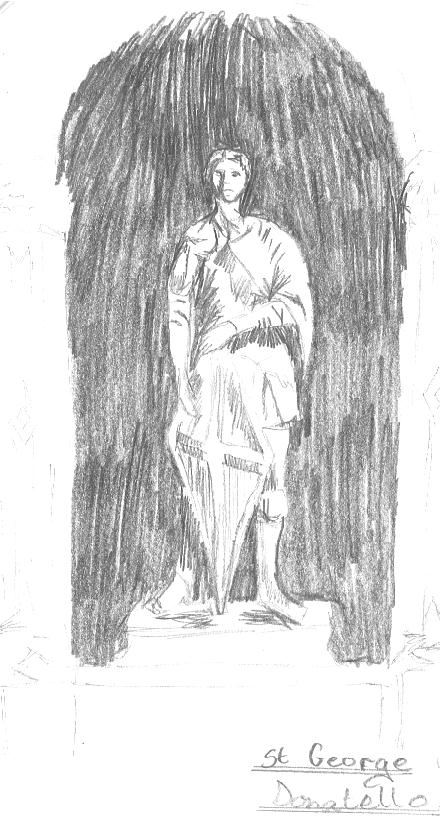
has a religious theme e.g. ‘St. George’ and ‘The Feast of Herod’. He was also patronised by the Medici
family. It is believed that his famous
statue ‘David’, a nude, free-standing figure of David with a large sword and
hat, standing on Goliath’s helmeted head, was commissioned for them, as the
first written record of the statue is at the wedding of Lorenzo the Magnificent
in 1469 when the statue was positioned in the courtyard of the Medici
palace. Donatello also took the
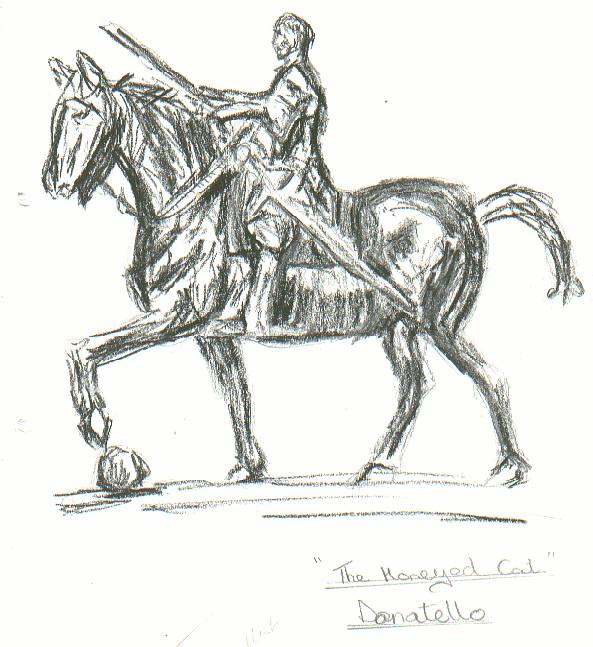
unprecedented step of accepting a commission for an equestrian sculpture of the
Venetian Condottiere Erasmo da Narmi, a sculpture that was nicknamed ‘The
Honeyed Cat’. This was scandalous at
the time as it was observed that only rulers were portrayed in equestrian
statues. This controversy spread the
fame both of the statue and of Donatello himself.
Donatello was influenced by the emotional intensity
of Giotto’s paintings. As a result his
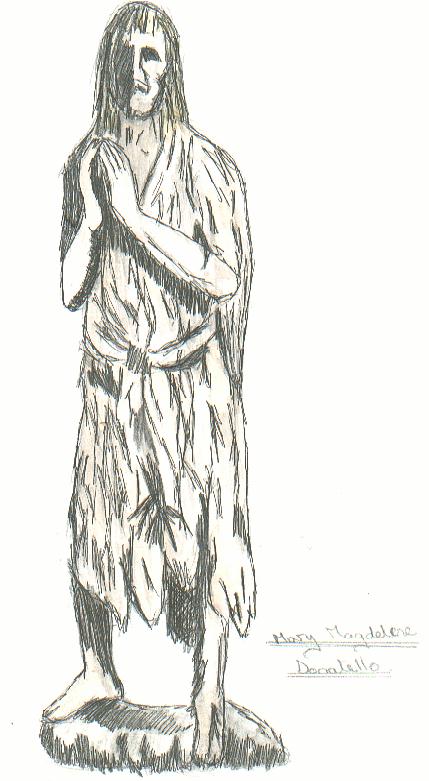
own work depicts deep emotion e.g. pain and suffering in ‘Mary Magdalene’. He was a master sculptor in several
different media and used these to create different atmospheres e.g. marble used
in ‘St. George’, a sculpture that
originally stood in the church of Orsanmichele, evokes strength and
wealth. Donatello was the first
sculptor since Roman times to represent a nude figure in ‘David’. The classical ‘S’ shape is similar to Greek
poses. It was also the first
freestanding since antiquity. It is
obvious form Donatello’s sculptures that he used live models. Because of this his sculptures contrast
greatly with the rows of serene but unreal figures previously sculpted.
Donatello also displayed a mastery in handling large numbers of figures, which
would become a feature of the High Renaissance. Donatello invented his own type of relief in his marble panel
‘St. George Killing the Dragon’, a panel at the bas of the statue of St.
George, known as “schiacciato”. Unlike
Ghiberti’s panels, the schiacciato panel depends on visual rather than tactile
perceptions. It seems like painting
with a chisel.
Donatello’s early works such as ‘St. John the
Evangelist’ were still mainly Gothic in style. His sculpture ‘ David’ was influenced by Ghiberti, his teacher,
with its graceful, International Gothic lines.
‘St. George’ was a contrast to medieval sculpture in which the human
personality is shown with a confidence in its own worth. During the 1420s Donatello entered into a
limited partnership with the sculptor and architect Michelozzo. In the partnership Donatello sculpted a
bronze effigy of Pope John ⅩⅩⅢ while Michelozzo
was responsible for the architectural framework and decorative sculpture. The style of this work done during this
partnership was reminiscent of that of Brunelleschi. Although Donatello showed a command of scientific linear
perspective only a few years after Brunelleschi had invented it, his work done
alone contrasts with Brunelleschi’s and tends to have an unusual mixture of
classical and medieval influences.
One of Donatello’s principle works is
the statue of Mary Magdalene that was created between 1450 and 1455. It is worked in wood to convey a mood of
poverty and desolation. At the time in
Florence a generation of sculptors had emerged that excelled in the sensuous
treatment of marble surfaces. Thus
Donatello’s wooden figure must have been a shock. It was also coloured.
Traces of blue eyes and yellow streaked hair re still visible. At this time most Florentine art tended to
be authoritative and colourless.
The line in this sculpture is very
hard and jagged. This creates the
haggard image of the figure. In her
youth Mary Magdalene was very beautiful but tears of fasting have worn into her
face and body. Her clothes are jaggedly
sculpted rags. This along with the
medium creates a rough uneven texture in the sculpture. It is a new insight into psychological
reality. Donatello’s formerly powerful
bodies have become withered and spidery, overwhelmed by emotional tensions
within. At the time Donatello was
suffering from illness and had almost died.
This sculpture was produced to portray
repentance and suffering. At the time
it was made the monk Savonarola was preaching repentance in Florence. This was the source of Donatello’s
inspiration. The sculpture was placed
in the baptistery of the Florence Cathedral.
The figure’s pained expression and pitiful appearance as well as her
stance of humility with her hands clasped in prayer and one knee bent, makes
her a symbol of remorse, suffering and pain.
Donatello’s statues are extremely
life-like and achieve their intended purpose.
The techniques and skills used as well as the uniqueness of his work at
the time make his sculptures some of the most important pieces of the early
Renaissance.
|
|
|
|
|
|