ART NOTES
 Botticelli
Botticelli was a distinctive
and individual figure among the artists of the early Renaissance. Discuss the characteristic features of his
painting.
By
the mid-1400s Florence had become one of the wealthiest states in Italy. With this prosperity more attention was paid
to the arts. In accordance with
Renaissance ideals more value was placed on man’s self-will. More wealthy families vied with each other
as patrons of the arts. The most
significant artist patronised by the Medici family in the last half of the
1400s was Sandro Botticelli.
Botticelli
was a student of Lippi, a Carmelite monk under the patronage of Cosimo de
Medici. Botticelli was greatly
influenced by him and also by Montegna and preaching of the time. He was later to influence such great artists
as Raphael and Renoir. Now, he is one
of the best-known artists of the early Renaissance. However in his own lifetime his works fell out of favour due to
the distinctive and individual features of his work.
The
characteristic features of Botticelli’s work are his wistful, slim, elegant
figures. These he learned from Lippi
who painted an idealised form of female beauty with slender faces, small mouths
and raised eyebrows. Botticelli was
also on of the greatest linear painters.
Unlike other artists who used light and shade to create a
three-dimensional effect, he preferred to use single lines. He achieved great harmony and balance in his
paintings. Botticelli’s themes are
mostly mythological rather than religious.
They are the first large-scale secular works to survive from the early
Renaissance. In ‘Primavera’ the figures
represent mythological gods such Venus and Mercury. Botticelli’s style didn’t develop obviously. This makes it difficult to date his
work. Botticelli also distinctively
patterned the surfaces in his paintings.
One
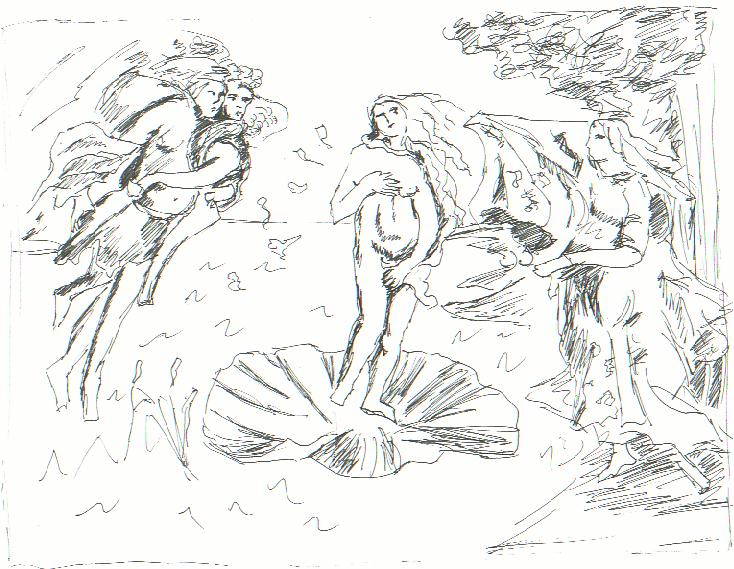
of Botticelli’s most popular paintings is the ‘Birth of Venus’, painted in
1484. Although painted in the
mid-Renaissance it is distinctive and individual. It is a tempera on canvas.
The line in this painting is particularly important. Elegant, graceful lines take the place of
volume and monumentality. There is a flowing movement to the painting. The figure of Flora is wispy and seems to
float along the ground. The texture of
the painting is smooth although Flora’s dress is patterned with small sprigs of
flowers. The colours are bright. The soft, fresh white on the shell
symbolises newness.
The
‘Birth of Venus’ was inspired by a contemporary translation of a Greed text
that was well known at the time. In
this painting Venus was a symbol of beauty.
Botticelli was a member of a Neo-Platonist group in the court of the
Medicis who believed that truth could be identified with beauty.
Botticelli’s
‘Primavera’ and ‘Birth of Venus’ are both complex and allegorical works. Their distinctive and individual themes and
execution is typical of Botticelli and set them apart from contemporary
paintings. However the religious frenzy
created by Savonarola in Florence in the late 15th century causes
much of Botticelli’s early works to be burned as “vanities”. It wasn’t until the 19th century
that Botticelli was rediscovered and his distinctive and individual paintings
were reappreciated.