PILTDOWN
THE HOAX
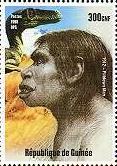
Eoanthropus dawsoni, (Dawson 1953)
Charles Dawson (1864–1916)
an amateur archaeologist, geologist and antiquarian
[ 1909 - Charles Dawson studied the fragments and concluded that the pieces were from a human skull. ]
The Piltdown Forgery:
21 November 1953
For decades the remains of fossils found in Piltdown, England were believed to come from a "missing link," a creature with a human cranium and an ape's jaw.
Dr. Weiner shows how he
discovered the truth about these remains, and went on to expose one of the
world's greatest scientific frauds.
Forty years later when JS Weiner discovered that this so called Piltdown Man was a fake made out of a 500 year old skull and an orangutan jawbone, the hunt began to find out who had perpetrated the fraud.

In 1909 a few amateur researchers thought they had found the answer to this question. In the English shire of Sussex near Piltdown, in a gravel pit, the shovel of a workman hit something that looked like a coconut. The solicitor and amateur geologist Charles Dawson studied the fragments and concluded that the pieces were from a human skull. Dawson investigated the location together with the curator of the geological department of the Natural History Museum in London, Arthur Smith Woodward.
In total they discovered nine fragments of a brain case, mainly of the left side of the skull and the right side of the lower jaw with two teeth which resembled human teeth. Furthermore flint tools and fossil bones of extinct animals were found. They presented their discovery to the famous anatomist Arthur Keeth. He had already been investigating the origin of the ancient Briton for a long time. According to Keeth this skull had a brain volume as large as a modern human’s skull. He thought that the discovery was the oldest hominid fossil. He called it: Eoanthropus dawsoni (Dawson’s Dawnman). It was an instant hit.
The discovery fully matched the line of thinking about human origin. English anthropologists welcomed it jubilantly. They believed that the brains, which played the leading part in mankind’s survival, had already increased in size in an early stage of evolution, while teeth and attitude came later.
Arthur Keeth and others received knighthood. In future great Britain was assured of being the birthplace of modern man.
The so called Piltdown Man was fragments of a skull and jaw bone collected in the early years of the twentieth century from a gravel pit at Piltdown, a village near Uckfield, in the English county of Sussex. The fragments were claimed by experts of the day to be the fossilised remains of a hitherto unknown form of early man.
The Latin name Eoanthropus dawsoni was given to the specimen.
The significance of the specimen remained the subject of controversy until it was exposed in 1953 as a forgery, consisting of the lower jaw bone of an ape combined with the skull of a fully developed, modern man. It has been suggested that the forgery was the work of the person said to be its finder, Charles Dawson, after whom it was named. This view is strongly disputed and many other candidates have been proposed as the true creators of the forgery.
November 20th sees the 50th anniversary of the revelation of what must have been the mother of all scientific fakes, namely the bogus nature of what, at the time, was regarded as the missing link in Darwin's evolutionary chain - Dawn Man or Piltdown Man as it was better known.
Piltdown was guarded more strictly than the crown jewels. One could not study the specimen thoroughly until the fifties, as it was exhibited then. A certain got the opportunity to have a look at it. He soon noticed that something was not right. This specimen did not fit properly as a whole. When the conservator of the British Museum applied fluor dating (see also the background information about dating techniques) he discovered that the skull was ten thousand years older than the jawbone.
A devastating publication proved that the lower jaw was of an orang-utan which had been remodelled into a human jaw. For forty years many experts had been cheated.
Who were the offenders? No matter how intensely this was investigated, no proof was found. Why had this ‘joke’ lasted for so long? The Piltdownman had fitted in so well in the hopes of that time; an evolutionary missing link that combined those characteristics of man with those of the man-ape.
This incident shows that what we expect to find can influence our interpretation of what we actually find.
As Piltdown was refuted, the child of Taung was cheerfully hauled in as our rightful ancestor. At last Africa proved to be the cradle of mankind. Over the years the African soil provided more and more indications concerning the mystery of human origin.
