Homo ergaster
1998
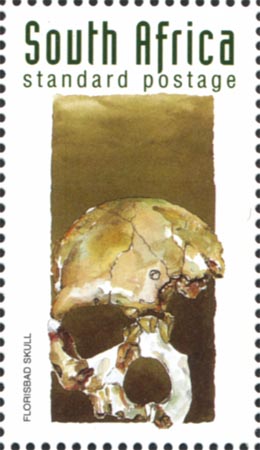
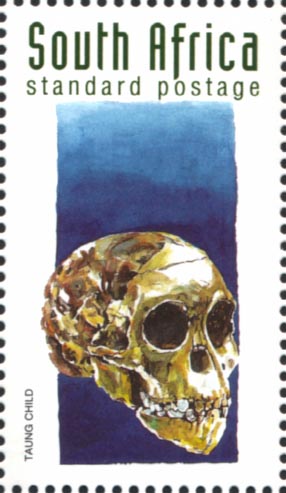
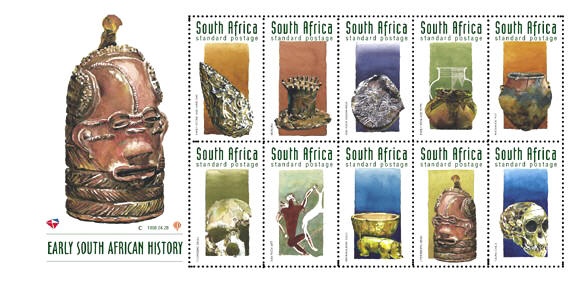
Block 1998
By 1.9 million years ago, another lineage of the genus Homo emerged in Africa. This species was Homo ergaster. Traditionally, scientists have referred to this species as Homo erectus and linked this species name with a proliferation of populations across Africa, Europe, and Asia. Yet, since the first discoveries of Homo erectus, it had been noted that there were differences between the early populations of "Homo erectus" in Africa, and the later populations of Europe, Africa and Asia. Many researchers now separate the two into distinct species Homo ergaster for early African "Homo erectus", and Homo erectus for later populations mainly in Asia. Since modern humans share the same differences as H. ergaster with the Asian H. erectus, scientist consider H. ergaster as the probable ancestor of later Homo populations.
H. ergaster had a rounded cranium and a prominent browridge. Its teeth were much reduced in size, especially when compared to Australopithecus. Several features that distinguish H. ergaster from H. erectus are thinner bones of the skull and the lack of an obvious sulcus, or depression, just behind the browridge.
By 1.6 million years ago, an advance in stone tool technology is identified with H. ergaster. Known as the Achulean stone tool industry, it consisted of large cutting tools, primarily hand axes and cleavers. Originally thought to be responsible for the spread of early humans beyond Africa, it is now known that the migration out of Africa predates this tool industry.

The Philately explains and teaches ...
1987 – Yvert: 623/626 (4). Scott: 694/697. Petroglifos. 16c elande, Sebaaieni Cave. 20c Leaping lion, Clocolan. 25c black wildebeest, Mhlwazini Valley. 30c san dances, Floukraal.
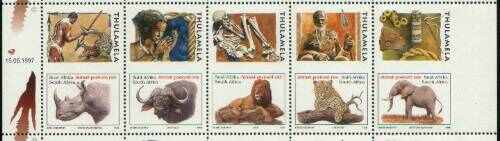
Set of 5 stamps with the " Big Five ", emitted in 1997, that it shows 5 vignettes on Thulamela.
From the moment she saw the meticulously reconstructed walls of this gold city, Sue was captivated by the spirit which still seem you grace Thulamela.
Sue visited for the first time Thulamela in February of 1997, with Sidney Miller, an arqueologista who has worked in the project per four years. Sidney's profound knowledge and the hard work of his team combined you bring the discovered arefatos beneath the ground of Thulamela you vivid life. Sidney's tales of the mysteries within its walls were Sue Dickinson's inspiration will be the Thulamela labels. The amazing discoveries became the living history which Sue chose you depict in to her watercolour paintings.
Sue Dickinson is an artist of Johannesburg with a passion will be the bush and is well known will be to her paintings of wild beasts. It describes sitting upon the walls of Thulamela while sketching the seen from the hilltop one of the happiest moments of its life. Far below Thulamela's enclosure, the wide feet of many elephants have forged centuries-old trail through the bushveld, and ancient baobab trees seem you stand sentinel to over the City which was uninhabited enters the years of 1200 the 1600.
Sue's version of Thulamela's living history appears on these special postcard tags. The design of the Thulamela stamps and booklet is by Gill Marshall, a South African leading graphic designers.
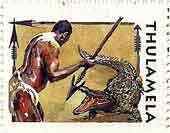
Hundreds of bones of animals had been exhumed in the proximity of Thulamela. Scientific analyses disclose that even so several of them belonged to the domestic animals, the people hunted animals as hipopótamo and elephant. The painting to the gouache shows a hunter of crocodile with a harpoon discovered in the place. Still today, the crocodile continues to have a significant place in the mythology of the region. The iron spears that decorate the edge of the vignette, serve as evidence that this sophisticated community fundiu a variety of metals.
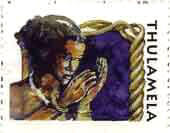
The radio test carbon discloses that Losha queen lived after in Thulamela about 200 years the death of king Ingwe. Measures of its bones had disclosed that it was a bonanza high woman. The gold bracelet that carried is shown in the edge of the vignette. Here, it is being portraied as she would have to be in life, adopting a traditional gesture losha - a respect gesture, of which gave its name.
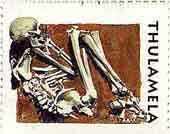
The skeleton of Losha Queen was discovered in August of 1996 and meticulously excavated by the Department of Anatomy of the University of Pretorship. It was burnt in the fetal position, with its together hands, located to the side of its face - a gesture losha of repeito. As the land carefully was removed, the bracelet (shown in the previous stamp) became visible in the bones of its arm.
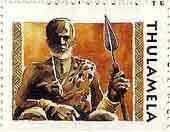
King Ingwe was regent of Thulamela for return of year 1400. It insurance a spear, which originally was covered in gold. The blade of the spear was found in the place and she was not sharp. This, suggests that it was a ceremonial spear and that, probably, was a symbol of the leader. Its neck is ornado with gold and penalty of ostrich. On its shoulder it has leopard skin. Sue Dickinson imagined as the king would seem, creating this image.
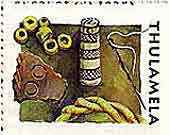
The amulet (in the center) sculptured in ivory, occupies a special place in the heart of the arqueologista Sidney Miller. It was in return of the neck of a child, supposedly as protection against illnesses. The iron needle (to the right) assumes the theory of that the cotton was manufactured in the place. Still today, the wild cotton grows in Thulamela. The pot of ceramic shows a typical utensil of the time. The gold bracelet was discovered in the arm of Losha queen.
Homo ergaster
SOUTH AFRICA
Booklet
(Labels)
Year 1999
Year 1998

Year 2006


 |
