Homo erectus modjokertensis
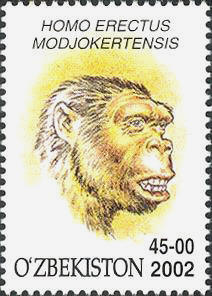
10.May.2002
Homo erectus modjokertensis by Koenigswald, 1936
Turning to the situation in Indonesia, the re-dating of strata that have produced hominid remains at Sangiran and Modjokerto to 1.6-1.8 MYA (Swisher et al. 1994), opens up an entirely new Pandora's box of diversity. Some of the specimens dated to the earliest Pleistocene have long been recognized as well-evolved forms of H. erectus. The Indonesian paleoanthropologist Prof. T. Jacob (1981) has in the past allied one of them, Sangiran 17 (Pithecanthropus VIII), with H. erectus soloensis, long thought to be a late occurring archaic human that persisted into the upper Pleistocene (approximately 100-200 KYA) of Java, while some have seen similarities between the Modjokerto juvenile cranium (H. modjokertensis) and H. habilis (Tobias and von Koeningswald 1964, Cronin et al. 1981). Other sites, from what could be equally old stratigraphic horizons, have yielded remains of hyper-robust individuals attributed by some to an australopithecine-like taxon, Meganthropus (Robinson 1953, Franzen 1985, Tyler 1995). In Java, as in China, we have specimens from the same time and place possibly representing three very different grades or clades of hominid.
If, for the sake of argument, we accept all of the above evidence as representing valid Plio-Pleistocene Asian hominids, and there seems to be a much greater willingness to do so now than in the recent past, what do we get? Apparently at least three and possibly four distinct hominid lineages in Asia at or near the Plio-Pleistocene boundary: a small, gracile form of early Homo in China; a form, H. modjokertensis, in Java, thought by many until the early 1980s to be conspecific with H. habilis (Cronin et al 1981); a larger, fully evolved form of H. erectus in China and Java; and larger still, a form attributed to a kind of robust australopithecine, both in China and island Southeast Asia. Hominid diversity of this magnitude would be highly reminiscent of that encountered in East Africa at approximately the same time, where Australopithecus boise, H. habilis, H. rudolfensis and H. ergaster are said to occur more or less sympatrically and synchronically (Wood 1992).
Homo erectus:
 Homo
erectus erectus Dubois, 1894
Homo
erectus erectus Dubois, 1894
Homo
erectus pekinensis Black & Zdansky,
1927
Homo
erectus modjokertensis von Koenigswald, 1936
Homo
erectus javensis
Homo
erectus capensis Broom & Robinson, 1949
Homo
erectus mauritanicus Arambourg, 1954
Homo
erectus leakey Heberer, 1963
Homo
erectus lantianensis Woo, 1964
Homo
erectus paleojavanicus sangiranensis
Sartono, 1976
