Australopithecus afarensis
UZBEQUISTAN
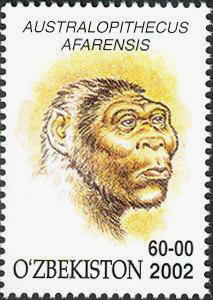
Australopithecus afarensis
10.May.2002

Australopithecus (Dart, 1925)
Australopithecus afarensis (Johanson, White, and Coppens, 1978)
Inhabiting eastern Africa between four and three million years ago, Australopithecus afarensis was a long-lived species that may have given rise to the several lineages of early human that appeared in both eastern and southern Africa between two and three million years ago. For its antiquity, A. afarensis is one of the better known species of early human, with specimens collected from over 300 individuals. It is a species that exhibits many cranial features which are reminiscent of our ape ancestry, such as a forward protruding (prognathic) face, (with the cheek teeth parallel in rows to each other similar to an ape) and not the parabolic shape of a modern human, and a small neurocranium (brain case) that averages only 430cc in size (not significantly larger than a modern chimpanzee).
Australopithecus afarensis
Is a hominid which lived between 3.9 to 3 million years ago belonging to the genus Australopithecus, of which the first skeleton was discovered on November 24, 1974 by Donald Johanson, Yves Coppens and Tim White in the Afar Depression of Ethiopia. They named it "Lucy" in reference to the famous Beatles song "Lucy in the Sky with Diamonds" (LSD=toxid), which was played as they celebrated the find.
Until recently, the earliest known hominine for which sufficient diagnostic anatomical evidence was available was Australopithecus afarensis, fossils of which have been found in Ethiopia, Tanzania, and Kenya, and most of which date between 2.9 and 3.9 million years. New finds of fossils as old or older than A. afarensis have been made in Ethiopia, Kenya, and Chad. These speciments, which are sufficiently different from A. afarensis to have been named a new species, include the following: Ardipithecus ramidus from Ethiopia, dated at 4.4 million years; Australopithecus anamensis from Kenya, with an age range of 4.2 to 3.9 million years; and Australopithecus bahrelghazali from Chad, with an age estimate of 3 to 3.5 million years.
The first afarensis fossils were found in the mid 1970s. Their initial interpretation was controversial and remains so today, albeit to a lesser degree. While many anthropologists accept that the multitude of fossil specimens that have been attributed to afarensis do indeed represent a single, sexually dimorphic species, others believe that the fossils belong to two, and perhaps more, species. For a long time afarensis was assumed to have represented the founding species of the hominine clade and the ancestor of all later species.
The Ethiopian hominine fossils were first found in the mid-1970s in the Hadar region of that country, by an international team led by Donald Johanson, of the Institute of Human Origins, Berkeley, and Maurice Taieb, a French paleontologist. The many hundreds of fosils recovered included mostly cranial and dental specimens (but no complete cranium) and postcranial elements. The most spectacular of these finds was the partial skeleton named "Lucy"; in addition, remains of 13 individuals were found at a single site and were subsequently dubbed the First Family. It was clear from the start that some of the homninines were small while others were large.
Work continued in the region until the early 1980s, but was then suspended for almost a decade. Recent prospecting in Hadar by Johanson and his colleagues at IHO, and in the nearby Middle Awash region by Tim White, or the University of California at Berkeley, has yielded many more fossils specimens, including the first complete cranium, details of which were published in 1993 and 1994.

CUBA
1967
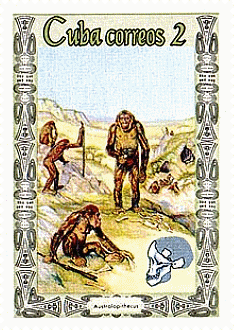
1997

ETHIOPIA
1977
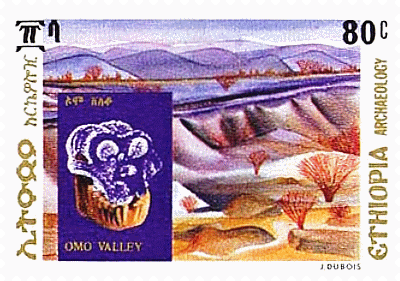
1986