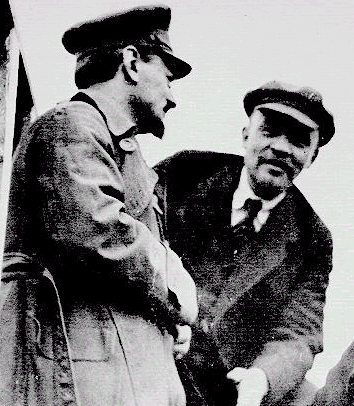
Trotskyism
The rise of Joseph Stalin and the bureacracy within the Soviet Union was not a process that went unchallenged - Leon Trotsky, organizer of the insurrection in 1917 and leader of the Red Army during the civil war, led that challenge. In doing so, he helped perserve and expand on the Marxist tradition - tradition meaning the ideas, strategy, and tactics that guide the actions of revolutionary socialists - that otherwise would have been buried under the Stalinist heap of lies, deceptions, and betrayals.
Trotsky was expelled from the USSR in 1929, and assassinated by a Stalinist agent in 1940. Before his expulsion from Russia, he organized the Left Opposition, a faction within the Russian Communist Party that challenged Stalin's policies and police methods. After his expulsion, Trotsky continued to mercilessly criticize Stalin and Stalinism; he organized the few followers he had under the banner of the International Left Opposition.
Trotskyism developed as a revolutionary socialist opposition to Stalinism (as opposed to a McCarthyist, pro-capitalist opposition to Stalinism); but was unable to recruit a significant number of worker militants. The numbers of people who considered themselves Trotskyists at the time - the 1930s - was tiny. This was true for a number of reasons. Many revolutionary working class militants looked to the USSR because it cloaked itself in the legacy of the Russian Revolution; the Stalinist parties, and the government of Russia, hounded, persecuted, slandered, expelled, and isolated anyone who was accused of being a Trotskyist - falsely or not; the threat of fascism put enormous pressure on workers to remain united, not to join a small "splinter" group, and to look to the USSR as a counter-weight to the Nazis.
Before the Nazis seized power in Germany, Trotsky and Trotsky alone argued for a united front of all workers' organizations to beat back Hitler before it was too late. He wrote that, "the hellish work of Italian fascism would probably appear as a pale and almost humane experiment in comparison with the work of the German National Socialists".{1}
In contrast to Trotsky's call to action, the German Social-Democratic Party told workers to rely for protection on the Weimar Constitution and Hitler's promise to "remain legal and constitutional". The Communist Party of Germany parroted the Communist International's "Third Period" line, which held that the Social-Democrats were the real fascists - ignoring the Nazis altogether! Because of that, Hitler came to power and obliterated the most well-organized working class movement, and not a single shot was fired in its defense.
Up until the Nazis had taken power, Trotsky thought that the Left Opposition should seek re-admission into their respective CPs; essentially, he thought that Stalinism could be reformed from within. Before 1933, he thought that the Russian working class could peacefully, legally recapture power from the bureaucracy, "without a new revolution, with the methods and on the road of reform."{2}
After 1933, Trotsky's analysis of the USSR changed; when the Nazis came to power unopposed by the most organized workers' movement in the world and one of the largest Communist Parties in the Comintern, it was a betrayal of the working class - matched only by the Second International's betrayal of workers with the start of WWI. When not a single person in a single CP criticized the disastrous outcome of the Comintern's "Third Line", Trotsky concluded (rightly) that the Third International was nothing but a rotting corpse and that within Russia, the prospect of reforming the Stalinist bureaucracy was hopeless. He argued that the task now was to build new revolutionary parties, and that what was needed in Russia was a new workers' revolution.
But every objective factor militated against the fledgling Trotskyist movement. Forced out of the working class movement, the Trotkysists recruited mostly petty-bourgeois intellectuals, or people who had little or not contact with, much less experience in leading, workers' struggles. This would have serious consequences - on both the Trotskyist movement's theory and practice - later on.
In 1938, Trotsky and a handful of followers from around the world, formed the Fourth International. In its founding document, "The Death Agony of Capitalism and the Tasks of the Fourth International," otherwise known as "The Transitional Program," outlined the political perspective that motivated the foundation of the Fourth International. It stated:
	The economic prerequisite for the proletarian revolution
	has already in general achieved the highest point of
	fruition that can be reached under capitalism. Mankind's
	productive forces stagnate. ...

	... Without a socialist revolution, in the next historical
	period at that, a catastrophe threatens the whole culture
	of mankind. The turn is now to the proletariat, i.e.,
	chiefly to its revolutionary vanguard. The historical
	crisis of mankind is reduced to the crisis of the
	revolutionary leadership.{3}
In otherwords, capitalism had reached its end. According to Trotsky, World War II would end with the destruction of the Stalinist bureaucracy, either at the hands of imperialism (the Nazis, more specifically), or a workers' revolution. Because capitalism was at an end, its "death agony," the end of WWII was bound to bring an economic crisis the likes of which would dwarf that of the 1930s. The collapse of Stalinism and capitalism's "death agony" would open up tremendous possibilities for the Fourth International. Its isolation - imposed by objective forces over which it had no control - would be over, and millions of workers would join it and turn it into the revolutionary force in the world.
Much of Trotsky's perspective hinged on how we understood the degeneration of the Russian Revolution. He thought that Russia was a "degenerated workers' state". In other words, the working class had taken power in 1917, establishing the world's first workers' state. But because it was isolated and Russia was incredibly economically backward, the Stalinist bureaucracy arose. As he put it:
	When there is enough goods in a store, the purchasers can
	come whenever they want to. When there is little goods,
	the purchasers are compelled to stand in line. When the
	lines are very long, it is necessary to appoint a
	policeman to keep order. Such is the starting point of
	the power of the Soviet bureaucracy.{4}
Trotsky argued that this bureaucracy was not a ruling class. Rather, it was a social group caught between two class forces - the working class of Russia, and the capitalist classes of the world. As such, it was an unstable formation; either it would be overthrown by workers' revolution, or the imperialist powers would invade the USSR and restore capitalism. As Trotsky put it, "a sphere balanced on the point of a pyramid must invariably roll down on one side or the other."{5}
During the late 1930s and early 1940s - midnight of the 20th century - this perspective seemed to be confirmed. The world's most destructive war ever claimed the lives of millions, and ruined countries all over the globe.
But after WWII, while there was a revolutionary upsurge - anti-fas, or anti-fascist committees, held power in Germany, workers took control of northern Italy before the Allied armies came, almost 1 out of 10 people were members of the Communist-led anti-fascist resistance in France - it was suppressed by the Communist Parties, the Social Democrats, and the Allies.
The aftermath of WWII saw the biggest, most thorough-going expansion of the capitalist system. Workers' living standards, especially in the United States, were higher than they ever were. In Eastern Europe, Stalinism not only did not collapse, it greatly expanded. Russian tanks occupied all of Eastern Europe and half of Germany.
All three of Trotsky's predictions - capitalism's impasse, the collapse of Stalinism, and revolutionary upsurge - were wrong. This left Trotsky's followers and the fledgling Fourth International confused, disoriented, demoralized, and again, without a significant working class following anywhere in the world.
Because the Trotskyist movement was so small and so isolated from the working class movement, their theoretical errors were never checked by practice, and they did not become evident until years after Trotsky's death. And even then, many Trotskyists refused to admit Trotsky's perspective was wrong. James Cannon, leader of the Socialist Workers Party in America, was the worst example of this when he said in November of 1945:
	Trotsky predicted that the fate of the Soviet Union
	would be decided in the war. That remains our firm
	conviction. Only we disagree with some people who
	carelessly think that the war is over. The war has
	only passed through one stage and is now in the
	process of regroupment and reorganisation for the
	second. The war is not over, and the revolution
	which we said would issue from the war in Europe is
	not taken off the agenda. It has only been delayed
	and postponed, primarily for lack of a sufficiently
	strong revolutionary party.{6}
The Trotskyist movement began to bend reality to fit theory. Doing this required an incredible amount of either blindness, or self-deception, or a combination of the two. But this lead the Trotskyist movement into a dead end, and was the root cause of the dozens of splits in Trotskyist organizations, nationally and internationally. Today, there are 3 or 4 groups that claim to be "the" Fourth International - even though the international never had any mass following whatsoever in any country. As Tony Cliff put it, "In the desert for such a long time, thirsty for water, they succumbed to hallucinations, seeing a mirage of green trees and a world of water."
Just by typing "Trotskyist" into a search engine, dozens and dozens of splits, offshoots, sects, all claiming to be "more true" to Trotsky's words than their competitors come up on the screen. Many have a lot of grandiose phraseology, like "Rebuild the 4th International" or "For International Proletarian Revolution Under the Banner of the Leninist-Trotskyist-Internationalism!" or some such nonsense. As if they had the forces to actually lead an international working class revolution under their banner!
In order for the Trotskyist movement to find its way out of the impasse after WWII, Trotsky's analysis of Russia had to be re-examined, and fundamentally changed. One Trotskyist, named Tony Cliff, was utterly shocked that Trotsky had been so wrong, when he had been so right about German fascism, among other things. But unlike his counterparts, he went back and analyzed Russia, and produced a systematic and rigorous analysis of Stalinist Russia. He developed the theory that Russia was bureaucratic state capitalist, meaning that the state - controlled by the party bureaucracy - played the same role as the capitalist class in the West by extracting profits from workers and re-investing it into the means of production. This led him to break with Trotsky's words, but remain true to his spirit, meaning that he didn't see Trotsky's words or writings as the end-all and be-all of Marxism; rather, he understood them to be a guide to action, and once it ceased to be a good guide, he ceased to use it.
The theory of state capitalism is rooted in the idea that "the emancipation of the working class has to be act of the working class itself" - meaning that Red Army tanks cannot impose "socialism" on the workers of Poland or Germany from above. It is in this tradition that the ISO stands in.
- Trotsky, Germany, the Key to the International Situation, 1931. http://www.marxists.org/archive/trotsky/works/1930-ger/311126.htm
- Trotsky, Writings, 1930-1931, p. 225. Trotsky's emphasis.
- Trotsky,The Death Agony of Capitalism and the Tasks of the Fourth International: The Mobilization of the Masses around Transitional Demands
to Prepare the Conquest of Power, also known as the Transitional Program. See:
http://www.marxists.org/archive/trotsky/works/1938-tp/index.htm
- Trotsky, the Revolution Betrayed, 1937, Chapter 5. http://www.marxists.org/archive/trotsky/works/1936-rev/ch05.htm#ch05-3
- Trotsky, The Workers' State, Thermidor and Bonapartism,
http://www.marxists.org/archive/trotsky/works/1935/1935-bon.htm
- This statement was made in November 1945. See J P Cannon, The Struggle for Socialism in the 'American Century' (New York, 1977), p200.
Back
Next
"State Capitalism in Russia" by Tony Cliff
Trotskyism After Trotsky" by Tony Cliff
