How can workers ever run society?
The working class is the only class that has the power to overthrow the capitalist system and to build a socialist society.
But how can workers ever run the whole of society, its factories, its mines, its offices without bosses, without capitalists and without their coercion?
The power of the working class lies in its collective labor. Therefore if workers are to take over and run things, they have to do it collectively, as a class. The heart of workers' power lies in the workplace and any workers' government must be based first and foremost on the power that workers have in their factories, offices, machine shops, mines and stores.
The key to workers' self-government and organization is the workers' council.
This is not some bureaucratic, above-the-workers and behind-closed-doors sort of thing. The first workers' councils in history formed during the 1905 Revolution in Russia. They took control of whole cities, running the hospitals, ensuring the food supplies, patrolling the neighborhoods, making sure the trains came on time - in short, the workers ran society.
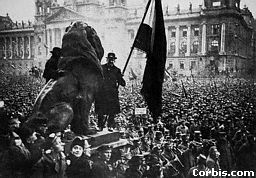 The Russian word for council, or soviet, was the central organ that ran the cities. The soviets were made up of delegates (roughly 1 for every 500 workers) from every workplace that were elected by the workers of the factory. These delegates were paid average wages and were immediately recallable, so as to prevent the careerism and corruption so prevalent in politics today. The delegates were also their co-workers, so every one knew who was who and who was trustworthy and honest and who was not. The delegates from all the factories in a given locale (like a city) assembled and ran the city. Motions and decrees were voted on and rafitified by a majority and published in the newspaper of the soviet to keep the workers informed. The decrees were immediately put into action by the workers themselves. The soviets were working bodies, and as a result required little to no bureaucracy at all, because they were the governmental organs of the working class, by the working class and for the working class.
 To run the workplaces on a day-to-day basis, the workers elected committees of fellow workers to oversee production. Important decisions were made at mass meetings called before, after or even during the hours of work. The nuts and bolts of the decisions were the responsibility of the committee to carry out. As a result, no one could go against what the workers themselves wanted because new elections would be held to replace irresponsible delegates.
These councils were NOT formed "because socialists said so". They sprang up, more or less spontaneously, in many places and in many time periods since capitalism created the working class. The first workers' government, the Paris Commune, was in France in 1871. Then came Russia in 1905 and 1917. These councils sprang up in Germany 3 times between 1918 and 1923; in Italy in the 1920s; in Spain in the 1930s; in Minneapolis during the Teamsters' strike in 1934; in Germany right after WWII; in Hungary and East Germany in 1953; in Chile in 1973; in Iran in 1979; and in 1981 in Poland. Far from being organs created purely by the goodwill of socialists, they have sprung up to meet the needs of the working class in its struggle with the bosses.
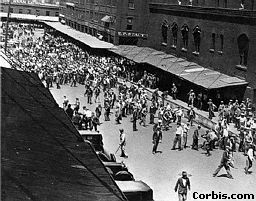 They have sprung up when the capitalist system was in such a deep crisis that workers had but no choice but to fight back. Capitalism itself drives the working class into "do or die" situations; it creates the conditions which force workers to fight back, whether they like it or not. Workers' councils arose in these different periods because they had to, otherwise nothing would've been done and all the workers would have perished. Many times they formed in the heat of a general strike (a general strike is when everyone walks off the job) because if all the workers went on strike, they'd all starve, freeze, trains would not run, hospitals would close, the fire deparment wouldn't put out fires and their homes would fall apart. So the workers took things over and ran the factories, hospitals, nurseries, mines and so on in their own interests, for themselves and not for the capitalists and their profit.
In Chile in 1973, the bosses went on "strike", essentially locking out workers in many of the major industries. Instead of taking the shaft, the workers organized themselves, occupied the factories, took over the railway system and took over the food supplies. When sections of the middle class closed down their stores in solidarity with the bosses, the workers re-opened them so people could get basic necessities. To make sure all this was done correctly and effectively, they organized cordones industriales, (the literal transaltion is "industrial belts"), i.e., workers' councils, to accomplish and coordinate these tasks.
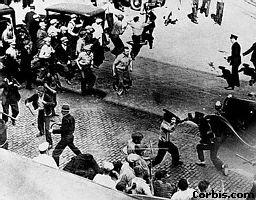 In Minneapolis, the Teamsters (led by the Trotskyist group the Communist League of America) tried to organize the city's truck drivers in 1934, in the middle of the Great Depression. The bosses wouldn't have any of it and they tried to break the strike by bringing in scabs protected by cops. The Teamsters formed a strike committee, rented a large garage for HQ, sent out flying pickets (armed with sticks/clubs/pipes) to chase scabs off the scabs and the cops protecting them. The committee organized food drives, found nurses and doctors to treat injured pickets and raised a strike fund. Eventually, the strike committee had so much power that farmers bringing their food to the city's market got permits from them instead of the cops because they were the de facto government of the city. When cops shot and killed some strikers on picket duty, the workers disappeared briefly from the streets only to return armed with shotguns, dear-rifles, WWI souveneirs, revolvers and the like to defend themselves from the cops and their murderous tactics. The leadership had no choice but to disarm the pickets so that the government wouldn't have the excuse of an "insurrection" to crush the union.
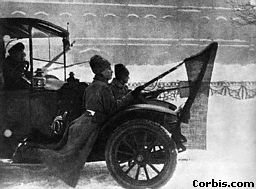
This situation of dual power, or two governments, which existed in Minneapolis was much like the situation of dual power that arose after the Tsar was overthrown in Russia in February of 1917. There was the workers' government on the one hand, and the capitalists' government on the other hand. Because two antagonistic classes, the proletariat and the bourgeoisie, cannot both rule society simultaneously, this situation is inherently unstable; one side will seek to disperse the other with the force of arms. Unfortunately, this dual power situtation was isolated in Minneapolis, so the workers were forced to back down. But in Russia, after winning majorities in the soviets all over the countries, the Bolshevik party led an insurrection that overthrew the Provisional Government. If they hadn't, the Provisional Government would've attacked the soviets to "restore order". In 1871, when the French army marched on the first workers' government known as the Paris Commune, it slaughtered almost 30,000 or 40,000 workers in a week (compare this to the 58,000 Americans who died over the 10 year long Viet Nam war!). Imagine what the capitalist Provisional Government would've done to the 6 million strong working class of Russia which had overthrown the Tsar!
Marx wrote that "the emancipation of the working class must be the act of the working class itself." When he proclaimed himself in favor of "the dictatorship of the proletariat", he meant precisely the workers' councils that sprang up in Russia, in Paris and in Germany and that will continue to spring up until "either in a revolutionary reconstitution of society at large, or in the common ruin of the contending classes."
The class struggle, between the working class and the capitalist class, is the heart of socialist politics.
Back
Next